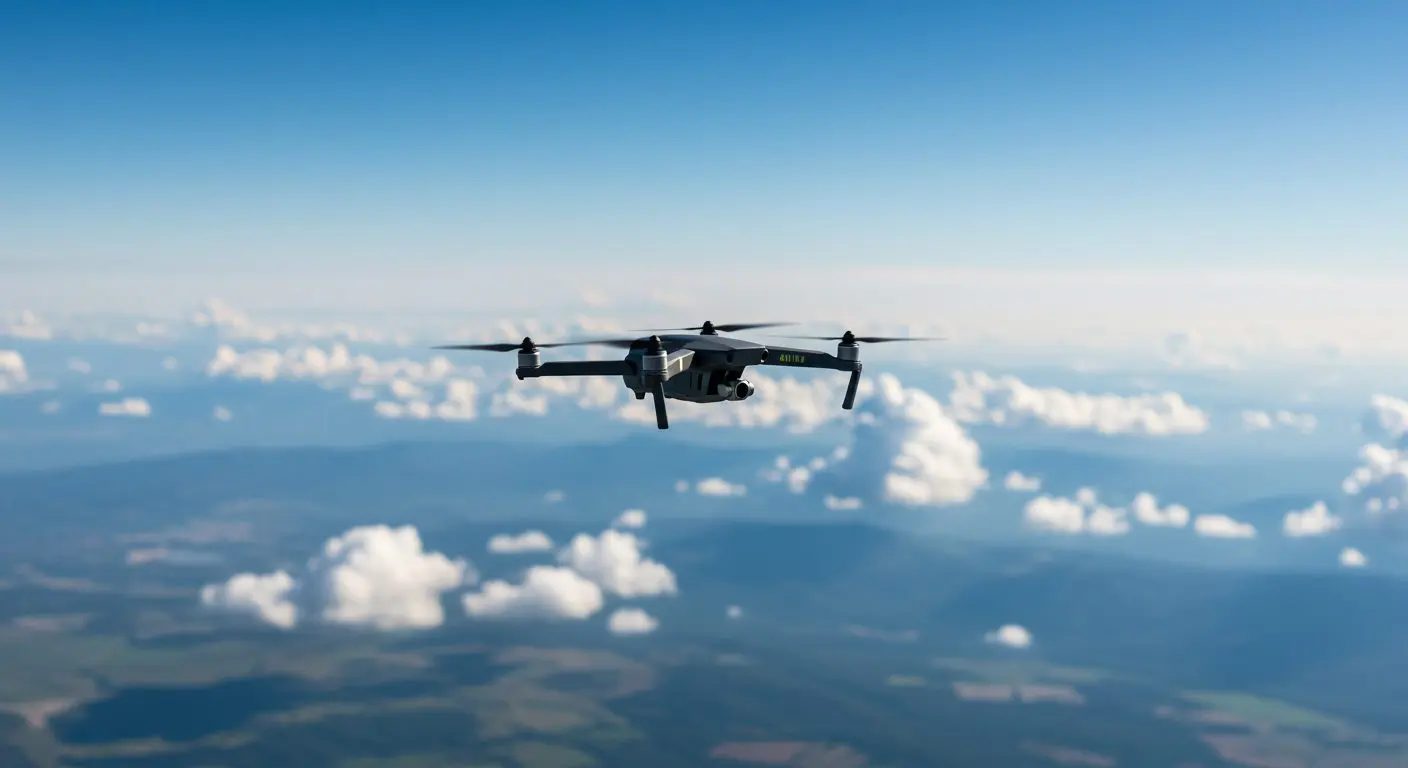
The increasing autonomy of unmanned aerial vehicles (UAVs) presents significant challenges in complex environments, requiring robust control systems that can interpret ambiguous instructions and adapt to unforeseen circumstances. Researchers are now exploring the application of large language models (LLMs), a type of artificial intelligence that is adept at processing natural language, to enhance the operational reliability of UAVs. Wenhao Wang, Yanyan Li, Long Jiao et al., detail a novel closed-loop control framework in their paper, ‘Large Language Model-Driven Closed-Loop UAV Operation with Semantic Observations’, which utilises two LLM modules to translate observations into actionable control code and refine performance through simulation, thereby mitigating risks associated with real-world deployment. This approach converts numerical data into descriptive trajectory language, improving the LLM’s comprehension of UAV dynamics and enabling more precise feedback generation.
Recent research demonstrates a clear trajectory in integrating Large Language Models (LLMs) into robotic systems, particularly advancing Unmanned Aerial Vehicle (UAV) control. Current work actively explores methods for translating human instructions into executable code, enabling greater autonomy and adaptability in robotic operations. A central theme emerging from cited papers is the development of closed-loop control frameworks that leverage LLMs for both code generation and performance evaluation, improving the reliability and precision of robotic actions.
Researchers address inherent limitations of LLMs, notably challenges in logical reasoning and complex decision-making, by developing novel closed-loop control frameworks. These frameworks employ two distinct LLM modules: a Code Generator and an Evaluator, transforming numerical data from UAV operations into descriptive trajectory language. This enhances the Evaluator LLM’s comprehension of UAV dynamics and facilitates precise feedback generation, prioritising safety by allowing iterative improvement within a virtual space before deployment in real-world scenarios. A closed-loop system operates by continuously monitoring the output of an action, comparing it to the desired outcome, and adjusting the input to minimise the error.
Extensive experimentation validates the framework’s effectiveness on UAV
Extensive experimentation validates the framework’s effectiveness on UAV control tasks of varying complexity, consistently demonstrating significant improvement in both success rate and task completion compared to baseline approaches. The system effectively translates high-level instructions into precise robotic actions, showcasing the potential of LLMs to enhance robotic capabilities, particularly as task complexity increases. Current research also highlights critical areas requiring attention, such as vulnerabilities to prompt injection attacks, where malicious actors manipulate the LLM through carefully crafted input.
Studies investigate vulnerabilities to prompt injection attacks, and further work focuses on mitigating bias amplification within LLM refinement processes. Researchers ensure the stability and reliability of LLMs themselves, underscoring the importance of robust safety mechanisms and continuous monitoring when deploying LLM-driven robotic systems. The rapid growth in publications from 2024 confirms the increasing momentum and importance of this interdisciplinary field, driving innovation in robotic control.
The efficacy of these frameworks extends to more complex robotic platforms and environments, presenting a significant opportunity for future work. Researchers investigate the application of LLMs to multi-robot coordination and collaborative tasks, unlocking new capabilities and addressing challenges in areas such as search and rescue, environmental monitoring, and infrastructure inspection. The convergence of LLMs and robotics holds immense potential, driving innovation in robotic control and expanding the capabilities of autonomous systems.
👉 More information🗞Large Language Model-Driven Closed-Loop UAV Operation
🗞 Large Language Model-Driven Closed-Loop UAV Operation with Semantic Observations
🧠 DOI: https://doi.org/10.48550/arXiv.2507.01930




See today’s quantum computing news on Quantum Zeitgeist for the latest breakthroughs in qubits, hardware, algorithms, and industry deals.