Research demonstrates that the coherence time of nitrogen-vacancy (NV) centres, defects in materials like diamond, responds to water’s molecular behaviour at interfaces. Molecular dynamics simulations reveal sensitivity to hydrogen bonding, ion concentration and temperature, offering a novel method to probe aqueous interfacial properties using near-surface qubits.
The behaviour of water at interfaces profoundly influences processes across numerous scientific disciplines, from biological function to materials design, yet direct measurement of these interfacial properties remains a significant challenge. Researchers are now applying techniques traditionally used in quantum information science to probe these complex systems. Alfonso Castillo, Gustavo R. Pérez-Lemus, and colleagues from the University of Chicago detail their investigation into utilising spin defects, specifically nitrogen-vacancy (NV) centres, as sensors to characterise water/graphene interfaces in their article, ‘Probing aqueous interfaces with spin defects’. Their work combines molecular dynamics simulations with calculations of spin dynamics to demonstrate the sensitivity of NV centre coherence times to the arrangement and dynamics of water and ions at surfaces, offering a novel approach to understanding aqueous interfacial properties.
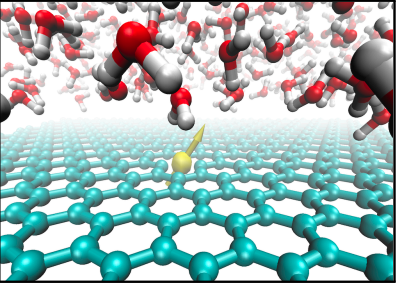
Researchers investigate the sensitivity of near-surface qubits, specifically nitrogen-vacancy (NV)-like colour centres, to aqueous interfaces by combining molecular dynamics (MD) simulations of water/graphene interfaces with calculations of spin dynamics. NV centres are point defects in a crystal lattice, exhibiting quantum mechanical properties suitable for use as qubits, the fundamental units of quantum information. This study establishes a direct link between interfacial water characteristics and qubit coherence, revealing how these qubits respond to changes in their surrounding environment.
The investigation systematically explores the influence of several
The investigation systematically explores the influence of several factors on qubit coherence, beginning with temperature variations within the liquid phase which directly affect the dynamics of water molecules and consequently the qubit’s coherence time. Researchers also modulate the strength of interaction between water and the graphene surface, observing how this impacts the interfacial water structure and qubit performance. Furthermore, the presence of mono- and di-valent ions significantly alters the interfacial environment, influencing both the hydrogen bonding network and the overall dynamics of water molecules, thereby affecting qubit coherence.
This work establishes near-surface qubits as a sensitive probe for characterising aqueous interfaces, offering a novel method for investigating the microscopic properties of water and its interactions with materials. Scientists correlate changes in qubit coherence with specific interfacial properties, providing a pathway for gaining deeper understanding of aqueous environments and potentially controlling phenomena. This research has broad implications for diverse fields, including materials science, biology, and the development of quantum sensors.
Researchers conduct molecular dynamics simulations to model water-graphene interfaces, accurately representing the behaviour of water molecules and their interactions with the qubit material. They subsequently calculate the resulting spin dynamics, providing a comprehensive understanding of how the interfacial environment affects qubit performance. The study reveals a sensitivity of the Hahn echo coherence time – a measure of qubit stability – to motional narrowing and the hydrogen bonding arrangement, demonstrating the intricate relationship between molecular dynamics and qubit stability.
The findings demonstrate a sensitivity of the Hahn
The findings demonstrate a sensitivity of the Hahn echo coherence time to motional narrowing, a phenomenon where molecular motion averages out interactions, and to the hydrogen bonding arrangement and dynamical properties of water and ions at the interface. Researchers reveal that the coherence time is affected by both the speed of molecular motion and the structure of hydrogen bonds formed between water molecules, establishing a clear link between molecular dynamics and qubit performance. Specifically, faster molecular motion and alterations to hydrogen bond networks both contribute to changes in qubit coherence.
🗞 Probing aqueous interfaces with spin defects
🧠 DOI: https://doi.org/10.48550/arXiv.2507.01220