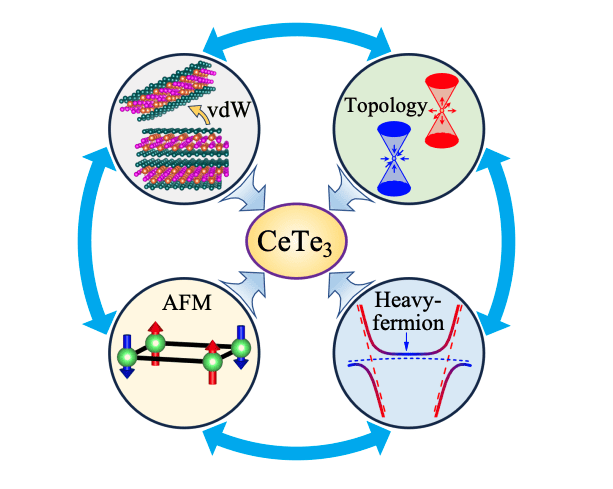
The pursuit of materials exhibiting both strong electronic correlations and high carrier mobility represents a significant challenge in condensed matter physics, crucial for advancing next-generation electronic and spintronic devices. Researchers are now reporting the observation of unexpectedly high mobility in CeTe, a two-dimensional van der Waals antiferromagnetic metal. This material displays characteristics of ‘heavy quasiparticles’, where electrons effectively behave as though they possess a significantly larger mass than their intrinsic value, a phenomenon typically associated with reduced mobility. However, optical spectroscopy and high-field magneto-oscillation measurements reveal that CeTe not only exhibits substantial mass enhancement due to both antiferromagnetic ordering and narrow-band electronic correlations, but also demonstrates a surprising increase in mobility, reaching 2403 cm2/Vs, and even 3158 cm2/Vs in atomically thin flakes. This work, detailed in a recent publication, is led by Hai Zeng, Yang Zhang, Bingke Ji, Jiaqiang Cai, Shuo Zou, Zhuo Wang, Chao Dong, Kangjian Luo, Yang Yuan, Kai Wang, Jinglei Zhang, Chuanyin Xi, Junfeng Wang, Yaomin Dai, Jing Li, and Yongkang Luo, representing institutions including the Wuhan National High Magnetic Field Center, Huazhong University of Science and Technology, Nanjing University, and the Hefei Institutes of Physical Science, Chinese Academy of Sciences, under the title “High-mobility heavy quasiparticles in a van der Waals antiferromagnetic dense Kondo lattice CeTe”.
Cerium telluride (CeTe₃) exhibits a compelling combination of high carrier mobility and strong electronic correlations, positioning it as a material of interest for advanced electronic applications. Researchers meticulously investigate both bulk crystals and atomically thin nanoflakes, employing a comprehensive suite of techniques to characterise carrier density, mobility, and the topology of the Fermi surface, which represents the boundary between filled and empty electron states in a material. This detailed analysis reveals a complex interplay between these properties, suggesting potential for next-generation spintronic devices, a field that exploits the spin of electrons, in addition to their charge, to store and process information.
Hall effect measurements confirm the presence of both electron and hole carriers contributing to conductivity within CeTe₃. Electrons are negatively charged carriers, while holes represent the absence of an electron and behave as positive charge carriers. The presence of both indicates a complex band structure, the range of energies that electrons are allowed to have within the material, which warrants further investigation. Scientists determine carrier densities and mobilities for both types of carriers across a range of temperatures, providing valuable insight into the material’s electronic behaviour and its response to external stimuli.
Quantum oscillation experiments, specifically Shubnikov-de Haas (SdH) measurements, provide crucial information about the Fermi surface topology and the underlying electronic structure of CeTe₃. These measurements detect oscillations in electrical resistance caused by the quantisation of electron orbits in a magnetic field. Researchers fit the observed oscillations to the Lifshitz-Kosevich (LK) formula, a theoretical model that relates the oscillation period to key parameters such as carrier density and effective mass, which reveals the intricate relationship between electronic interactions and charge transport. This analysis confirms a substantial enhancement of effective mass at low temperatures, arising from both antiferromagnetic ordering, where electron spins align in an antiparallel fashion, and strong electronic correlations within the material.
Notably, despite the observed enhancement of effective mass, carrier mobility surprisingly increases, reaching values up to 3158 cm²/Vs in atomically thin nanoflakes, a counterintuitive result that challenges conventional understanding of correlated electron systems. Scientists attribute this enhancement to topological protection of the electronic states, a mechanism that shields charge carriers from scattering and preserves high mobility even in the presence of strong interactions. This finding distinguishes CeTe₃ from other correlated electron systems and underscores its potential for high-performance electronic devices.
The research demonstrates that CeTe₃ maintains its unique properties – high mobility and heavy quasiparticles – even when reduced to atomically thin nanoflakes, a crucial requirement for realising nanoscale devices. This combination of characteristics positions CeTe₃ as a promising two-dimensional van der Waals material, named after the weak intermolecular forces between layers, for spintronics and other advanced technologies, offering potential for novel device concepts that leverage both charge and spin degrees of freedom. Detailed characterisation of its electronic and magnetic properties provides a solid foundation for further exploration of its potential in next-generation devices.
Future research should focus on exploring methods to further enhance the topological protection of charge carriers in CeTe₃, potentially through strain engineering or chemical doping. Scientists should also investigate the impact of different nanofabrication techniques on the electronic properties of CeTe₃, optimising the material for specific device applications. Furthermore, theoretical modelling and simulations can play a crucial role in understanding the underlying mechanisms governing charge transport in CeTe₃, guiding the development of novel device architectures.
👉 More information
🗞 High-mobility heavy quasiparticles in a van der Waals antiferromagnetic dense Kondo lattice CeTe
🧠 DOI: https://doi.org/10.48550/arXiv.2506.23653