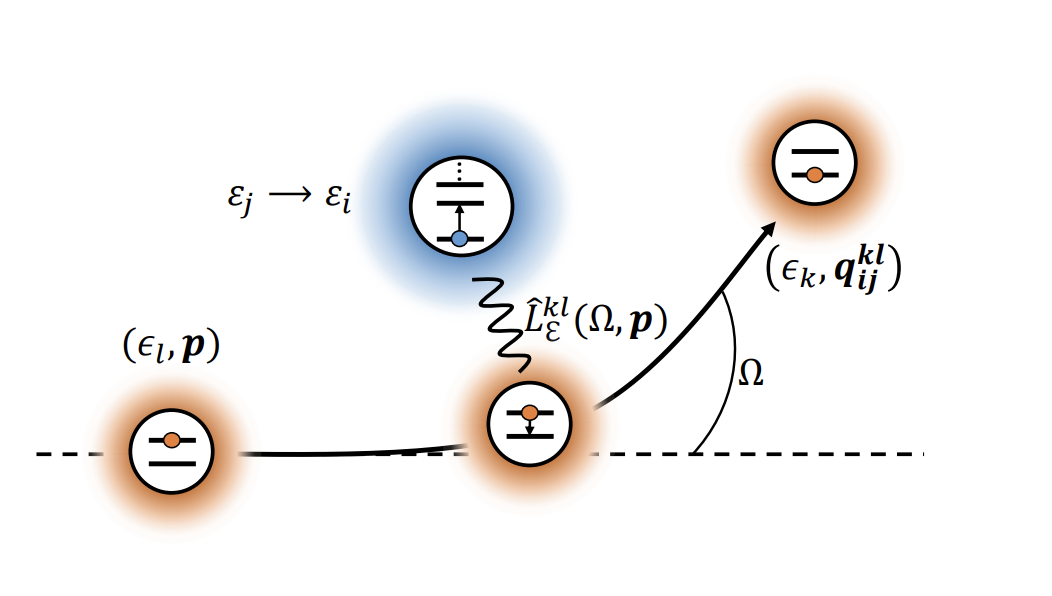
The behaviour of gases extends beyond simple kinetic theory when considering interactions with internal structures and differing temperatures, potentially yielding non-equilibrium reservoirs capable of energy generation. Researchers at the Naturwissenschaftlich-Technische Fakultät, Universität Siegen, namely Michael Gaida, Giulio Gasbarri, and Stefan Nimmrichter, investigate this phenomenon in their work, “Thermodynamically consistent collisional master equation in a low-density gas with internal structure”. They formulate a master equation, a mathematical description of a system’s evolution over time, to model the dynamics of a system experiencing inelastic scattering from a dilute thermal gas, where the gas particles themselves possess internal degrees of freedom. This approach demonstrates thermodynamic consistency when the gas is in thermal equilibrium and reveals that differing temperatures between internal and motional states create a structured, non-equilibrium reservoir with the potential to generate energy from seemingly random collisions.
Recent investigations detail a master equation accurately describing the dynamics of a quantum system interacting with a dilute thermal gas, explicitly modelling inelastic scattering processes and establishing thermodynamic consistency when the gas maintains thermal equilibrium. This work moves beyond traditional approaches which typically treat the gas as two independent heat baths, instead presenting evidence that the gas functions as a structured, non-equilibrium reservoir capable of generating energy through collisions. This offers a novel perspective on energy transfer and decoherence in open quantum systems, systems that exchange energy and information with their surroundings.
The core of this work lies in deriving a Lindblad master equation, a standard tool for modelling open quantum systems and their dissipation. This equation accounts for the exchange of energy between the quantum system and the thermal gas, considering the internal degrees of freedom of the gas particles and providing a framework for predicting the behaviour of quantum systems interacting with complex thermal environments. The Lindblad formalism describes how a quantum system evolves over time due to interactions with its environment, effectively modelling the loss of quantum coherence, known as decoherence.
Crucially, the model diverges from conventional treatments when
Crucially, the model diverges from conventional treatments when the internal and motional states of the gas are thermalised to different temperatures, revealing a complex interplay between energy levels and thermal gradients. In this scenario, the gas behaves not as two separate heat reservoirs, but as a single, complex reservoir exhibiting structured behaviour, allowing for the possibility of extracting useful energy from uncontrolled collisions. This finding has potential implications for understanding and harnessing non-equilibrium thermodynamics, challenging conventional assumptions about energy dissipation and opening new avenues for energy harvesting.
Researchers define energy transition rates, specifically for <a href=”https://quantumzeitgeist.com/rapid-excitation-removal-from-transmon-qubits-via-quantum-circuit-refrigeration/”>excitation and de-excitation between energy levels within the quantum system, providing a quantitative framework for understanding energy transfer processes. These rates depend on the temperature of the gas, the energy scales of both the system and the gas particles, and a detuning parameter that reflects the degree of resonance between them, allowing for precise control and prediction of system behaviour. The integral (I(\alpha, s)) plays a key role in determining the probability of energy transfer, being suppressed for large energy scales and significant detuning, and providing a crucial link between microscopic interactions and macroscopic observables.
Calculations reveal that a non-equilibrium thermal gas introduces a structured reservoir effect, challenging conventional assumptions about energy dissipation and opening new avenues for energy harvesting. Unlike traditional models assuming independent heat baths, differing temperatures within the gas create a non-equilibrium environment capable of generating useful energy through collisions, suggesting that non-equilibrium environments can be harnessed for energy generation. This challenges the traditional view of thermal environments as purely dissipative, instead suggesting they can be sources of usable energy under specific conditions.
The implications of this research extend to several areas of quantum technology, particularly in the pursuit of robust and reliable quantum devices. Understanding and controlling decoherence is paramount for advancing quantum computing, sensing, communication, and metrology, and this work provides a crucial step towards achieving this goal. Minimising decoherence is essential for maintaining the quantum state of qubits, the fundamental units of quantum information, and enabling complex quantum computations.
Future research directions include exploring the specific conditions
Future research directions include exploring the specific conditions under which the structured non-equilibrium reservoir effect is most pronounced, investigating the potential for controlling and harnessing the generated energy, and extending the model to incorporate more complex interactions and environments. Researchers plan to investigate the impact of different gas compositions and densities on the structured reservoir effect, and to explore the potential for using external fields to control the energy transfer processes.
This research details a comprehensive theoretical framework for understanding energy transfer and decoherence in open quantum systems, offering a novel perspective on the role of thermal environments in quantum technologies. By demonstrating the existence of a structured non-equilibrium reservoir effect, researchers challenge conventional assumptions about energy dissipation and open new avenues for energy harvesting. This work has significant implications for the development of robust and reliable quantum devices, paving the way for future advancements in quantum computing, sensing, communication, and metrology.
Researchers emphasise the importance of controlling the thermal environment to minimise decoherence and maximise energy transfer efficiency, highlighting the need for careful design and optimisation of quantum devices. This work provides a solid foundation for further investigation into the intricate interplay between quantum systems and their thermal surroundings, paving the way for future technological advancements.
🗞 Thermodynamically consistent collisional master equation in a low-density gas with internal structure
🧠 DOI: https://doi.org/10.48550/arXiv.2506.21394