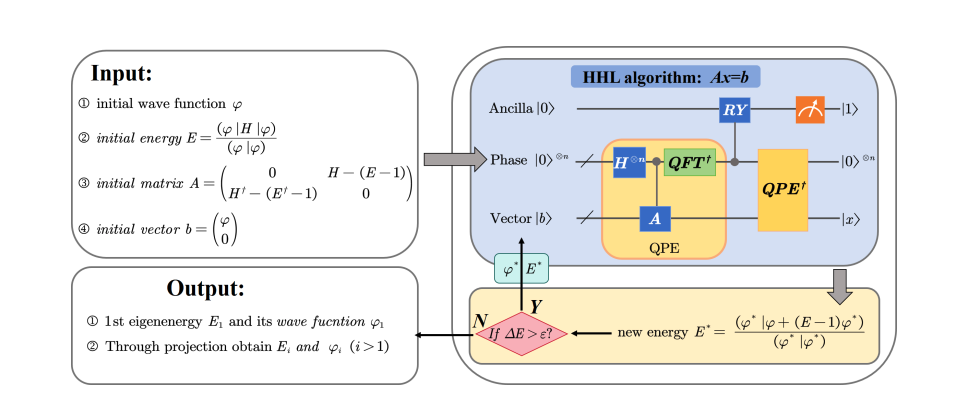
The accurate determination of nuclear resonances, crucial for understanding nuclear reactions and astrophysical processes, presents a significant computational challenge. These resonances arise from quasi-bound states within the nucleus, necessitating methods that can handle non-Hermitian operators, which describe systems that exchange energy with their surroundings. Researchers now present a novel algorithmic approach to this problem, combining the iterative Harrow-Hassidim-Lloyd (HHL) algorithm, a quantum algorithm for solving linear systems of equations, with eigenvector continuation. This technique employs complex scaling to isolate resonant states. Hantao Zhang from Tongji University, Dong Bai from Hohai University, and Zhongzhou Ren, also from Tongji University, detail their method in a paper entitled “Iterative Harrow-Hassidim-Lloyd quantum algorithm for solving resonances with eigenvector continuation”, demonstrating its efficacy in calculating resonant states and achieving results consistent with established techniques. Their work offers a potentially efficient pathway for exploring nuclear resonances utilising quantum computation.
Recent advances in quantum algorithms demonstrate a capacity to effectively model nuclear resonances, thereby validating established computational techniques used in nuclear physics. A significant body of work, published between 2020 and 2023 by researchers including Bai, Drischler, Furnstahl, Garcia, and others, concentrates on developing and refining methods to model complex nuclear interactions efficiently. These studies, appearing in journals such as Physics Letters B, Physical Review C, Journal of Physics G: Nuclear and Particle Physics, and Frontiers in Physics, consistently utilise eigenvector continuation as a core component of these ‘emulators’.
Eigenvector continuation extends the range of calculable states by analytically continuing solutions beyond the physically defined boundaries, improving both the accuracy and efficiency of calculations. This technique is particularly valuable when dealing with resonances, which represent unstable states in quantum systems. The development of these emulators represents a shift towards faster and more computationally tractable methods for predicting reaction outcomes, crucial for applications in nuclear astrophysics, reactor physics, and fundamental nuclear theory. Researchers consistently demonstrate good agreement between emulator results and established techniques, confirming the reliability and accuracy of the algorithms.
The collaborative nature of this research is evident
The collaborative nature of this research is evident in the frequent co-authorship of publications, indicating a concerted effort within the nuclear physics community to advance the field of nuclear reaction modelling. Multiple researchers contribute to the development and refinement of these techniques, pushing the boundaries of nuclear physics calculations and aiming for increased accuracy, efficiency, and the ability to tackle increasingly complex nuclear systems. The focus on emulation and the development of efficient computational surrogates is significant for applications such as nuclear astrophysics, where numerous nuclear reaction calculations are required to model stellar processes.
Building upon this foundation, a novel algorithm for solving nuclear resonances has been proposed, leveraging the iterative Harrow-Hassidim-Lloyd (HHL) algorithm and incorporating eigenvector continuation with complex scaling. The HHL algorithm is a quantum algorithm designed to solve systems of linear equations, offering a potential speedup over classical methods for specific problems. Complex scaling is a mathematical technique used to treat resonances as quasi-bound states, enabling their accurate calculation. To validate this approach, researchers investigate the resonant states of a specific system and achieve results that align well with established traditional methods, establishing a foundation for further exploration of nuclear resonances utilising quantum algorithms. This study presents a novel approach to calculating eigenvalues of non-Hermitian operators, potentially enabling more accurate predictions of nuclear behaviour in various astrophysical and technological contexts.
👉 More information🗞Iterative Harrow-Hassidim-Lloyd quantum algorithm for solving
🗞 Iterative Harrow-Hassidim-Lloyd quantum algorithm for solving resonances with eigenvector continuation
🧠 DOI: https://doi.org/10.48550/arXiv.2506.20929