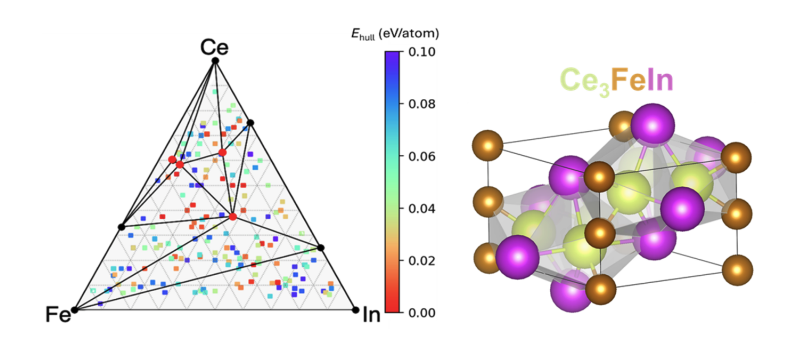
The pursuit of novel materials with tailored functionalities increasingly relies on computational methods, demanding workflows that can integrate artificial intelligence, extensive databases, and complex physical simulations. Researchers are now addressing this challenge with scalable, high-performance computing frameworks designed to accelerate the discovery and design of materials. A team comprising Maxim Moraru and Ying Wai Li from Los Alamos National Laboratory, alongside Weiyi Xia, Zhuo Ye, Feng Zhang, Yongxin Yao, and Cai-Zhuang Wang from Ames Laboratory and Iowa State University, present exa-AMD, a Python-based application detailed in their work titled ‘exa-AMD: A Scalable Workflow for Accelerating AI-Assisted Materials Discovery and Design’.
The application leverages Parsl, a task-parallel programming library, to decouple workflow logic from execution configuration, enabling flexible scaling across diverse computing resources. Computational materials discovery experiences considerable acceleration through the exa-AMD workflow, an integrated system that combines automated computation with machine learning prediction, delivering a scalable and reproducible framework for identifying novel materials with desired characteristics. The process initiates with defined material inputs, followed by Density Functional Theory (DFT) calculations to establish baseline properties, and crucially, employs a Crystal Graph Convolutional Neural Network (CGCNN) to predict properties, potentially reducing the computational demand of extensive DFT simulations. This iterative cycle refines understanding and efficiently identifies promising material candidates, streamlining the identification of materials with desired properties and promising to accelerate innovation in fields reliant on advanced materials such as energy storage, catalysis, and electronics.
The exa-AMD workflow represents a significant advance in computational materials science, offering a powerful and efficient means of discovering new materials with tailored properties through a synergistic combination of first-principles calculations, machine learning, and high-performance computing. The workflow begins by defining a set of initial material candidates, which can be based on existing knowledge or generated through computational screening. Then it performs Density Functional Theory (DFT) calculations to determine the electronic structure and properties of these materials, providing a fundamental understanding of their behaviour. DFT, a quantum mechanical modelling approach, calculates the electronic structure of materials based on their atomic composition and arrangement, enabling the prediction of various properties.
The exa-AMD workflow’s architecture deliberately decouples the workflow
The exa-AMD workflow’s architecture deliberately decouples the workflow logic from the underlying execution configuration, enabling researchers to scale their investigations without requiring substantial code modifications for different computing platforms. The workflow is built upon the Parsl framework, a task-parallel programming library that facilitates flexible execution across diverse computing resources, ranging from personal laptops to large supercomputers. This portability is crucial for wider adoption, enabling researchers to effectively leverage available computational infrastructure.
The exa-AMD workflow’s performance is further enhanced by its ability to learn from past calculations, using machine learning to build predictive models that can accurately estimate the properties of new materials, reducing the need for computationally expensive DFT calculations. The Crystal Graph Convolutional Neural Network (CGCNN) plays a key role in this process, learning to identify the relationships between crystal structure and material properties. CGCNNs, a type of deep learning architecture, operate directly on the graph representation of crystal structures, allowing them to capture complex relationships between atomic arrangements and material behaviour. This enables the workflow to efficiently screen large numbers of materials, identifying those with the most promising characteristics.
The exa-AMD workflow’s impact extends beyond the discovery of new materials, offering a powerful platform for materials design and optimisation. It allows researchers to explore the vast chemical space of possible materials, identifying those with the most desirable properties for specific applications. The workflow can be used to tailor material properties, such as strength, conductivity, and optical absorption, to meet the requirements of a wide range of technologies, and it can also be used to optimize material processing conditions, improving the efficiency and cost-effectiveness of manufacturing.
Future development of the exa-AMD workflow will focus
Future development of the exa-AMD workflow will focus on several key areas, including improving the accuracy and efficiency of the machine learning models, expanding the range of materials and properties that can be predicted, and developing new methods for uncertainty quantification and data integration. The workflow will also be extended to incorporate more sophisticated modelling techniques, such as molecular dynamics simulations and finite element analysis, allowing researchers to predict the behaviour of materials under a wider range of conditions. The ultimate goal is to create a fully automated materials discovery platform that can accelerate the development of new technologies and address some of the world’s most pressing challenges.
🗞 exa-AMD: A Scalable Workflow for Accelerating AI-Assisted Materials Discovery and Design
🧠 DOI: https://doi.org/10.48550/arXiv.2506.21449



See today’s quantum computing news on Quantum Zeitgeist for the latest breakthroughs in qubits, hardware, algorithms, and industry deals.