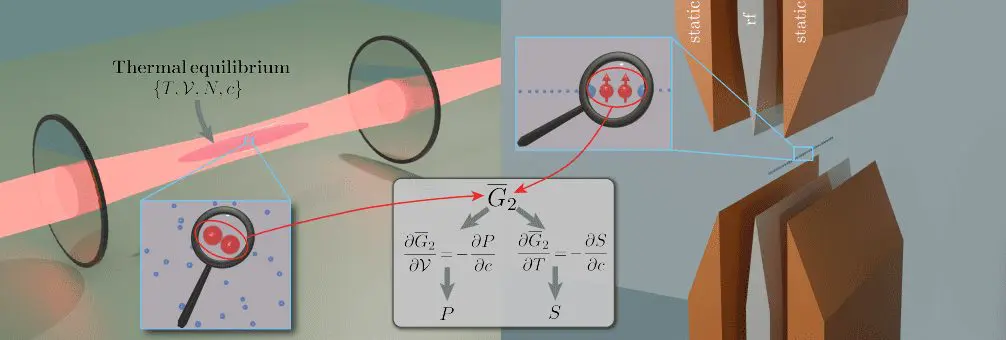
The pursuit of understanding complex physical systems frequently encounters a disparity between the ease with which microscopic properties can be simulated and the difficulty in extracting macroscopic thermodynamic quantities relevant to experimental comparison. Researchers now demonstrate a method to bridge this gap, establishing generalised Maxwell relations which connect every thermodynamic property to a single, locally measurable correlation function. This allows for the deduction of challenging thermodynamic properties from readily accessible data within quantum simulators, offering a universal approach applicable to systems where direct thermodynamic measurement proves difficult, such as two-dimensional materials. This work, detailed in a recent publication, originates from a collaborative effort led by F. Rist, R. S. Watson, H. L. Nourse, B. J. Powell and K. V. Kheruntsyan, all affiliated with the School of Mathematics and Physics at the University of Queensland, with additional contributions from the School of Chemistry at the University of Sydney, and is entitled “Quantum simulation of thermodynamics: Maxwell relations for pair correlations”.
Researchers present a novel technique for determining the thermodynamic properties of many-body systems, utilising a single, measurable two-particle correlation function. Traditionally, characterising these systems, which involve the interactions of numerous particles, requires extensive computational resources and multiple measurements of various properties. This new method circumvents these difficulties by establishing a direct link between a readily accessible quantity – the two-particle correlation function – and all relevant thermodynamic observables.
The two-particle correlation function describes the probability of finding two particles at a given distance from each other, providing insight into the system’s structure and interactions. This research leverages generalised Maxwell relations, mathematical equations that connect changes in thermodynamic variables, to demonstrate how the complete thermodynamic behaviour of a system can be inferred from this single function. This represents a significant simplification, as it eliminates the need for independent measurements of quantities such as energy, pressure, and entropy.
The implications of this advancement extend across several fields. In condensed matter physics and materials science, it offers a more efficient means of characterising complex materials and predicting their behaviour under different conditions. Furthermore, it streamlines the process of validating and refining quantum simulations, which are increasingly used to model and understand complex physical systems. The ability to derive all thermodynamic properties from a single correlation function accelerates analysis and reduces computational demands, potentially enabling the investigation of more complex systems than previously feasible.
This methodology is particularly relevant to the burgeoning field of quantum simulation, where researchers attempt to model quantum systems using controllable platforms. Validating the accuracy of these simulations often requires comparing predicted thermodynamic properties with experimental data or other theoretical calculations. This new technique provides a more direct and efficient pathway for such comparisons, facilitating the development and refinement of quantum simulation techniques.
👉 More information
🗞 Quantum simulation of thermodynamics: Maxwell relations for pair correlations
🧠 DOI: https://doi.org/10.48550/arXiv.2506.19407




See today’s quantum computing news on Quantum Zeitgeist for the latest breakthroughs in qubits, hardware, algorithms, and industry deals.