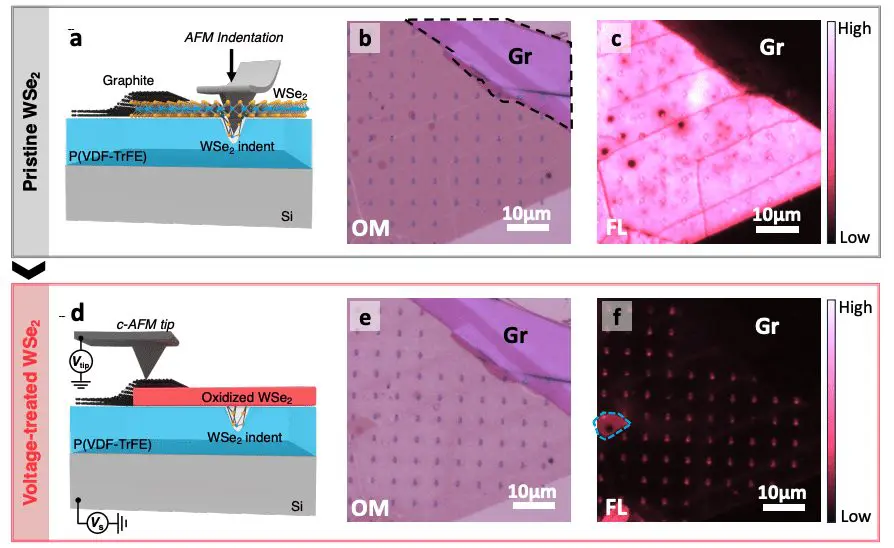
The pursuit of reliable, single-photon emitters represents a critical challenge in the development of advanced quantum technologies, including quantum computing and secure communication networks. Imperfections within two-dimensional materials, such as tungsten diselenide (WSe2), often introduce unwanted luminescence that degrades the purity of emitted photons, hindering their practical application. Researchers at the U.S. Naval Research Laboratory, comprising Sung-Joon Lee, Hsun-Jen Chuang, Kathleen M. McCreary, Mehmet A. Noyan, and Berend T. Jonker, detail a novel technique for enhancing the performance of these materials in their article, “Voltage-Induced Oxidation for Enhanced Purity and Reproducibility of Quantum Emission in Monolayer 2D Materials”. Their work demonstrates the use of conductive atomic force microscopy to induce localised oxidation around nanoscale indentations in monolayer WSe2, effectively suppressing defect-related emissions and significantly improving the purity of single-photon emission, a key metric quantified by the second-order correlation function, g2(0). This approach offers a spatially controlled and non-volatile method for optimising emitter performance, paving the way for the integration of high-quality single-photon sources into photonic integrated circuits.
Researchers demonstrate a method to enhance single-photon emission from monolayer tungsten diselenide (WSe₂) utilising conductive atomic force microscopy (AFM) to induce localised oxidation. This technique significantly improves both the purity and reproducibility of single-photon emission, a crucial requirement for emerging quantum technologies. The process centres on a WSe₂/poly(vinylidene fluoride-co-trifluoroethylene) (P(VDF-TrFE)) heterostructure deposited on silicon, providing a platform for precise control over the emitter environment and facilitating scalable photonic integration.
The study reveals that applying a controlled electric field around nano-indented sites within the WSe₂ selectively suppresses unwanted luminescence originating from defect-bound excitons. These excitons, created by the excitation of electrons and holes bound to defects in the material, typically degrade the signal quality. By oxidising the surrounding material, researchers effectively eliminate these interfering signals while preserving emission from pristine regions within the indentations, offering a substantial improvement over existing methods reliant on material purification or complex fabrication.
Investigations into the underlying mechanisms suggest the oxidation
Investigations into the underlying mechanisms suggest the oxidation process passivates defects at the WSe₂ surface and edge, reducing non-radiative recombination pathways. Non-radiative recombination occurs when excited electrons lose energy through mechanisms other than photon emission, diminishing the efficiency of the light source. By reducing these pathways, the lifetime of excited states is increased, enhancing the probability of photon emission. Furthermore, the oxidation process modifies the electronic structure of the WSe₂, potentially altering band alignment and increasing the radiative recombination rate, the rate at which electrons and holes recombine to produce photons.
The potential applications of this technology are extensive, spanning quantum cryptography, quantum sensing, quantum imaging, and quantum communication. Quantum cryptography, for example, relies on the secure transmission of information using single photons, demanding high-purity sources for secure key distribution. Quantum sensing leverages the sensitivity of single photons to detect weak signals, while quantum imaging utilises their unique properties for high-resolution imaging with reduced noise. Quantum communication, meanwhile, employs the entanglement of single photons for secure and efficient long-distance information transfer.
Currently, researchers are focused on scaling up the fabrication process to create large-area arrays of single-photon emitters with high uniformity and reproducibility. Exploration of new materials and heterostructures is also underway, aiming to further enhance performance and functionality. Future research will concentrate on developing integrated photonic circuits incorporating these emitters, alongside investigations into novel applications within quantum technologies and advanced optical systems. This work represents a significant advancement towards realising practical and scalable quantum technologies reliant on high-purity single-photon sources.
Fabrication of the WSe₂/P(VDF-TrFE) heterostructure begins with mechanical exfoliation of WSe₂ flakes from a bulk crystal onto a silicon substrate coated with P(VDF-TrFE). The P(VDF-TrFE) layer functions as a dielectric substrate, providing a smooth surface for subsequent lithography. Electron beam lithography then defines nano-indented sites within the WSe₂ layer, creating localised regions for oxidation. A controlled oxidation process utilising conductive AFM applies a precise voltage, inducing localised oxidation around these nano-indented sites.
The oxidation process is monitored in real-time using
The oxidation process is monitored in real-time using in-situ Raman spectroscopy, tracking changes in the WSe₂ material. Raman spectra provide information on chemical composition and structural properties, allowing optimisation of oxidation parameters. Following oxidation, the sample undergoes characterisation using optical microscopy, atomic force microscopy, and photoluminescence spectroscopy, providing data on morphology, structural integrity, and optical properties.
Photoluminescence measurements are performed at cryogenic temperatures to minimise thermal noise and enhance signal-to-noise ratio. These measurements reveal a significant enhancement in single-photon emission efficiency following voltage treatment, demonstrating the effectiveness of the oxidation process in suppressing defect-related luminescence. Second-order correlation measurements confirm the single-photon nature of the emitted photons, with g²(0) values consistently below 0.14, indicating strong anti-bunching and high photon purity.
The spatially selective nature of the oxidation process enables the creation of arrays of single-photon emitters with precise control over location and spacing, facilitating the development of integrated photonic circuits with complex functionalities. This opens new possibilities for advanced quantum technologies and integrated quantum photonics.
🗞 Voltage-Induced Oxidation for Enhanced Purity and Reproducibility of Quantum Emission in Monolayer 2D Materials
🧠 DOI: https://doi.org/10.48550/arXiv.2506.19659




See today’s quantum computing news on Quantum Zeitgeist for the latest breakthroughs in qubits, hardware, algorithms, and industry deals.