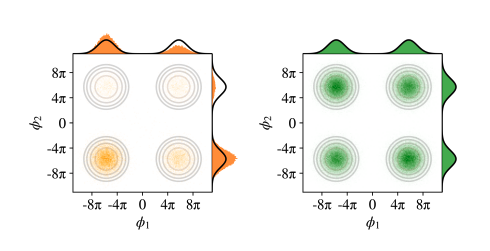
Researchers demonstrate that normalising flows accurately model the Boltzmann distribution within the fermionic Hubbard model, a crucial system for understanding material electronic structure. This new approach, utilising symmetry and independent sampling, overcomes limitations of Hybrid Monte Carlo methods and achieves computational efficiency gains.
Understanding the behaviour of electrons in complex materials remains a central challenge in condensed matter physics, crucial for advancements in areas ranging from superconductivity to novel electronic devices. Traditional computational methods, such as Hybrid Monte Carlo, frequently encounter difficulties when modelling strongly correlated electron systems, often producing inaccurate results due to limitations in sampling efficiency. Now, researchers at the University of Bonn, the Jülich Supercomputing Centre, and the University of Regensburg demonstrate a novel approach utilising symmetry-enforced normalising flows, a type of machine learning technique, to simulate the electronic structure of the fermionic Hubbard model accurately. This work, detailed in a paper authored by Dominic Schuh, Janik Kreit, Evan Berkowitz, Lena Funcke, Marcel Rodekamp, Thomas Luu, and Kim A. Nicoli, entitled “Simulating Correlated Electrons with Symmetry-Enforced Normalising Flows”, offers a potentially more efficient and reliable pathway to modelling these complex quantum systems. Normalising flows are a class of generative models that learn to transform a simple probability distribution into a complex one, and in this instance, are used to represent the Boltzmann distribution, a statistical measure of the probability of a system being in a particular state.
Quantum materials pose a significant computational challenge, requiring novel approaches to accurately model their intricate electronic behaviour. Researchers now demonstrate a powerful technique employing symmetry-aware Normalizing Flows (NFs) to determine the Boltzmann distribution of the fermionic Hubbard model, a foundational model in condensed matter physics. This advancement establishes NFs as a viable, and often superior, alternative to established methods like Hybrid Monte Carlo (HMC), which frequently encounter ergodicity issues and computational bottlenecks when simulating strongly correlated systems.
The fermionic Hubbard model describes the behaviour of
The fermionic Hubbard model describes the behaviour of interacting electrons within a lattice structure, providing a fundamental framework for understanding phenomena such as high-temperature superconductivity and magnetism. Traditional methods, including HMC, approximate the many-body quantum problem by sampling configurations in a high-dimensional space. However, these methods often struggle to explore the entire relevant configuration space, leading to biased results and inaccurate predictions. NFs offer a fundamentally different approach, learning the probability distribution directly from data using a sequence of invertible transformations, thereby circumventing the limitations of traditional sampling methods. A Normalizing Flow is a machine learning technique that transforms a simple probability distribution into a complex one via a series of invertible mappings.
The core innovation resides in incorporating symmetry into the NF architecture. Researchers have demonstrated that this approach improves both accuracy and efficiency. Exploiting the inherent symmetries of the physical system constrains the possible configurations, reducing the computational burden and enhancing the reliability of the results. The ability to accurately model strongly correlated materials is essential for understanding a wide range of phenomena, including high-temperature superconductivity, magnetism, and quantum phase transitions.
Future work focuses on extending the NF approach to even larger system sizes and exploring its application to more complex models, including those incorporating longer-range interactions. Researchers plan to investigate the computational scaling of the method with system size, assessing its feasibility for simulating truly large-scale materials and identifying potential bottlenecks. Exploring different NF architectures and coordinate transformations may lead to further improvements in accuracy and efficiency.
Investigating the application of NFs to dynamical properties, such as time-dependent correlation functions, represents a significant opportunity for expanding the scope of the method. Researchers aim to develop techniques for efficiently sampling from the NF-generated distribution at different time steps, enabling the study of non-equilibrium phenomena and the investigation of real-time dynamics. Correlation functions describe the statistical relationship between quantum operators at different points in space and time.
The successful application of NFs to the Hubbard
The successful application of NFs to the Hubbard model demonstrates the potential of machine learning techniques for solving complex problems in physics. Researchers are exploring other applications of machine learning in condensed matter physics, including the development of new materials discovery algorithms and the analysis of experimental data. The integration of machine learning techniques with traditional computational methods promises to revolutionise the field of materials science.
The development of open-source software packages for implementing NF-based simulations will be crucial for promoting wider adoption of the method. Researchers are working on developing user-friendly software packages that will allow other researchers to easily apply the NF approach to their own problems. The availability of open-source software will facilitate collaboration and accelerate progress in the field.
The combination of advanced computational techniques, such as NFs, with experimental data analysis promises to accelerate the discovery of new materials with novel properties. Researchers are exploring ways to use machine learning techniques to analyse experimental data and identify promising candidates for further investigation. The integration of computational and experimental approaches will be essential for addressing some of the most challenging problems in materials science.
The development of new theoretical frameworks that can guide the application of machine learning techniques to physics problems is also crucial. Researchers are exploring ways to incorporate physical principles into the design of machine learning algorithms, improving their accuracy and interpretability. The integration of theoretical and computational approaches will be essential for advancing our understanding of complex physical systems.
🗞 Simulating Correlated Electrons with Symmetry-Enforced Normalizing Flows
🧠 DOI: https://doi.org/10.48550/arXiv.2506.17015




See today’s quantum computing news on Quantum Zeitgeist for the latest breakthroughs in qubits, hardware, algorithms, and industry deals.