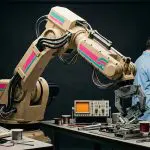
GAMORA, a virtual reality guided robotic system, enables remote operation of hazardous laboratory tasks with enhanced precision. Integrating the Oculus Quest 2 and Robot Operating System, it achieves 2.2 mm positional accuracy and 0.2 mL pipetting accuracy, alongside 1.2 mm repeatability. Object detection via YOLOv8 and reduced energy consumption further optimise performance.
The increasing need for remote handling of hazardous materials, particularly within virology and high-containment laboratories, presents significant engineering challenges. Minimising direct human contact with pathogens demands innovative robotic solutions that prioritise both safety and precision. Researchers are now exploring systems that move beyond traditional teleoperation and scripted automation, seeking intuitive control methods and enhanced spatial awareness. A team from Muffakham Jah College of Engineering and Technology, comprising Farha Abdul Wasay, Mohammed Abdul Rahman, and Hania Ghouse, detail their development of GAMORA (Gesture Articulated Meta Operative Robotic Arm), a virtual reality-guided robotic system for hazardous material handling, in their forthcoming publication.
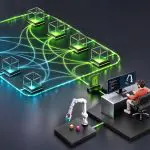
GAMORA (Gesture Articulated Meta Operative Robotic Arm) presents a novel approach to remote operation within hazardous environments, specifically addressing escalating safety needs in virology laboratories. The system minimises direct human exposure to biohazards while maintaining the dexterity required for complex procedures, recognising the critical balance between operator safety and experimental fidelity. Integrating the Oculus Quest 2 virtual reality headset, the Jetson Nano embedded computing system, and the Robot Operating System (ROS), a flexible framework for writing robot software, GAMORA delivers real-time immersive control, a comprehensive digital twin simulation, and precise articulation based on inverse kinematics – a method of calculating joint parameters to achieve a desired end-effector position and orientation. This creates a synergistic platform for remote manipulation.
Unlike conventional scripted automation, which executes pre-programmed sequences,
Unlike conventional scripted automation, which executes pre-programmed sequences, or standard teleoperation systems, GAMORA prioritises intuitive control and adaptable performance, allowing operators to respond dynamically to unforeseen circumstances and complex tasks. A detailed three-dimensional environment, constructed within the Unity game engine, enables real-time motion planning, collision detection, and comprehensive hardware-in-the-loop testing, ensuring robust operation. This simulation allows for virtual practice and refinement of procedures before execution in the physical world.
The system’s ability to remotely handle hazardous materials proves particularly valuable in situations where direct human contact is undesirable or impossible, envisioning applications in infectious disease research, drug discovery, and environmental monitoring. Potential extends to high-containment laboratories, mobile diagnostic units, and remote field operations. Adaptability exists for use in other hazardous environments, such as nuclear power plants and chemical processing facilities, where remote intervention mitigates risk.
Rigorous testing refined the system’s algorithms and hardware, ensuring it met stringent performance requirements. Precision and repeatability were demonstrated through quality assurance inspections and audits. User studies evaluated the usability and effectiveness of GAMORA’s interface and control scheme, recruiting experienced laboratory technicians and researchers to perform tasks. Data collected on performance was analysed to identify areas for improvement, focusing on minimising latency and maximising intuitive control.
The successful development of GAMORA represents a significant step forward in remote handling and biosafety, with the potential to transform how researchers work with hazardous materials, reducing exposure risk and improving laboratory efficiency. Development was supported by a grant from the National Institutes of Health, and the research team remains committed to continuous development and global accessibility.
The team actively seeks partnerships with commercial entities
The team actively seeks partnerships with commercial entities to facilitate widespread adoption, exploring licensing agreements, joint ventures, and strategic alliances. A comprehensive training program is under development, providing users with the skills and knowledge needed for safe and effective operation, including online modules, hands-on workshops, and a user-friendly documentation library.
Continuous improvement and innovation remain central to the team’s objectives, constantly seeking new ways to enhance performance, functionality, and usability. Research into new technologies and incorporation of user feedback are ongoing. The team is committed to maintaining the highest standards of quality and safety in design, development, and operation, complying with all applicable safety regulations and standards.
🗞 GAMORA: A Gesture Articulated Meta Operative Robotic Arm for Hazardous Material Handling in Containment-Level Environments
🧠 DOI: https://doi.org/10.48550/arXiv.2506.14513

See today’s quantum computing news on Quantum Zeitgeist for the latest breakthroughs in qubits, hardware, algorithms, and industry deals.