Uncertainty extends objects, inducing relativistic effects and assigning weight to entropy and purity, influencing geodesic motion. Correlated positions necessitate non-Riemannian geometry governed by a state’s entropy and purity. Analysis also reveals a novel Minkowski structure within entanglement degrees of freedom.
The fundamental connection between information and gravity receives renewed scrutiny in recent work exploring how uncertainty inherent in quantum systems manifests as measurable relativistic effects. Researchers demonstrate that an object’s extension due to quantum uncertainty directly influences its interaction with gravity, effectively assigning weight to entropy and purity. This analysis, detailed in the paper ‘Relativistic implications of entropy and purity’, reveals that geodesic motion, the path an object takes through spacetime, deviates from standard Riemannian geometry when considering entangled states. Joseph Balsells and Martin Bojowald, both from the Institute for Gravitation and the Cosmos at The Pennsylvania State University, present a theoretical framework suggesting that the degree of entanglement dictates these deviations, and furthermore, uncovers a novel Minkowski structure within the space describing these entangled degrees of freedom. This work has potential implications for understanding phenomena ranging from precision measurements in free-fall experiments to the behaviour of Hawking radiation emitted by black holes.
Recent investigations demonstrate quantum uncertainty fundamentally influences spacetime geometry and gravitational interactions, establishing a novel connection between information-theoretic quantities and observable physical phenomena. Researchers now explore how extending an object via quantum uncertainty introduces measurable relativistic effects, specifically tidal forces, and assigns weight to both entropy, a measure of disorder or uncertainty, and purity, representing the degree to which a quantum state is mixed or certain. This challenges traditional understandings of mass as solely a property of energy-momentum. The work establishes a direct link between a system’s quantum state and its geodesic motion, impacting interpretations of phenomena ranging from terrestrial free-fall experiments to the theoretical framework of Hawking radiation, the predicted thermal radiation emitted by black holes.
The research actively demonstrates geodesic deviation, a measure
The research actively demonstrates geodesic deviation, a measure of how nearby geodesics, the paths objects follow in spacetime, converge or diverge, directly modulates both the entropy and purity of the object’s quantum state, revealing a deeper connection between information content and the curvature of spacetime. Higher entropy and lower purity, indicative of greater uncertainty, amplify these deviations, altering the object’s trajectory and suggesting the very act of quantum measurement, which affects an object’s purity, measurably influences its gravitational behaviour. This implies that observing a quantum system can subtly alter its gravitational interaction with the surrounding spacetime.
When an object exhibits correlations in at least two spatial directions, a more complex geometric description becomes necessary, prompting scientists to move beyond standard Riemannian geometry, the foundation of general relativity which describes spacetime as smooth and curved. This non-Riemannian geometry arises from the inherent uncertainty in defining the object’s position, necessitating a framework that accounts for these quantum fluctuations and providing a new perspective on how gravity operates at the quantum level. It suggests that at extremely small scales, spacetime may not be smooth but rather exhibit quantum fluctuations.
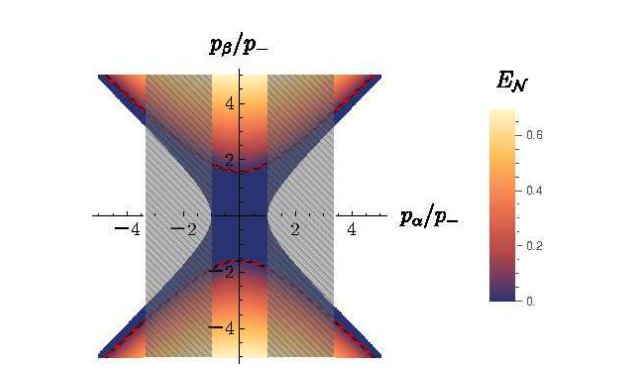
Furthermore, the analysis reveals a novel Minkowski structure, a spacetime geometry characterised by constant curvature, existing within the subspace defined by the object’s entanglement. Entanglement, a quantum phenomenon where particles become correlated regardless of distance, generates this distinct geometric structure, providing a potential link between quantum information and the emergence of gravity. This suggests that entanglement, a fundamental feature of quantum mechanics, may play a role in shaping the fabric of spacetime itself.
The calculated second-order moments of canonical variables, mathematical
The calculated second-order moments of canonical variables, mathematical quantities describing the system’s position and momentum, provide a framework for quantifying these effects, characterising the statistical properties and correlations within the system, and directly influencing the derived geometric descriptions. This work successfully integrates these mathematical tools with theoretical frameworks of quantum gravity and effective field theory, producing concrete predictions about observable phenomena.
Precision measurements of free-fall trajectories and investigations into the behaviour of entangled systems in gravitational fields represent crucial steps in validating these theoretical findings. Expanding the analysis to include higher-order moments and more complex quantum states could reveal further nuances in the relationship between quantum mechanics and gravity, and investigating the implications of this non-Riemannian geometry for black hole physics and cosmology presents a promising direction for future work.
🗞 Relativistic implications of entropy and purity
🧠 DOI: https://doi.org/10.48550/arXiv.2506.14705