Is it over for QNNs? Can they be replaced with classical structures?
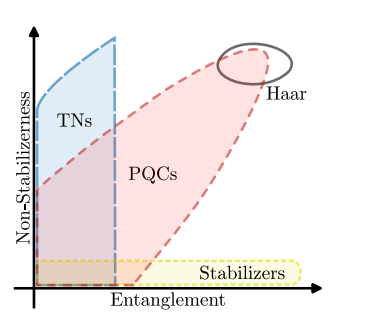
Research demonstrates that the expressive capability of quantum neural networks, typically reliant on complex quantum circuits, can be replicated using classical computational methods. Specifically, Clifford-enhanced matrix-product states, a type of tensor network, converge more rapidly towards random quantum states, exhibiting comparable entanglement and ‘magic’ without quantum hardware.
The pursuit of enhanced machine learning capabilities continually drives exploration into quantum neural networks (QNNs), architectures designed to leverage quantum mechanical principles for improved performance. However, recent research challenges the assumption that quantum hardware is essential for achieving certain desirable characteristics within these networks. A team led by Marco Maronese, Francesco Ferrari, Matteo Vandelli, and Daniele Dragoni, all from Quantum Computing Solutions and the Hyper-Computing Continuum Unit at Leonardo S.p.A., demonstrates that high expressibility (a key attribute of QNNs) can be replicated using purely classical computational resources. Their work, detailed in the article “High-expressibility Quantum Neural Networks using only classical resources”, investigates the expressibility of parametrised quantum circuits, comparing it to that of matrix-product states (MPS) and Clifford-enhanced matrix-product states (CMPS). MPS and CMPS are efficient classical representations of quantum states, and the team’s findings suggest that the benefits often attributed to quantum computation in neural networks may, in some instances, be achievable through optimised classical algorithms.
Researchers demonstrate that the expressibility commonly associated with quantum neural networks (QNNs) can be replicated using purely classical computational resources, thereby challenging the assumption that quantum resources are necessary for superior machine learning performance. The study meticulously compares the representational capacity of parametrised quantum circuits, central to many QNN architectures, with that of matrix product states (MPS) and a newly developed class of states, Clifford-enhanced MPS (CMPS). This comparison provides a detailed analysis of how these different representations converge towards maximal expressibility, a state where the model can represent a wide range of functions.
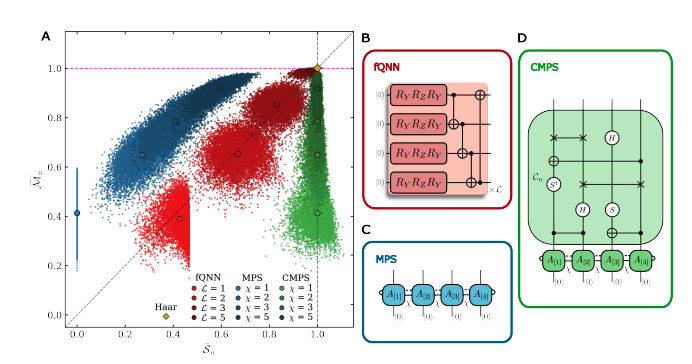
Matrix product states, or MPS, represent quantum states using a tensor network structure, effectively compressing the information needed to describe complex quantum systems. They are widely used in condensed matter physics and have found application in classical machine learning due to their ability to represent high-dimensional data efficiently. However, accurately representing arbitrary quantum states with MPS requires a considerable number of parameters, potentially limiting their scalability. The researchers introduce Clifford-enhanced MPS (CMPS), which augment standard MPS with Clifford operations, a specific type of quantum gate. These Clifford gates introduce additional flexibility, allowing CMPS to converge more rapidly towards the Haar distribution, a benchmark for maximal randomness and expressibility.
The Haar distribution represents a uniform probability distribution over all possible quantum states, signifying maximal expressibility. The study reveals that CMPS exhibit faster convergence towards this distribution in both entanglement and ‘magic’, a measure of non-stabilizerness. Stabilizerness refers to the ability of a quantum state to be described by a relatively simple set of stabiliser operators, while ‘magic’ quantifies the deviation from this simplicity and is considered a key resource for quantum computation. The accelerated convergence of CMPS suggests that a substantial portion of the expressibility observed in QNNs does not necessarily originate from genuinely quantum effects, but rather from the inherent flexibility of highly parametrised classical models. This finding prompts a reevaluation of the field’s core assumptions and directs future research towards identifying genuinely quantum properties that contribute to improved performance in machine learning applications.
👉 More information
🗞 High-expressibility Quantum Neural Networks using only classical resources
🧠 DOI: https://doi.org/10.48550/arXiv.2506.13605