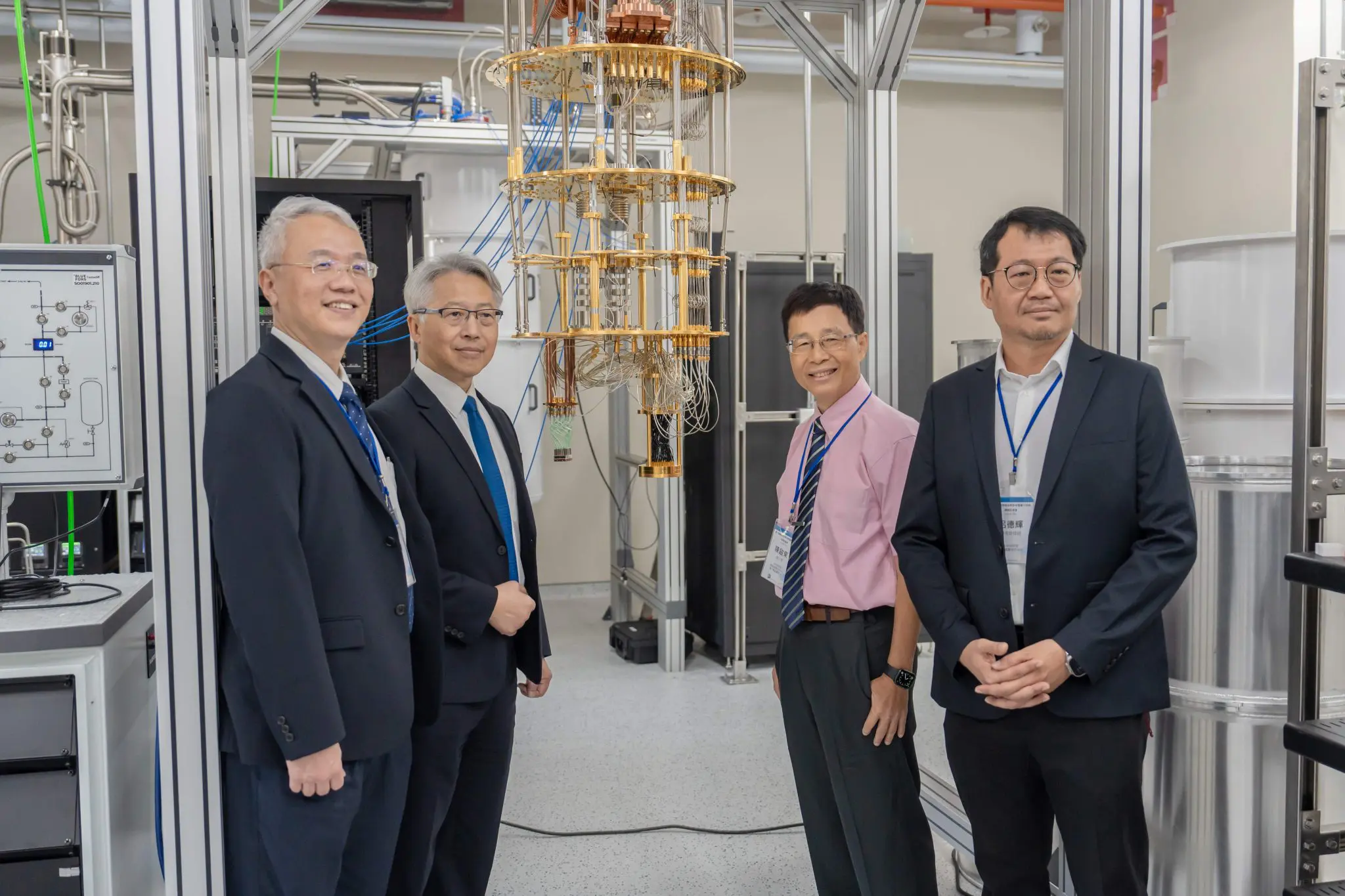
Academia Sinica in Taiwan announced advances in quantum computing chip fabrication, including the successful manufacture of superconducting qubits using eight-inch wafer processing. The institution simultaneously unveiled two new research facilities – the Quantum Chip Fabrication Space (QC-Fab) and the Quantum Computing Test Space (QC-Test) – located on its South Campus. These facilities will be open to the national academic and research communities.
Taiwan establishes a comprehensive quantum infrastructure with the launch of dedicated fabrication (QC-Fab) and testing (QC-Test) facilities, propelling its ambition to become a significant player in the burgeoning field of quantum technology. Researchers actively explore quantum algorithms for diverse applications, including materials science, drug discovery, and financial modelling. This holistic approach ensures that Taiwan remains competitive in all aspects of quantum technology, driving economic growth and enhancing national security.
The QC-Fab focuses on advancing superconducting qubit fabrication, while the QC-Test space rigorously characterises device performance and integrates hardware with emerging software solutions. These initiatives represent a strategic investment in building a vertically integrated quantum computing ecosystem, leveraging existing semiconductor expertise and fostering collaborative research. Collaboration with the Industrial Technology Research Institute (ITRI) and the Taiwan Semiconductor Research Institute (TSRI) leverages established expertise in semiconductor manufacturing to address the specific challenges of quantum device fabrication.
The QC-Fab addresses the critical need for scalable
The QC-Fab addresses the critical need for scalable qubit manufacturing by transitioning to eight-inch wafer processing, which accommodates increasing complexity and density. Maintaining uniformity across larger substrates proves paramount, directly impacting qubit coherence and overall performance, so advanced metrology and process control techniques become integral to the facility’s operations. Beyond scaling substrate size, the materials science underpinning superconducting qubit fabrication presents unique challenges, demanding precise control over film stoichiometry, interface quality, and defect density.
Minimising energy dissipation and maximising qubit lifetimes require innovative deposition and etching processes tailored to the specific materials used in fabrication. The QC-Test space complements fabrication efforts by providing comprehensive device characterisation beyond basic functionality, employing techniques such as microwave spectroscopy, single-shot readout, and coherence mapping. These advanced methods assess qubit performance metrics, identify sources of error, and guide iterative improvements in both hardware and fabrication processes.
Automated data acquisition and analysis pipelines efficiently process the large datasets generated during testing, accelerating the pace of discovery and enabling rapid prototyping of new designs. Parametric amplifiers, essential components in quantum readout schemes, demand stringent fabrication and characterisation, requiring precise control over impedance matching and electromagnetic shielding. Integrating parametric amplifier development within the QC-Fab and QC-Test facilities facilitates co-design and optimisation of the entire quantum circuit, enhancing signal fidelity and measurement accuracy.
This holistic approach ensures seamless integration of all
This holistic approach ensures seamless integration of all components within the quantum system, maximising overall performance. The availability of a five-qubit processor within the QC-Test space enables preliminary testing of quantum algorithms and benchmarking of device performance, providing a crucial platform for validating theoretical models and identifying areas for improvement. Researchers utilise this capability to explore the potential of quantum computation and refine algorithms for specific applications, accelerating the transition from research to practical implementation.
Furthermore, the facility serves as a valuable training ground for researchers and engineers, thereby fostering a skilled workforce in quantum technologies. This partnership encompasses the development of advanced lithography techniques, materials characterisation methods, and packaging technologies, accelerating innovation and reducing time to market. The combined resources of these institutions aim to establish a robust and sustainable quantum computing ecosystem within Taiwan.
External Link: Click Here For More