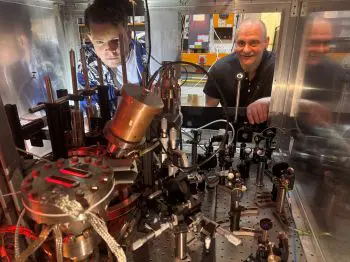
Researchers at the University of Sussex have developed a technique to detect electric fields with a sensitivity exceeding previous methods by two orders of magnitude – a hundredfold improvement – with potential for further enhancement to one million times current levels. Published on 11 June 2025 in Nature Physics, the discovery utilises a single charged atom within a vacuum system to achieve unprecedented measurement capability. While initially developed to mitigate electrical noise impacting quantum computer performance, the technology offers applications across multiple sectors including improved brain imaging for conditions like depression and epilepsy, underwater communication and detection, geological prospecting, and enhanced microscopy. The research was conducted at the Sussex Centre for Quantum Technologies and represents a significant advancement in quantum sensing capabilities.
Record-Breaking Electric Field Detection
Researchers at the University of Sussex have achieved a record level of sensitivity in electric field detection, surpassing previous capabilities by two orders of magnitude – a hundredfold improvement. This advancement utilises a single charged atom, or ion – an atom that has gained or lost electrons, giving it an electrical charge – held within a vacuum system, and employs a measurement approach developed by the university’s quantum computing team. Projections indicate a possible six-order-of-magnitude enhancement – a millionfold increase – through the implementation of alternative ion species and a newly developed microchip, suggesting considerable potential for further refinement.
The initial impetus for this research stemmed from the need to mitigate electric field noise, a limiting factor in the performance of quantum computers. By identifying and eliminating sources of this noise, researchers aim to construct quantum computers with world-leading specifications. However, the developed measurement device extends beyond quantum computing, offering applications across diverse sectors.
Enhanced electric field detection has significant implications for advanced brain imaging, potentially revolutionising neurological diagnostics and research. The technique could facilitate less intrusive and more detailed three-dimensional mapping of brain activity, improving diagnostic capabilities and furthering understanding of neurological processes. This improved resolution also benefits microscopy, enabling more accurate analysis of samples in healthcare settings and accelerating scientific discovery.
Beyond medical applications, the technology offers potential in underwater communication and submarine detection, where sensitivity to subtle electric fields is crucial for effective operation. Similarly, geological prospecting could benefit from the ability to detect minute electric field variations indicative of subsurface raw materials and mineral deposits, improving resource exploration.
The Sussex Centre for Quantum Technologies conducts this research, fostering collaboration between leading experts and innovative approaches to quantum challenges. The University of Sussex actively pursues the development of a ‘Quantum Valley’ in Sussex, positioning the university as a catalyst for economic growth and innovation in quantum technologies. This initiative includes comprehensive training programmes, such as a four-year undergraduate degree and the UK’s first online distance learning degree in quantum technology, designed to cultivate a skilled workforce for the future. These programmes aim to equip individuals with the expertise necessary to drive advancements in this rapidly evolving field.
More information
External Link: Click Here For More




See today’s quantum computing news on Quantum Zeitgeist for the latest breakthroughs in qubits, hardware, algorithms, and industry deals.