Researchers demonstrated 24 picosecond root mean square clock synchronisation between drones using satellite timing and entanglement, overcoming limitations imposed by drone size, weight and power. This protocol facilitates drone-based quantum key distribution and enables wide-area quantum networks without requiring precision reference clocks.
The demand for secure communication networks continues to escalate, prompting investigation into quantum key distribution (QKD) as a potential solution. Traditional fibre optic QKD systems are limited by infrastructure requirements and distance. Recent research explores the use of drones to distribute entangled photons, offering flexibility and broad coverage, but presents challenges in maintaining the precise timing necessary for secure key generation. A team led by researchers from Sun Yat-sen University, the National University of Defence Technology, and the Air Force Engineering University, detail a protocol for synchronising clocks between drones utilising Global Navigation Satellite System (GNSS) timing and entanglement-based correction. Their work, entitled ‘Clock Synchronization for Drone-Based Entanglement Quantum Key Distribution’, demonstrates 24 picosecond root mean square (RMS) synchronisation in dynamic free-space conditions, without reliance on a precision reference clock, and suggests a pathway towards scalable quantum networks.
Drone-Based Entanglement Distribution Achieves Picosecond Synchronization
The demand for secure communication is driving exploration of quantum technologies, with quantum key distribution (QKD) offering a physics-based approach to encryption. Traditional QKD systems, reliant on fibre optic cables, are limited in scenarios requiring mobility or broad geographical coverage. Drone-based platforms offer a flexible and rapidly deployable infrastructure; however, maintaining precise timing between airborne nodes presents significant challenges.
Precise clock synchronisation is fundamental to QKD security, as timing inaccuracies degrade the fidelity of quantum state measurements. Achieving this synchronisation on drones is complicated by limitations in Size, Weight, and Power (SWaP) and the effects of dynamic movement. We have developed a synchronisation protocol that overcomes these constraints, leveraging both nanosecond-accurate Global Navigation Satellite System (GNSS) timing and entanglement-based timing correction.
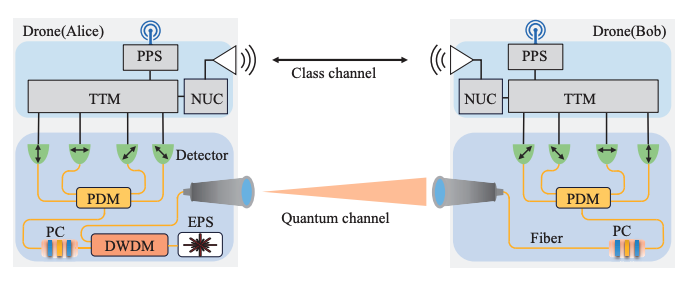
The system achieves 24 picosecond Root Mean Square (RMS) synchronisation in free-space channels experiencing distance variations, without requiring a precision reference clock onboard each drone. This is accomplished by combining a coarse time reference from GNSS with the refinement offered by entangled photon pairs generated and measured on each drone. The entangled photons establish a shared time reference, enabling precise synchronisation despite atmospheric disturbances and drone mobility.
The experimental setup consisted of two drones, each equipped with entangled photon sources and single-photon detectors, and was flown in a controlled environment that simulated realistic operating conditions. A time-to-digital converter (TDC) with 10 picoseconds resolution measured the arrival time difference of entangled photons, allowing estimation of synchronisation error.
The implications of this work extend beyond QKD. Precise synchronisation between mobile platforms has potential applications in distributed sensing, precision navigation, and fundamental physics research. This technology could enable advanced autonomous systems and intelligent infrastructure, facilitating collaborative data acquisition and real-time control. We envision a future where drone-based quantum networks provide secure and reliable communication for applications ranging from disaster relief and environmental monitoring to smart cities.
Future research will focus on improving system robustness to atmospheric disturbances, increasing the range of the quantum link, and integrating the technology into a fully functional QKD network. Exploring advanced entanglement sources, detection schemes, and satellite-based quantum repeaters will further enhance performance and extend the network range. The development of drone-based quantum networks represents a significant step towards realising the full potential of quantum technologies.
👉 More information
🗞 Clock Synchronization for Drone-Based Entanglement Quantum Key Distribution
🧠 DOI: https://doi.org/10.48550/arXiv.2506.07831
See today’s quantum computing news on Quantum Zeitgeist for the latest breakthroughs in qubits, hardware, algorithms, and industry deals.