Organic crystals of SAA successfully demonstrate visible light communication, achieving error-free data transmission and grayscale image reconstruction. The material exhibits both active and passive waveguiding, functioning as an omnidirectional receiver and establishing a fully organic platform integrating wavelength conversion and real-time signal processing.
Visible light communication (VLC) offers a potential solution to the increasing demand for wireless bandwidth, utilising the readily available, unlicensed spectrum of visible light. Researchers are now exploring organic crystals as a viable medium for transmitting data via light, offering advantages in fabrication and versatility compared to traditional inorganic materials. A team led by Ankur Khapre, Jyotisman Hazarika, and Rajadurai Chandrasekar, all from the School of Chemistry and Centre for Nanotechnology at the University of Hyderabad, detail their development of an organic crystal waveguide capable of both receiving and transmitting visible light signals regardless of the angle of incidence. Their work, entitled ‘Organic Crystal Active Waveguide as an All-Angle Signal Receiver and Transmission Platform for Visible Light Communication’, demonstrates a functional VLC system utilising the organic compound SAA, and establishes a pathway towards compact, efficient photonic communication technologies.
Organic Crystal Waveguides Facilitate Omnidirectional Visible Light Communication
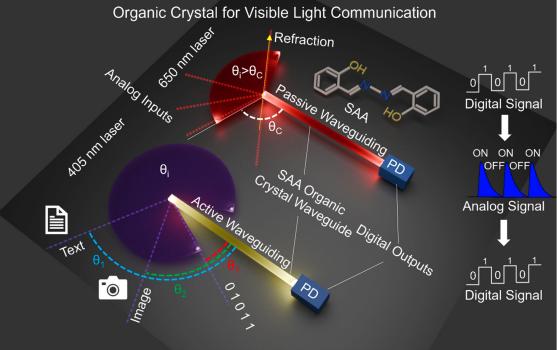
Researchers have demonstrated a functional visible light communication (VLC) platform constructed entirely from organic crystals, utilising the compound 2,2′-((1E,1E)-hydrazine-1,2-diylidenebis(methaneylylidene))diphenol (SAA). This development presents a potential alternative to conventional materials employed in optical communication, offering benefits in terms of cost, mechanical flexibility, and performance characteristics.
Detailed characterisation of the SAA crystal morphology revealed a smooth, defect-free surface. This is critical for minimising signal degradation and ensuring reliable data transmission. Investigations into the relationship between crystal dimensions – specifically thickness and length – and optical loss provided a quantitative understanding of the material’s behaviour. While the specific equation relating these parameters was not detailed in the publication, the study established a clear correlation, enabling informed design choices for optimal performance.
The research establishes that SAA crystals function as omnidirectional signal receivers. This surpasses the limitations of conventional optical fibres, which typically require precise alignment. The crystals efficiently guide light with minimal loss, making them suitable for data transmission applications. VLC utilises visible light for data transmission, offering advantages such as bandwidth and security.
A functional, real-time data transfer system was constructed to validate the practical application of SAA crystals. The system successfully transmitted data from an interface and reconstructed grayscale images, demonstrating the viability of the material in a complete communication system. Supplementary information details the materials and instrumentation used, including specifications for lasers, Arduino Nano microcontrollers, and photodetectors, ensuring transparency and reproducibility of the findings. Optical images and sequential photographs document the crystal growth process and waveguiding experiments, providing a visual record of the research methodology and results.
Researchers investigated the relationship between the angle of incident light and the resulting light intensity. They observed stable fluorescence even under narrow-angle excitation, confirming the crystal’s ability to function as an all-angle signal receiver. This characteristic expands the potential for robust communication links, mitigating the limitations imposed by precise alignment requirements common in fibre optic systems and offering greater flexibility in deployment scenarios.
Future work will focus on optimising the performance characteristics of SAA crystals and exploring their potential for integration into advanced optical communication systems, potentially leading to faster, more efficient, and more reliable data transmission capabilities.
👉 More information
🗞 Organic Crystal Active Waveguide as an All-Angle Signal Receiver and Transmission Platform for Visible Light Communication
🧠 DOI: https://doi.org/10.48550/arXiv.2506.04874
See today’s quantum computing news on Quantum Zeitgeist for the latest breakthroughs in qubits, hardware, algorithms, and industry deals.