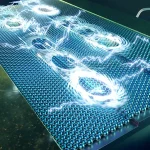
Symmetric open dynamics exhibit long-range entanglement even at infinite temperature. Researchers calculated several entanglement measures for these states, revealing a distinction in scaling behaviour: volume-law scaling for logarithmic negativity and exact entanglement cost, contrasted with subextensive scaling for other measures. This difference arises from Hilbert space fragmentation patterns.
The behaviour of quantum systems subject to strong symmetries reveals unexpected patterns of entanglement even in highly mixed states – those representing systems at thermal equilibrium. Researchers have demonstrated a hierarchy in how different measures of entanglement scale with system size for a specific class of these states, arising from models exhibiting ‘Hilbert space fragmentation’ – a phenomenon where the system breaks up into disconnected sectors. This work clarifies how the difficulty of preparing entangled states varies depending on the chosen measure, linking this to the underlying fragmentation of the system’s quantum state space. These findings are presented in a paper by Subhayan Sahu (Perimeter Institute for Theoretical Physics), Yahui Li (Technical University of Munich and Munich Center for Quantum Science and Technology), and Pablo Sala (California Institute of Technology and Walter Burke Institute for Theoretical Physics), entitled ‘Entanglement cost hierarchies in quantum fragmented mixed states’.
Entanglement Scaling in Symmetric Open Quantum Systems
Research details how conserved quantities govern entanglement characteristics in strongly symmetric, open quantum systems, even at infinite temperature. The study employs the commutant algebra framework to quantify several entanglement measures – including entanglement cost, squashed entanglement, and logarithmic negativity – for mixed states originating from systems displaying Hilbert space fragmentation. Researchers demonstrate that while logarithmic negativity and precise entanglement cost scale with system volume, entanglement of formation, squashed entanglement, and distillable entanglement exhibit subextensive scaling, revealing a fundamental difference in their response to system size.
Hilbert space fragmentation describes a breakdown of the usual connectivity between eigenstates of a quantum system, resulting in a proliferation of disconnected sectors. This fragmentation, the study establishes, directly correlates with the differing scaling behaviours of entanglement measures. Analytical results are presented for complex many-body systems, circumventing the computational difficulties typically associated with calculating entanglement in generic mixed states.
The work demonstrates the calculability of several bipartite entanglement measures for symmetric mixed states arising from fragmented systems, confirming that precise determination of entanglement properties remains possible within specific symmetry sectors. Calculations encompass entanglement of formation, squashed entanglement, entanglement cost, and distillable entanglement, revealing a distinction in scaling behaviour. Researchers attribute this divergence to the exponentially large commutant algebra – the set of operators that commute with the system’s Hamiltonian – which restricts the accessible state space.
The observed separation in scaling directly links to a parametric difference between the entanglement cost of preparing states exactly versus asymptotically. This implies that approximating states with truncated representations introduces a quantifiable loss of entanglement resource. The entanglement cost represents the minimum number of maximally entangled pairs required to create a given state.
Further investigation could focus on extending these calculations to systems with different symmetry groups and fragmentation patterns. Exploring the implications of this entanglement scaling for quantum information processing tasks, such as quantum error correction and state transfer, also represents a promising avenue for future research.
👉 More information
🗞 Entanglement cost hierarchies in quantum fragmented mixed states
🧠 DOI: https://doi.org/10.48550/arXiv.2506.04637



See today’s quantum computing news on Quantum Zeitgeist for the latest breakthroughs in qubits, hardware, algorithms, and industry deals.