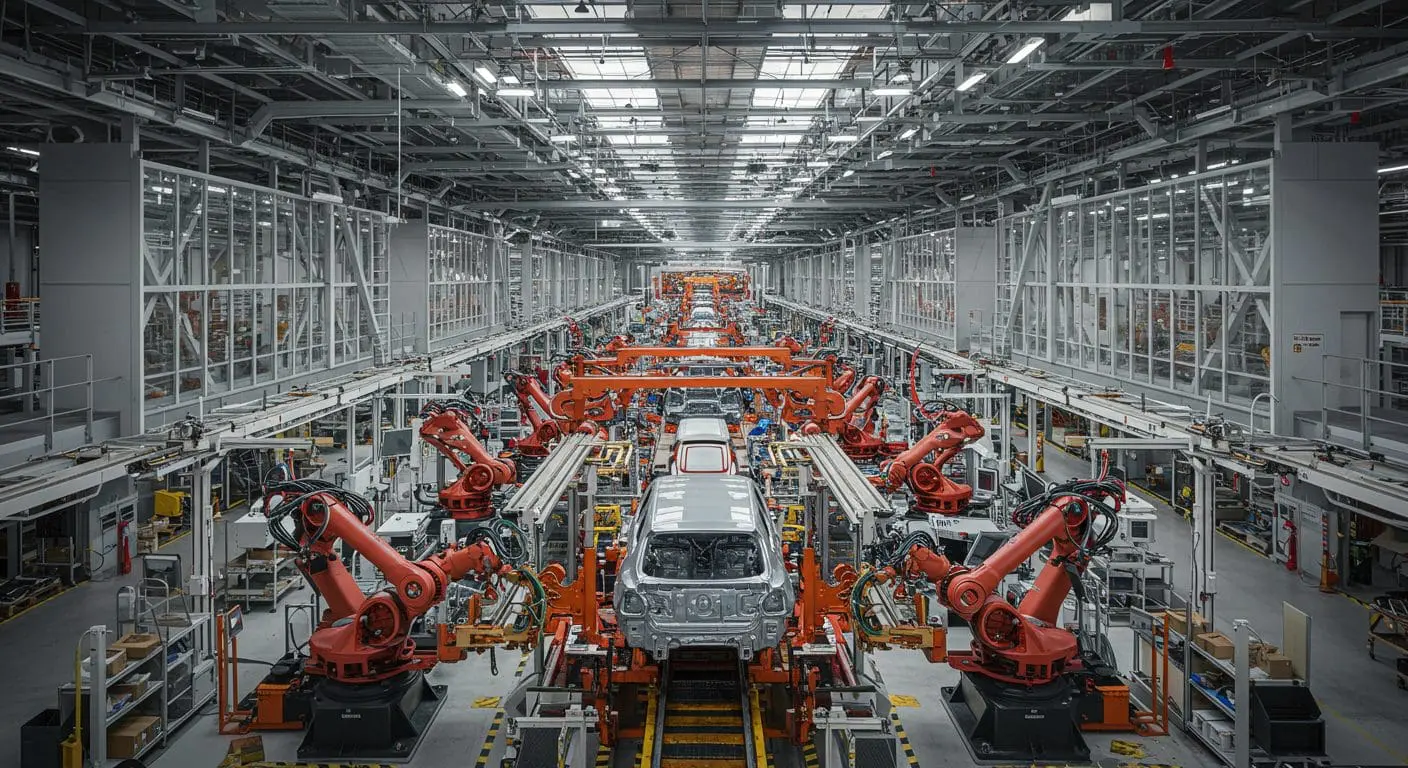
Agentic AI, integrated with intent-based networking, simplifies industrial automation by translating high-level operational goals into actionable tasks for specialised agents. A proof-of-concept, utilising predictive maintenance and the CMAPSS dataset, demonstrates feasible autonomous decision-making, despite ongoing challenges regarding data quality and transparency.
The pursuit of adaptable and intuitive automation within industrial settings is evolving beyond pre-programmed routines. Researchers are now investigating systems capable of interpreting high-level objectives – ‘intents’ – and autonomously translating them into actionable tasks. This approach seeks to bridge the gap between human oversight and complex machine operation, aligning with the principles of Industry 5.0 which prioritises human-centric, sustainable and resilient manufacturing. Marcos Lima Romero and Ricardo Suyama, from the Federal University of ABC (UFABC) in Brazil, detail this work in their article, ‘Agentic AI for Intent-Based Industrial Automation’, exploring a conceptual framework integrating autonomous large language models with intent-based networking principles to simplify human-machine interaction and enable scalable predictive maintenance.
Integrating Agentic AI and Intent-Based Automation for Industry 5.0
The increasing complexity of Industry 4.0 systems necessitates new approaches to automation. This work presents a framework integrating Agentic AI – artificial intelligence systems leveraging autonomous large language models – with intent-based automation, aiming to facilitate a transition towards the human-centric principles of Industry 5.0. The research proposes a system that simplifies human-machine interaction (HMI) by enabling operators to define high-level goals, rather than detailed instructions, for automation systems.
The framework translates human-defined intents – representing business or operational objectives – into actionable components, mirroring concepts from network research where intent-based networking automates network configuration based on desired outcomes, rather than manual settings. These intents decompose into specific elements – expectations, conditions, targets, context, and relevant information – which then guide specialised ‘sub-agents’ in performing domain-specific tasks. This effectively bridges the gap between human goals and automated execution, reducing the need for detailed programming and intervention, and allowing for a more dynamic and responsive industrial environment.
A proof-of-concept implementation utilises the CMAPSS dataset – a commonly used dataset for predictive maintenance – and Google’s Agent Developer Kit. This demonstrates the feasibility of automatically decomposing complex intents, orchestrating multiple agents, and enabling autonomous decision-making within a predictive maintenance scenario. The system successfully translates high-level goals, such as ‘predict potential engine failures’, into a series of actions performed by individual agents responsible for data analysis, anomaly detection, and predictive modelling.
This research builds upon existing work in both Agentic AI and intent-based systems, integrating these concepts to address the specific challenges of industrial automation. It draws on a diverse range of sources, including conference proceedings from IEEE’s Vehicular Technology and Industrial Electronics Society conferences, and technical reports from industry consortia like the TM Forum.
Future work will likely focus on addressing limitations to ensure the reliability and trustworthiness of these increasingly autonomous systems, paving the way for scalable and adaptable automation solutions aligned with the principles of Industry 5.0. Investigating methods for robust data validation and incorporating explainable AI (XAI) techniques are crucial steps. Expanding the range of tools available to agents and developing mechanisms for collaborative agent interaction represent additional avenues for investigation. Quantifying the benefits of this approach in terms of efficiency gains, cost reductions, and improved sustainability metrics will be essential for demonstrating its practical value.
The system effectively translates high-level objectives into concrete actions, suggesting a pathway towards more adaptable and user-friendly industrial processes. While the research confirms the potential of this intent-driven automation, it also acknowledges existing challenges related to data quality and the need for improved explainability in agent decision-making.
👉 More information
🗞 Agentic AI for Intent-Based Industrial Automation
🧠 DOI: https://doi.org/10.48550/arXiv.2506.04980
See today’s quantum computing news on Quantum Zeitgeist for the latest breakthroughs in qubits, hardware, algorithms, and industry deals.