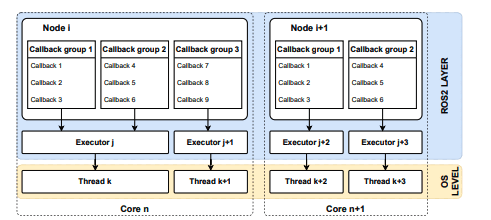
ROSGuard presents a portable timing interference control mechanism for Robotic Operating System 2 (ROS2) applications. Deployed on an AGX Orin platform, it effectively regulates bandwidth consumption, achieving performance comparable to finer-grained solutions while simplifying implementation for modular, less time-critical systems.
Controlling interference between computational tasks is crucial for reliable operation in complex systems, particularly those demanding precise timing. Researchers are now addressing this challenge within the context of the Robotic Operating System 2 (ROS2), a flexible framework increasingly used beyond robotics in diverse industrial applications. Jon Altonaga Puente, Enrico Mezzetti, Irune Agirre Troncoso, Jaume Abella Ferrer, and Francisco J. Cazorla Almeida detail their development of ROSGuard, a bandwidth regulation mechanism designed for ROS2-based applications, in their paper “ROSGuard: A Bandwidth Regulation Mechanism for ROS2-based Applications”. Their work, conducted across Ikerlan and the Barcelona Supercomputing Center, presents a portable solution for managing timing interference, achieving performance comparable to more complex, fine-grained approaches on an AGX Orin platform.
Mitigating Timing Interference in Modular Robotic Systems with ROSGuard
Research increasingly focuses on adapting the Robotic Operating System 2 (ROS 2) for time-critical applications, particularly those requiring functional safety certification, such as automotive systems. A key challenge lies in mitigating timing interference – contention for shared hardware resources that compromises predictable system behaviour. Several approaches investigate bandwidth control and regulation as methods to address these effects, enabling more reliable and deterministic robotic systems.
This work introduces ROSGuard, a portable implementation of a timing interference monitoring and control mechanism designed for ROS 2 applications. ROSGuard operates on a generic Linux-based software stack and leverages the modularity of ROS 2 to achieve effective bandwidth regulation, offering an advantage over traditionally complex configurations. Unlike many existing solutions requiring fine-grained, microsecond-level control, ROSGuard prioritises portability and applies effective regulation under less restrictive configurations, broadening its applicability to a wider range of industrial applications.
The authors deploy ROSGuard on an NVIDIA AGX Orin platform – a representative target for complex, distributed AI-based applications – and demonstrate its effectiveness in mitigating timing interference. Through synthetic and real-world benchmarks, they show that ROSGuard achieves comparable effectiveness to more specialised, finer-grained solutions, while offering significantly improved portability and ease of deployment. This suggests that a balance between precision and portability is achievable, enabling the deployment of ROS 2 in applications where predictable timing is crucial but absolute precision is not always necessary.
Further research builds upon existing work in resource isolation, contention management, and hardware acceleration, exploring techniques such as hypervisors, partitioning, and hardware Quality of Service (QoS) mechanisms to enhance the real-time capabilities of ROS 2. The focus remains on enabling the use of ROS 2 in safety-critical systems while maintaining the flexibility and modularity that define the framework, ultimately driving innovation in robotics and automation.
This work demonstrates the viability of ROSGuard as a portable timing interference monitoring and control mechanism integrated within a ROS 2 framework. It confirms that effective bandwidth regulation, traditionally reliant on fine-grained, specialised configurations, can be achieved using a more generalised and portable approach. ROSGuard successfully mitigates timing interference on an AGX Orin platform, demonstrating comparable performance to state-of-the-art, highly-configured solutions, and validating its potential for widespread adoption. The implementation leverages existing abstractions within a standard Linux-based software stack and the ROS 2 layer, facilitating broad applicability beyond robotics to a wider range of industrial applications.
Benchmarking, utilising both synthetic and real-world scenarios, validates the system’s ability to maintain performance under contention for shared hardware resources, addressing a critical concern for time-critical applications where predictable timing behaviour is paramount. This research highlights the potential for simplifying the deployment of bandwidth control mechanisms in modular, productised ROS 2 applications, reducing the complexity associated with fine-grained configurations and lowering the barrier to entry for implementing timing interference mitigation strategies. By achieving comparable performance metrics without sacrificing portability, ROSGuard presents a compelling solution for developers seeking to build reliable and deterministic robotic systems.
Ongoing research promises to unlock the full potential of ROS 2 in a wide range of applications, from robotics and automation to autonomous vehicles and industrial control systems. Further validation of its portability and general applicability would be achieved by testing on a wider range of platforms.
👉 More information
🗞 ROSGuard: A Bandwidth Regulation Mechanism for ROS2-based Applications
🧠 DOI: https://doi.org/10.48550/arXiv.2506.04640



See today’s quantum computing news on Quantum Zeitgeist for the latest breakthroughs in qubits, hardware, algorithms, and industry deals.