
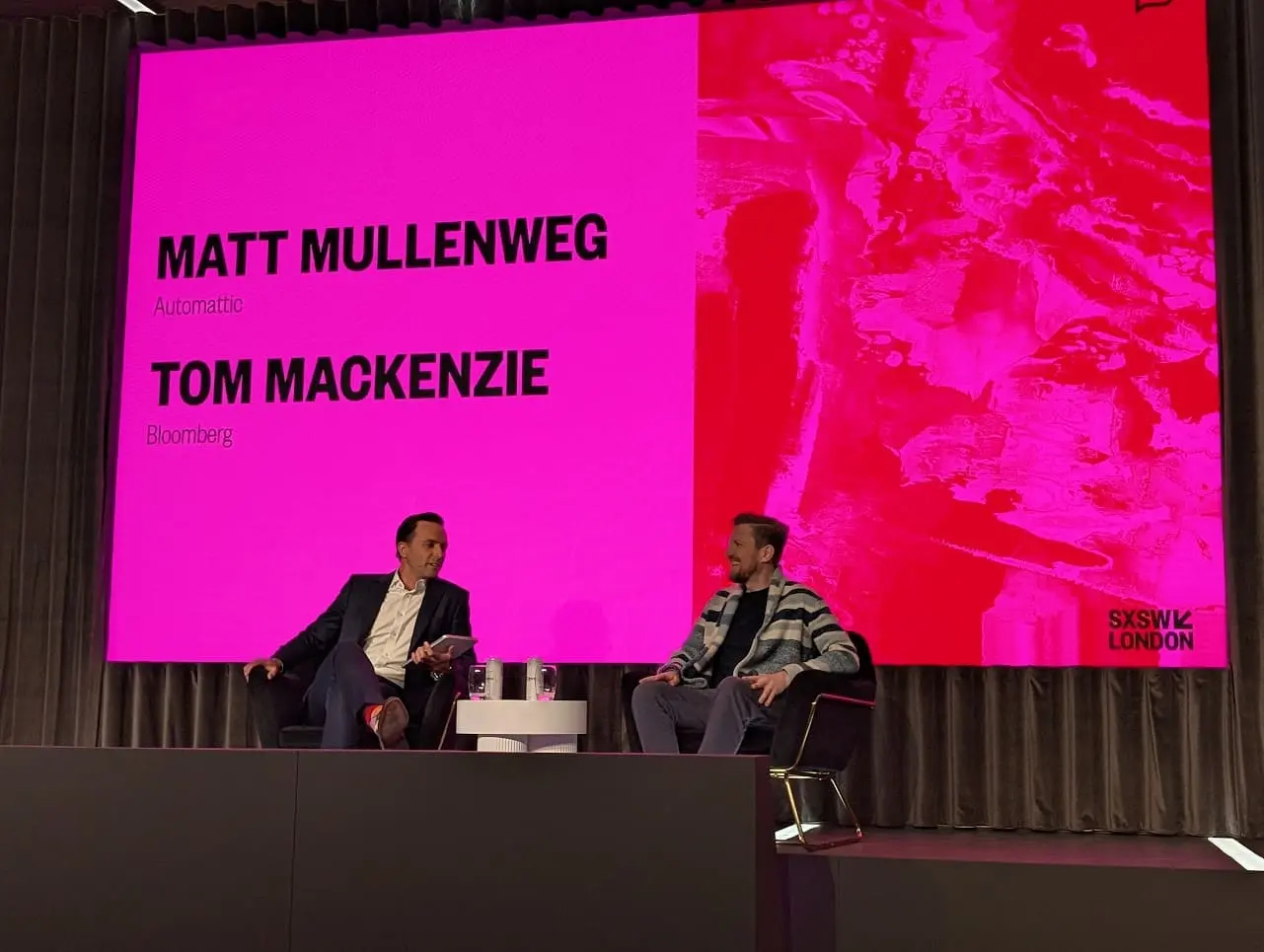
Matt Mullenweg argues that transparency and user control will prove decisive in the battle for the Internet’s future infrastructure.
London — In a digital landscape increasingly dominated by closed, proprietary systems, Matt Mullenweg remains an unwavering evangelist for open source technology. Speaking at SXSW London, the co-founder of WordPress and chief executive of Automattic made a compelling case that transparency and user autonomy will ultimately triumph over the walled gardens of Big Tech.
Mullenweg’s conviction carries considerable weight. WordPress now powers “42%, 43% of the world’s websites,” including those of the White House, NASA, Beyoncé, and the Rolling Stones. Automattic, the company where WordPress.com sits, commands a valuation of $7bn, making it one of the most valuable privately-held technology companies focused on open source software.
Yet for all WordPress’s success, Mullenweg acknowledges the platform operates as “the dark matter of the web” — ubiquitous but largely invisible to end users. “By design, when you’re on a WordPress site, it’s about you,” he explained. “It’s not about just another profile page on a social network that looks like every other profile page.”
This philosophy of user empowerment extends far beyond website creation. As artificial intelligence reshapes the technology landscape, Mullenweg sees open source principles as essential safeguards for digital freedom in an era when “software and algorithms are now driving our cars, cooking our food, teaching us, telling us” and “training our kids.”
The Four Freedoms of Digital Autonomy
Central to Mullenweg’s worldview are what he calls the “four freedoms” of open source software: the ability to use software for any purpose, to examine how it works, to modify it, and to distribute those modifications. These principles, he argues, constitute “like the Bill of Rights for software” and represent “the coolest hack that he once come up with to ensure like digital autonomy and agency as we go forward.”
The stakes of this philosophy are rising as technology becomes more intimate and pervasive. “As technology becomes more and more important, possibly even embedded in our brains, I want that chip in my brain to be open source,” Mullenweg declared. “I don’t want it to be getting like firmware updates from some random” company without transparency or user control.
This perspective puts Mullenweg at odds with much of Silicon Valley’s current trajectory toward proprietary AI systems. While companies like OpenAI, Anthropic, and Google’s DeepMind have largely embraced closed development models, Mullenweg points to emerging alternatives like DeepSeek, which he describes as “as capable as GPT 3.5 and 4.4 in some cases” while being “fully open source, open weights, every possible way it can be opened.”
The existence of capable open models challenges the safety arguments that have justified proprietary approaches. “A lot of the predicted dangers have not come to bear,” Mullenweg observed, noting that apocalyptic scenarios discussed at technology gatherings — where people would casually share their “P-doom,” or probability of world ending — have not materialised as open models have proliferated.
AI’s Double-Edged Impact on Development
The conversation around artificial intelligence’s impact on software development reveals both opportunity and disruption. For Mullenweg, who spent his first 15 years “convinced tens of thousands of more people to learn how to code,” the emergence of AI coding assistants initially gave him pause. But he has returned to advocating for programming literacy, albeit with a evolved perspective.
“I do believe you should think of it like learning a language,” he explained. “Coding and programming is also a way of thinking.” While AI can enable “vibey vibe coding” — creating software without deep understanding — Mullenweg argues this approach “will pale in comparison to what the folks who can prompt and vibe code with a knowledge and understanding of what the agents are doing.”
This nuanced view reflects the complex dynamics reshaping the technology workforce. While individual companies may find AI deflationary for development costs, Mullenweg predicts the historical pattern will hold: “Just like with every new technology, the opportunities it creates are probably going to outpace that initial deflationary trend.”
The key insight is that “the people who are fluent with AI will win over the candidates who aren’t every single time.” This creates both challenge and opportunity for WordPress’s ecosystem of developers and users.
Strategic Advantages in an AI-First World
For WordPress itself, artificial intelligence presents significant strategic advantages. The platform’s open source nature makes it ideal training data for AI systems, avoiding the copyright complexities that plague other content sources. “Some of the safest stuff in the world to train on is open source code,” Mullenweg noted. WordPress’s codebase and “all 60,000 plugins and themes are all GPL” licensed, meaning AI models can safely learn from them.
This has practical implications: “Even early versions, you can say, right here, WordPress plugin, and it just would one-shot it,” meaning AI can generate functional WordPress plugins with a single prompt. This capability democratises development while strengthening WordPress’s position as AI tools proliferate.
More broadly, Mullenweg sees AI driving increased demand for websites and personal publishing platforms. “If you have any sort of business, it’s actually going to be more important to have a place that you control that has kind of your data,” he argued. This reflects growing concerns about platform dependency, as social networks “come and go” and may “close down your data or make it less accessible.”
Privacy and Control in the Cloud Era
The conversation around data control touches on fundamental questions about privacy and user autonomy. While acknowledging that “we’re all putting stuff in the cloud,” Mullenweg emphasises the importance of user choice and transparency. “There’s some things I would never put in the cloud,” he said, particularly criticising advertising-driven business models that require extensive data collection.
When building open source, customer-centric companies, Mullenweg argues, “my first concern when building things as an engineer, and I actually feel this is an ethical obligation, is to make sure it is the most secure and the most privacy preserving. Because privacy is a human right.”
This philosophy extends to Automattic’s product development, particularly in applications like Day One, the journaling app that uses “the same encryption as like a 1 password” and “syncs to all your devices” while keeping data local and private.
The Broader Platform Strategy
Beyond WordPress, Automattic has assembled a portfolio of platforms that embody open web principles. The company owns Tumblr, WooCommerce (which competes with Shopify), and several mobile applications focused on personal publishing and privacy.
Day One represents Mullenweg’s vision for AI integration done right: a fully encrypted journaling platform that could leverage local AI models to provide personalised insights without compromising privacy. “Imagine now if that’s all that journal, essentially your second brain downloaded… was available to a local index on your cloud device, a local elbow. You don’t have to put it in the cloud.”
This approach contrasts sharply with cloud-first AI services that require uploading personal data to external servers. “You probably shouldn’t put this stuff ever in the cloud, because a lot of stuff gets hacked,” Mullenweg warned.
Looking Forward: The 58 Percent Challenge
Despite WordPress’s commanding market position, Mullenweg maintains an expansionist mindset. “We often say, you know, 42 percent is cool, but 58 percent, there’s a lot of work ahead,” he noted, expressing continued ambition to grow the platform’s reach.
This growth trajectory faces new challenges as no-code and AI-powered website builders lower barriers to entry. Rather than viewing this as a threat, Mullenweg sees it as validation of WordPress’s approach and an opportunity to serve a broader market of creators who want more control over their digital presence.
The fundamental question, as Mullenweg frames it, is whether the internet’s future will be defined by a handful of centralised platforms or by a diverse ecosystem of user-controlled websites and applications. With artificial intelligence accelerating both centralisation and democratisation trends, the outcome of this contest will shape not just how we build websites, but how we interact with technology in our daily lives.
For Mullenweg, the answer remains clear: “I believe it’s our obligation as a company to build these things in a super secure way” that preserves user autonomy and choice. Whether this vision can compete with the convenience and resources of Big Tech platforms will determine not just WordPress’s future, but the broader trajectory of the open web.
As technology becomes increasingly embedded in human experience, the principles Mullenweg champions — transparency, user control, and open collaboration — may prove to be not just idealistic goals, but practical necessities for maintaining digital freedom in an AI-driven world.