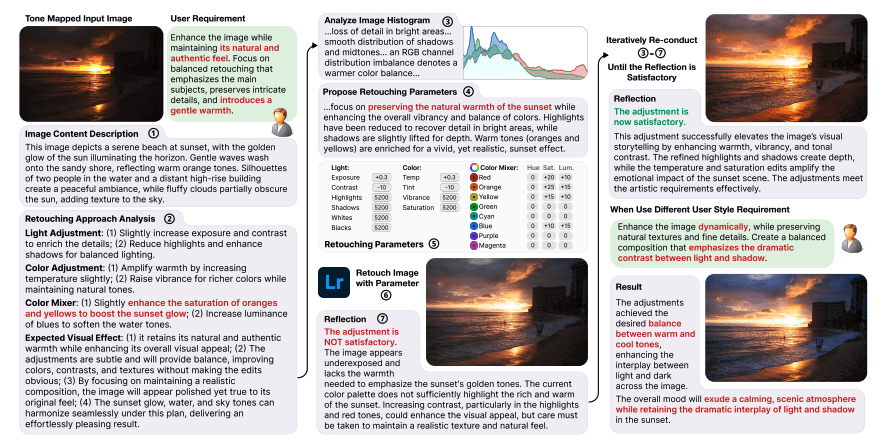
PhotoArtAgent, an intelligent system integrating vision-language models and reasoning, emulates professional artistic retouching. It analyses images, plans adjustments via Lightroom, and iteratively refines results with transparent textual explanations. User studies demonstrate performance that exceeds existing automated tools and approaches that of human artists.
The pursuit of automated image editing typically prioritises technical correction and aesthetic enhancement. However, replicating the nuanced, interpretative process of a skilled photographic artist presents a significant challenge. Researchers are now demonstrating a system capable of emulating artistic decision-making during photo retouching, moving beyond simple algorithmic adjustments to incorporate explicit reasoning and iterative refinement. Haoyu Chen, Keda Tao, Yizao Wang, Xinlei Wang, Lei Zhu, and Jinjin Gu, collaborating across institutions including The Hong Kong University of Science and Technology (Guangzhou), Xidian University, and the University of Sydney, detail their work in the article “PhotoArtAgent: Intelligent Photo Retouching with Language Model-Based Artist Agents”, presenting a system that leverages Vision-Language Models (VLMs) to analyse images, formulate retouching plans, and transparently explain its creative choices via textual rationales.
Intelligent Retouching: An Agent-Based Approach to Photographic Artistry
The creation of compelling imagery necessitates both technical proficiency and artistic judgement. PhotoArtAgent represents a new approach to photographic retouching, moving beyond simple automated correction to emulate the nuanced decision-making of a professional artist. This is achieved through the integration of Vision-Language Models (VLMs) and reasoned planning, resulting in a system capable of interpreting artistic direction and executing it within a professional editing environment.
PhotoArtAgent analyses images with an artistic sensibility, formulating retouching plans and precisely adjusting parameters within Adobe Lightroom via its Application Programming Interface (API). Crucially, the system provides clear, text-based explanations of its creative choices, facilitating user interaction and control. Experimental results indicate that PhotoArtAgent surpasses existing automated tools in user evaluations and achieves results comparable to those of professional human retouchers.
The system prioritises subtle enhancements that maintain a natural aesthetic, mirroring the approach of skilled practitioners. Retouching plans, whether executed by a human or an artificial intelligence, typically focus on balanced light and colour, accentuating architectural details and avoiding the hallmarks of over-processing. PhotoArtAgent operates through a defined sequence: initial light adjustments addressing exposure, contrast, highlights and shadows, followed by colour refinement using temperature and vibrance controls, and finally, fine-tuning of specific colours via individual Hue, Saturation, and Luminance (HSL) adjustments – often favouring enhancements to gold/orange tones and desaturation of reds.
The core innovation resides in the agent’s capacity to interpret high-level, natural language instructions – for example, “Warm the temperature slightly to enhance the golden tones” – and translate these into specific parameter settings. This contrasts with simpler automated tools such as Lookup Tables (LUTs) – pre-defined colour grading presets – or even Adobe Lightroom’s own auto-retouching features, and potentially offers a more sophisticated approach than algorithmic methods like TSFlow3D.
A key aspect of the research involved experimentation with the ‘Temperature’ parameter within the language model itself, influencing the creativity and stylistic variation of the retouching results. This ‘temperature’ parameter controls the randomness of the model’s output. A lower temperature encourages deterministic adjustments, producing consistent results, while a higher temperature introduces greater creative variation, allowing users to tailor the retouching process to their specific preferences. Researchers tested different temperature settings, including a default value and zero, to understand how language model configuration impacts the quality and artistic expression of the retouching process.
The system evaluates the resulting images after each adjustment, comparing them to the desired aesthetic and iteratively refining the parameters until the goal is achieved. This iterative refinement process ensures that the final image aligns with the intended artistic vision, delivering a polished and professional result. The emphasis on transparency and user interaction positions PhotoArtAgent as a tool that augments creativity rather than replacing it.
The ability to understand and control the system’s actions distinguishes PhotoArtAgent from traditional automated tools. This transparency empowers users to understand the rationale behind each adjustment, fostering a deeper understanding of the retouching process and enabling them to fine-tune the results to their liking. The system actively provides insight into its decision-making process, a feature absent in many existing automated solutions.
👉 More information
🗞 PhotoArtAgent: Intelligent Photo Retouching with Language Model-Based Artist Agents
🧠 DOI: https://doi.org/10.48550/arXiv.2505.23130



See today’s quantum computing news on Quantum Zeitgeist for the latest breakthroughs in qubits, hardware, algorithms, and industry deals.