Researchers developed DiffER, a novel retrosynthesis prediction method utilising categorical diffusion models to predict entire SMILES sequences representing chemical reactants simultaneously. This template-free approach achieves state-of-the-art top-1 accuracy and competitive performance across other top-k metrics, demonstrating improved confidence and likelihood in reaction prediction.
The efficient discovery of chemical synthesis routes remains a significant challenge in areas ranging from drug development to materials science. Researchers are increasingly employing machine learning techniques to automate retrosynthesis—the process of identifying precursor molecules required to synthesise a target compound. A team from The Ohio State University, comprising Sean Current, Ziqi Chen, Daniel Adu-Ampratwum, Xia Ning, and Srinivasan Parthasarathy, present a novel approach to this problem in their paper, ‘DiffER: Categorical Diffusion for Chemical Retrosynthesis’. Their work details DiffER, a template-free method utilising categorical diffusion models to predict entire reaction pathways simultaneously, offering an alternative to conventional autoregressive techniques and establishing a new benchmark for performance in top-k accuracy metrics.
Diffusion Models Advance Automated Retrosynthesis
Automated retrosynthesis, the computational prediction of precursor molecules required to synthesise a target compound, is increasingly reliant on diffusion models and refined molecular representations. Deep learning methodologies, notably transformer networks and graph neural networks (GNNs), are central to this progress, translating between SMILES (Simplified Molecular Input Line Entry System) notations – a linear notation for describing the structure of molecules – to facilitate automated route prediction.
Current research demonstrably focuses on automating retrosynthetic analysis, a computationally intensive process. Analysis of recent literature reveals a clear trend: deep learning, particularly transformer networks and GNNs, currently dominates the field, providing powerful tools for molecular representation.
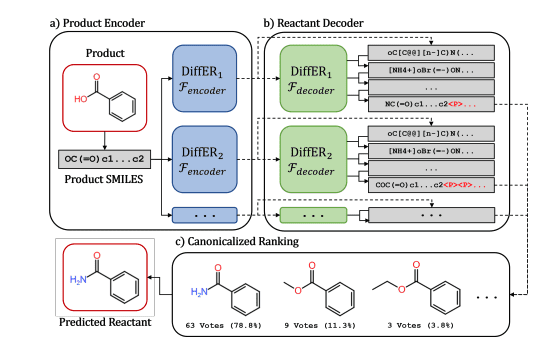
Researchers have now introduced DiffER (Diffusion for Efficient Retrosynthesis), a template-free method employing categorical diffusion to predict entire SMILES sequences simultaneously. This represents a departure from traditional sequential approaches, where the molecule is built step-by-step. DiffER constructs an ensemble of diffusion models – multiple models working in concert – achieving state-of-the-art performance in top-1 accuracy – correctly predicting the most likely reactant – and competitive results for top-3, top-5, and top-10 accuracy metrics when compared to other template-free methods. This establishes DiffER as a robust baseline for a new class of template-free retrosynthetic models, capable of learning diverse synthetic techniques commonly used in laboratory settings and offering a valuable tool for chemists.
The method approximates sampling from the posterior distribution of reactants, generating predictions with strong confidence and likelihood metrics, and providing a more reliable and robust approach to automated retrosynthesis. Analyses reveal that accurate prediction of the SMILES sequence length significantly boosts the performance of categorical diffusion models, highlighting the importance of incorporating length prediction as a key component in improving model accuracy.
Researchers continue to refine molecular representation techniques, striving to encode molecular structures in a manner suitable for machine learning algorithms and maximising the predictive power of these models. The success of DiffER, achieved through an ensemble of diffusion models incorporating a novel length prediction component, highlights the importance of accurately estimating SMILES sequence length for boosting predictive capabilities.
Ongoing research investigates novel architectures for diffusion models and explores methods to improve the robustness and generalisability of these models, particularly in handling complex or unusual chemical structures. Further research into quantifying prediction uncertainty and developing methods for incorporating experimental data could significantly enhance the practical utility of automated retrosynthesis tools, bridging the gap between computational prediction and laboratory synthesis. This ongoing research promises to accelerate the discovery of novel chemical syntheses and streamline the process of drug discovery and materials science.
👉 More information
🗞 DiffER: Categorical Diffusion for Chemical Retrosynthesis
🧠 DOI: https://doi.org/10.48550/arXiv.2505.23721