DeepRTE, a new neural network, accurately and efficiently solves the Radiative Transfer Equation – a complex equation governing radiation propagation relevant to fields including atmospheric science, neutron transport and medical imaging. Numerical experiments demonstrate the framework’s effectiveness in modelling radiative phenomena.
Modelling Radiation Propagation with Neural Networks
Accurate modelling of radiative transfer – the process by which energy is transported via photons in a medium – is crucial across a range of scientific and engineering disciplines, from climate modelling and medical imaging to nuclear reactor design. Traditionally solved using computationally intensive methods, researchers are now exploring machine learning techniques to accelerate and refine these calculations. A new approach, detailed in a recent study, utilises pre-trained attention-based neural networks to solve the steady-state Radiative Transfer Equation (RTE). This equation describes how radiation propagates through a participating medium – a substance that both emits and absorbs radiation. Yekun Zhu, Min Tang, and Zheng Ma present their framework, termed DeepRTE, demonstrating its accuracy and efficiency through numerical experimentation.
DeepRTE: A Neural Network Solution to the Radiative Transfer Equation
This study presents DeepRTE, a novel approach utilising attention-based neural networks to solve the steady-state Radiative Transfer Equation (RTE). The RTE describes the propagation of radiation within a participating medium and finds application in fields ranging from neutron transport and atmospheric science to heat transfer and medical imaging. Researchers demonstrate that DeepRTE achieves high accuracy and efficiency, potentially enabling real-time simulations and facilitating the solution of inverse problems.
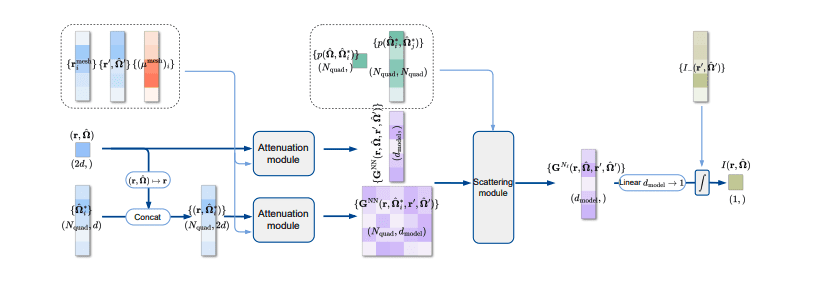
The core of DeepRTE lies in the utilisation of pre-trained attention-based neural networks, which learn to approximate the solution operator of the RTE. These networks map input parameters – such as source functions, scattering coefficients, and boundary conditions – to the resulting radiation field, representing a departure from traditional methods. Traditional methods often rely on computationally intensive numerical schemes like Monte Carlo or discrete ordinates methods, which can struggle with complex geometries and high dimensionality.
Monte Carlo methods solve the RTE by simulating the paths of a large number of photons or particles, relying on statistical averaging to determine the radiation field. Discrete ordinates methods, conversely, discretise the angular space and solve the RTE as a set of coupled equations. Both approaches can become computationally prohibitive as the complexity of the problem increases. DeepRTE, by learning the mapping between inputs and outputs, offers a potential pathway to significantly reduce computational cost.
A significant body of work underpins this research, encompassing both established radiative transfer theory and modern computational techniques. Foundational texts by Lewis & Miller (1993) and Lux (2018) detail core methods for solving the transport equation, providing a solid theoretical foundation. Further refinement comes from work on efficient numerical schemes, such as that by Zeytounian (2002), and research into optimisation algorithms.
The bibliography highlights a strong foundation in both established particle transport methodologies and emerging machine learning techniques, demonstrating a comprehensive understanding of the field. Core texts on neutron and particle transport, alongside research into radiative transfer, demonstrate a comprehensive understanding of the physical principles involved. The inclusion of papers on TensorFlow indicates a deliberate exploration of machine learning’s potential to accelerate and refine existing simulation techniques.
Future work will focus on extending DeepRTE to handle time-dependent radiative transfer problems, incorporating more complex scattering models, and exploring its application to three-dimensional geometries, expanding its capabilities and applicability. Investigating the framework’s generalisability to different physical systems, such as heat transfer and diffusion processes, also presents a promising avenue for research. Furthermore, exploring hybrid approaches that combine the strengths of DeepRTE with traditional numerical methods could yield even more robust and efficient solutions.
Numerical experiments validate the performance of DeepRTE, confirming its ability to accurately model radiation transport phenomena, which is essential for reliable simulations. The framework effectively addresses the challenges inherent in solving the RTE, particularly those associated with complex geometries and scattering media.
👉 More information
🗞 DeepRTE: Pre-trained Attention-based Neural Network for Radiative Tranfer
🧠 DOI: https://doi.org/10.48550/arXiv.2505.23190