Recent observations of exoplanets and protoplanetary disks reveal magnetohydrodynamic (MHD) disk winds, rather than turbulence, are central to planet formation. These winds influence disk evolution, angular momentum transport, and ultimately, the atmospheric composition, radii, and orbits of exoplanets, offering testable predictions for future observations.
The study of exoplanets – planets orbiting stars beyond our Sun – has rapidly matured from detection to characterisation. Current research focuses on understanding how the observed diversity of exoplanetary systems arises from the conditions within the protoplanetary discs where planets are born. A comprehensive review by Pudritz, Cridland, Inglis, and Alessi synthesises recent observational data – including results from the Atacama Large Millimeter/submillimeter Array (ALMA) and the James Webb Space Telescope – with theoretical modelling to propose a revised framework for planet formation. Their work, entitled ‘Connecting Planetary Composition with Formation: a New Paradigm Emerges’, suggests magnetohydrodynamic (MHD) disk winds, rather than turbulence, are the primary driver of disc evolution and, consequently, influence planetary characteristics such as atmospheric composition, radius, and orbital properties.
Magnetohydrodynamic Winds as a Key Driver of Planet Formation
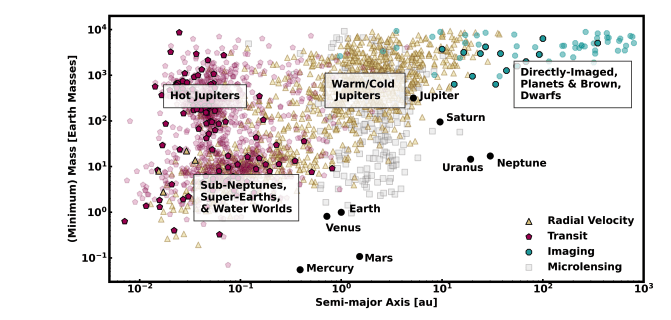
A substantial body of research now details the characteristics of thousands of exoplanets – planets orbiting stars other than our Sun – revealing their radii, masses, and orbital parameters. Increasingly, investigations extend to the composition of both planetary atmospheres and cores. This data informs studies into how these properties relate to the planet formation process within protoplanetary discs – rotating structures of gas and dust surrounding young stars where planets originate. Observations from ground and space-based telescopes, notably the Atacama Large Millimeter/submillimeter Array (ALMA) and the James Webb Space Telescope (JWST), provide detailed insights into disc structure, chemistry, kinematics (the study of motion) and winds – all crucial for understanding planet formation.
Current research focuses on how planets accrete material – gathering pebbles, planetesimals (small rocky bodies) and gas – and potentially migrate inwards or outwards within the disc. This work combines extensive exoplanet observations with recent data concerning disc structure, chemistry, kinematics and winds, allowing for a review and comparison of the latest theoretical advances and magnetohydrodynamic (MHD) simulations. MHD describes the behaviour of electrically conducting fluids – such as the plasma within protoplanetary discs – in magnetic fields.
Analysis suggests a new paradigm is emerging for planet formation, proposing that MHD disc winds, rather than turbulence within the disc, play a central role in disc evolution and planet formation. These winds facilitate the transport of angular momentum – a measure of an object’s tendency to rotate – creating gaps and rings within the disc. They also influence the disc’s astrochemistry – the chemical composition of the disc – and govern planet formation and migration. Crucially, these processes leave observable signatures on the resulting atmospheric composition, radii, and orbital characteristics of exoplanet populations.
Researchers are actively investigating the chemical composition of the disc, influenced by these winds and the presence of forming planets. This leaves a discernible imprint on the atmospheres of the resulting exoplanets. JWST observations are beginning to reveal complex chemical gradients within protoplanetary discs, allowing astronomers to infer the chemical environment in which exoplanets formed and test theoretical models of planet formation and migration.
This offers the possibility of observational tests to validate theoretical models and refine our understanding of how planetary systems form and evolve. Combining high-resolution observations from ALMA and JWST with advanced theoretical modelling provides crucial insights into the diversity of planetary systems beyond our own. Researchers are actively investigating how these processes leave observable signatures on exoplanet atmospheric composition, radii, and orbital characteristics, offering opportunities for future observational tests and validation of these emerging theories.
👉 More information
🗞 Connecting Planetary Composition with Formation: a New Paradigm Emerges
🧠 DOI: https://doi.org/10.48550/arXiv.2505.22724
See today’s quantum computing news on Quantum Zeitgeist for the latest breakthroughs in qubits, hardware, algorithms, and industry deals.