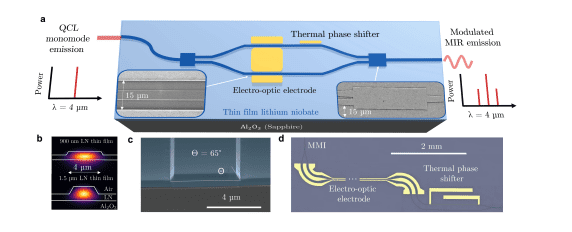
A lithium niobate on sapphire Mach-Zehnder modulator operates between 3.95 and 4.3 μm, achieving a 3 dB bandwidth exceeding 20 GHz and 34 dB extinction ratio. This delivers 10 Gbit/s data transmission and generates an 80 GHz frequency comb, demonstrating full π-phase modulation in the mid-infrared.
The mid-infrared (MIR) portion of the electromagnetic spectrum, spanning wavelengths from 3 to 14 μm, is increasingly vital for applications ranging from precise molecular identification to next-generation optical communications. Exploiting this range requires compact and efficient devices to control light, and integrated photonic circuits offer a potential solution. Researchers from ETH Zurich and ShanghaiTech University, led by P. Didier, P. Jain, M. Bertrand, et al., detail the development of a lithium niobate on sapphire modulator capable of operating within this crucial spectral region. Their work, published as “Integrated thin film lithium niobate mid-infrared modulator”, demonstrates a device achieving 10 Gbit/s data transmission, a 3 dB bandwidth exceeding 20 GHz, and full π-phase modulation – a significant step towards practical, high-performance MIR photonic systems.
High-Speed Mid-Infrared Modulation Achieved on Lithium Niobate Platform
Researchers have demonstrated a high-performance electro-optic modulator operating within the mid-infrared spectral region (3.95–4.3 μm). Fabricated on a lithium niobate on sapphire substrate, the device achieves a 3 dB bandwidth exceeding 20 GHz, a substantial extinction ratio of 34 dB, and requires a half-wave voltage of 22 V⋅cm, delivering optical power at the half-milliwatt level. This development addresses a key limitation in mid-infrared photonics – the scarcity of low-loss, high-performance integrated platforms – and opens avenues for compact, efficient systems.
The modulator successfully transmits data at 10 Gbit/s, validating its potential for high-speed communication. Furthermore, it generates a frequency comb with an 80 GHz bandwidth, extending its utility to precision spectroscopy and metrology, enabling more accurate analysis of molecular compositions and physical phenomena. This capability arises from achieving full π-phase modulation within the mid-infrared spectrum, a crucial step towards complex photonic integrated circuits.
Lithium niobate on sapphire was selected due to its broad transparency window (0.4–4.5 μm), high electro-optic coefficient – a measure of a material’s ability to change its refractive index in response to an electric field – and compatibility with standard microfabrication techniques. The sapphire substrate provides mechanical support and thermal stability, ensuring robust device operation.
The modulator’s design incorporates a ridge waveguide – a channel guiding light – with electrodes patterned on top to apply an electric field. This field induces a change in the refractive index of the lithium niobate, modulating the optical signal. Optimisation of the waveguide geometry and electrode configuration maximises modulation efficiency and minimises signal loss, resulting in the observed high bandwidth and extinction ratio. Fabrication employed techniques including electron beam lithography and reactive ion etching to create the intricate microstructures with precision.
Free-space optical communication, offering high bandwidth, is susceptible to atmospheric turbulence and scattering. This modulator provides a compact and efficient solution for generating and modulating the optical signals used in these systems, potentially enabling long-distance, high-speed wireless links. Its compact size and low power consumption suit mobile and remote sensing applications.
Molecular spectroscopy, a technique for identifying and quantifying chemical compounds, relies on analysing the interaction of light with matter. The generated frequency comb facilitates high-resolution spectroscopic measurements. The device’s sensitivity and compact size also benefit advanced sensing technologies.
Future work will focus on scaling fabrication for higher yields and integration densities, reducing manufacturing costs. Investigating alternative materials, such as aluminum nitride on silicon, could further enhance performance and reduce drive voltage requirements. Exploring advanced modulation schemes, like cascade and multi-level modulation, will be crucial for increasing data transmission rates.
Researchers plan to integrate the modulator with quantum cascade laser sources and high-speed detectors to create complete transceiver modules. Quantum cascade lasers offer tunable wavelengths and high power, ideal for free-space communication and spectroscopy. High-speed detectors are essential for capturing the modulated data.
System-level demonstrations will validate the technology’s potential in realistic operating conditions, including free-space communication links, high-resolution gas spectroscopy, and environmental monitoring.
Machine learning algorithms will also be explored to optimise performance, compensate for fabrication imperfections, and enhance spectroscopic accuracy. This advancement in mid-infrared photonics represents a significant step towards realising the full potential of this spectral region, paving the way for faster data transmission, more sensitive molecular sensing, and a new generation of compact, efficient mid-infrared systems with transformative impact across telecommunications, environmental monitoring, medical diagnostics, and security.
👉 More information
🗞 Integrated thin film lithium niobate mid-infrared modulator
🧠 DOI: https://doi.org/10.48550/arXiv.2505.23632