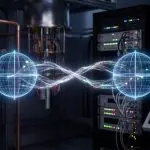
Researchers investigated entanglement generation within a one-dimensional spin system, analogous to an array of qubits, utilising the XXZ model with a tunable coupling parameter, λ. Simulations, conducted on cloud-based Noisy Intermediate-Scale Quantum (NISQ) devices, demonstrate that manipulating λ transitions the system from predictable, integrable dynamics to chaotic behaviour. Analysis using a multipartite entanglement metric – averaging entanglement across all possible system divisions – reveals a direct correlation between information scrambling, induced by the chaotic dynamics, and the overall entanglement generated within the system.
The efficient generation of quantum entanglement remains central to the development of quantum technologies, particularly in the realm of quantum computation and communication. Understanding how entanglement arises within complex, many-body systems is therefore paramount. Researchers are now investigating the relationship between information scrambling – the rapid dispersal of quantum information – and the creation of multipartite entanglement, utilising simplified models amenable to simulation on emerging quantum hardware.
This work, detailed in ‘Characterizing quantum dynamics using multipartite entanglement generation’ by Gaurav Rudra Malik (Indian Institute of Technology (Banaras Hindu University)), Rohit Kumar Shukla (Bar-Ilan University), S. Aravinda (Indian Institute of Technology Tirupati), and Sunil Kumar Mishra (Indian Institute of Technology (Banaras Hindu University)), examines a one-dimensional spin model, modified by a tunable coupling parameter, to quantify entanglement generation across all possible system divisions. The study employs a global metric to characterise the entanglement structure, offering insights into the dynamics of information scrambling and its potential for optimising entanglement production.
Entanglement Reveals Order-Chaos Transitions in Quantum Spin Systems
This study demonstrates how multipartite entanglement, shared across multiple quantum subsystems, reliably signals transitions between ordered and chaotic dynamics within a one-dimensional spin model. Researchers modulated a Heisenberg model with a coupling parameter, λ, inducing a shift from integrable (ordered) to chaotic behaviour.
Crucially, entanglement growth exhibited distinct characteristics in each regime: oscillatory and gradual in the integrable phase, and rapid, linear, and sustained in the chaotic phase. This establishes entanglement as a quantifiable diagnostic for identifying chaos.
The model’s simplicity, a well-studied spin chain, makes it ideally suited for implementation on near-term quantum computers. This allows for exploration of larger systems and complex entanglement structures, potentially unlocking resources for quantum information processing.
These findings highlight entanglement’s power not only as a quantum resource, but also as a sensitive probe of fundamental dynamical behaviour in many-body systems, offering insights into the interplay between order, chaos, and quantum correlations.
👉 More information
🗞 Characterizing quantum dynamics using multipartite entanglement generation
🧠 DOI: https://doi.org/10.48550/arXiv.2505.10477



See today’s quantum computing news on Quantum Zeitgeist for the latest breakthroughs in qubits, hardware, algorithms, and industry deals.