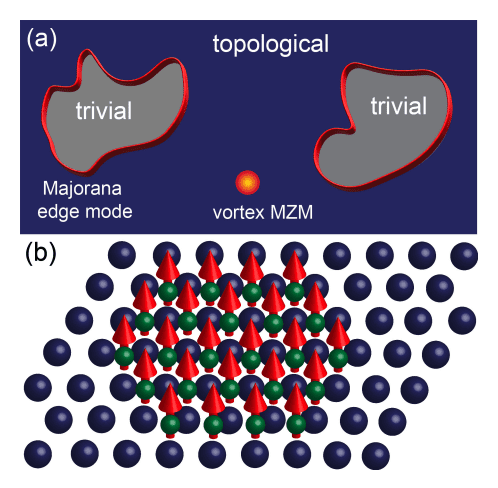
Majorana edge modes (MEMs) have emerged as a promising resource for advancing topological quantum computing, offering potential solutions to challenges in fault-tolerant operations. In their study titled Majorana Edge Modes as Quantum Memory for Topological Quantum Computing, Jasmin Bedow and Dirk K. Morr from the Department of Physics at the University of Illinois Chicago explore how MEMs can be integrated with Majorana zero modes (MZMs) within two-dimensional topological superconductors. Their research demonstrates that this combination enables efficient simulation of fundamental quantum gates, including Pauli X, Y, Z, and Hadamard gates, with MEMs serving as memory elements. This work presents a novel platform for enhancing the practicality of fault-tolerant quantum computing, contributing to the ongoing exploration of topological systems in quantum technologies.
The study demonstrates that combining Majorana edge modes (MEMs) and Majorana zero modes (MZMs) in two-dimensional topological superconductors provides a new platform for efficient fault-tolerant quantum gates. By simulating the system’s many-body dynamics, the researchers successfully implemented Pauli X, Y, Z, and Hadamard gates with MEMs serving as memory units.
Topological superconductivity offers potential for quantum computing via Majorana fermions in 2D materials.
Topological superconductivity holds significant promise for quantum computing due to its potential to host Majorana fermions, which are ideal candidates for fault-tolerant operations. These exotic particles emerge in two-dimensional systems where spin-orbit coupling, magnetic interactions, and superconductivity converge, giving rise to non-trivial topological properties.
Magnetic vortices within these materials play a pivotal role by serving as sites where Majorana fermions can be trapped at their cores. The formation of these vortices depends on the interplay between the superconducting order parameter and the material’s magnetic texture, making them critical for understanding how to stabilise Majorana states.
While previous research has explored various factors influencing the emergence of Majorana fermions, a comprehensive understanding of their interplay in two-dimensional systems remains elusive. This gap motivates further investigation into how spin-orbit coupling, magnetic interactions, and superconductivity collectively shape these topological phases.
The study at hand seeks to address this challenge by examining the interplay between these key factors within a two-dimensional model system. By employing a theoretical framework that integrates these elements into a unified Hamiltonian, researchers aim to map out the conditions under which Majorana fermions can arise and persist.
Through analysis of the resulting phase diagrams, the study identifies regions conducive to Majorana emergence, shedding light on their stability across different conditions. This insight is crucial for advancing quantum computing technologies by guiding the design of materials with tailored properties.
The findings underscore the potential for designing new materials that enhance fault-tolerant capabilities in quantum computing. Additionally, the research highlights a novel platform where the combination of Majorana edge modes and zero modes within vortices enables efficient implementation of fault-tolerant gates, marking a significant step forward in quantum technology development.
Simulated fault-tolerant quantum gates using Majorana edge and zero modes.
The field of quantum computing is on the brink of a transformative shift with the exploration of Majorana fermions, exotic particles that are their own antiparticles. These particles hold immense potential for topological quantum computing due to their robustness against local disturbances, offering a promising avenue for more reliable and efficient computations.
At the heart of this innovation lies the Bernstein-Vazirani algorithm, designed to determine a hidden binary string with exponential efficiency compared to classical methods. Researchers have successfully applied Majorana-based topological quantum systems to simulate this algorithm, marking a significant leap in quantum computing capabilities.
The study introduces a novel platform combining Majorana edge modes (MEMs) and Majorana zero modes (MZMs), located in the vortex cores of two-dimensional topological superconductors. This approach allows for the efficient implementation of fault-tolerant gates, a critical component in quantum computing. By leveraging the full many-body dynamics of the system, the researchers demonstrated the successful simulation and visualization of key quantum gates, including Hadamard gates, with MEMs functioning as memory units.
A standout feature of this research is its emphasis on fault tolerance. The topological nature of Majorana fermions ensures that information is encoded in global properties, significantly reducing susceptibility to noise and errors. This robustness not only enhances the reliability of quantum computations but also paves the way for more practical applications in the future.
While the current work remains theoretical, it lays crucial groundwork for experimental advancements. The ability to simulate complex quantum operations with high fidelity underscores the potential of Majorana-based systems as a cornerstone of next-generation quantum technologies. As researchers continue to explore these systems, the promise of realizing robust and scalable quantum computers draws ever closer.
Majorana fermions enable robust quantum computing via topological properties.
Majorana fermions, as non-Abelian anyons, hold significant potential in topological quantum computing due to their unique braiding statistics. These properties enable the execution of quantum gates with robustness against decoherence, a critical advantage in maintaining computational integrity.
These states emerge at the termini of topological superconductors or around magnetic impurities, facilitated by the superconducting proximity effect involving Cooper pairs. This emergence provides a practical pathway for creating Majorana states, essential for their application in quantum computing.
The braiding of Majorana fermions induces a Berry phase, encoding quantum information geometrically and reducing the need for direct qubit manipulation, thereby minimizing errors. This mechanism offers a more reliable approach compared to traditional quantum computing methods.
Despite these advantages, challenges remain in maintaining coherence and controlling environmental factors. While robustness against local perturbations is promising, practical verification is necessary to ensure scalability and reliability.
Numerical simulations, employing techniques like self-consistent mean-field approaches, aid in predicting Majorana state behavior, supporting theoretical advancements without relying on experimental setups.
The application of Majorana-based systems extends to fault-tolerant quantum computing and topological error correction. Recent studies have successfully simulated Hadamard gates using a combination of Majorana edge modes (MEMs) and zero modes (MZMs), with MEMs functioning as memory, marking a significant step forward in practical implementation.
Magnet-superconductor hybrids provide scalable, robust solutions for quantum computing.
The research demonstrates that magnet-superconductor hybrid structures offer a promising platform for realizing Majorana-based topological quantum computing. By leveraging Yu-Shiba-Rusinov (YSR) states induced by magnetic impurities in superconductors, the study highlights the potential of these states to host Majorana fermions, which exhibit non-Abelian braiding statistics and are ideal for robust quantum operations. The ability to manipulate YSR states using external fields provides a pathway for precise control over Majorana fermions, enabling the creation of quantum gates and fault-tolerant operations.
The article underscores the importance of topological operations, where braiding Majorana fermions results in computations that are inherently resistant to local perturbations. This property is critical for achieving reliable quantum computations. Furthermore, the research addresses scalability and fault tolerance by proposing 2D hybrid structures as a solution, which may offer improved control over quantum effects compared to traditional 3D setups.
Numerical simulations play a pivotal role in this work, allowing researchers to study YSR states and simulate topological gates without physical experimentation. Recent progress in simulating quantum algorithms, such as the Bernstein-Vazirani algorithm, demonstrates the potential for practical applications of Majorana-based systems. However, challenges remain in achieving the experimental conditions and material fabrication required to fully realize these systems.
In conclusion, the research presents a compelling approach to overcoming current limitations in quantum computing by leveraging Majorana fermions in 2D hybrid structures. The findings offer insights into scalable and robust topological quantum systems, with significant implications for developing fault-tolerant quantum technologies. Future work should focus on advancing experimental techniques to realize these systems, improving control over YSR states, and further refining numerical simulations to predict Majorana behaviour more accurately. Collaborative efforts between theorists and experimentalists will be essential in addressing remaining challenges and translating this promising approach into practical applications.
🗞 Majorana Edge Modes as Quantum Memory for Topological Quantum Computing
🧠 DOI: https://doi.org/10.48550/arXiv.2505.08888




See today’s quantum computing news on Quantum Zeitgeist for the latest breakthroughs in qubits, hardware, algorithms, and industry deals.