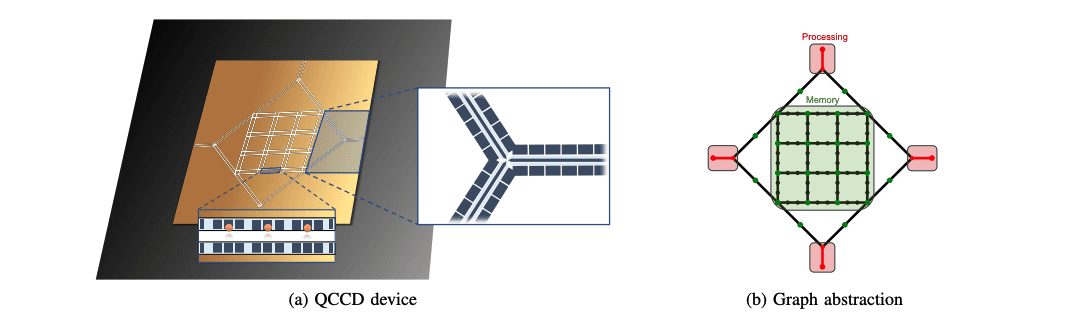
Trapped-ion qubits offer high-quality quantum computing with long coherence times. The QCCD architecture scales by shuttling ions between zones but requires software for managing multi-zone layouts. This research introduces a compilation strategy that models structural constraints of processing zones outside grid-type memory zones, unlike previous black-box approaches. It optimises ion movement and reduces inter-zone shuttling via qubit partitioning and dependency-aware gate selection, enabling simultaneous gate execution. Implemented in an open-source tool, the method was empirically demonstrated across QCCD layouts, establishing a foundation for compiling multi-zone trapped-ion systems.
Trapped-ion quantum computers are renowned for their high-quality qubits, long coherence times, and high-fidelity gate operations, making them a promising platform in quantum computing. The Quantum Charge Coupled Device (QCCD) architecture enhances scalability by facilitating ion shuttling between distinct zones. However, effectively managing this movement across multiple zones necessitates advanced software support.
In their study titled Orchestrating Multi-Zone Shuttling in Trapped-Ion Quantum Computers, Daniel Schoenberger and Robert Wille, along with colleagues from the Technical University of Munich and other institutions, present a novel compilation strategy. Unlike previous approaches that treated processing zones as black boxes, their method explicitly models structural constraints to optimise ion movement and reduce inter-zone shuttling. Integrating qubit partitioning with dependency-aware gate selection enables efficient simultaneous gate execution.
The researchers implemented this strategy in an open-source tool, demonstrating its effectiveness across various QCCD layouts through empirical testing. Their work provides a foundational approach for compiling multi-zone trapped-ion systems, advancing the practical implementation of scalable quantum architectures.
Trapped-ion systems scale using efficient ion shuttling in QCCD designs.
Quantum computing has seen significant advancements, particularly in scaling hardware, with trapped-ion systems emerging as a leading platform. These ions offer high-quality qubits characterised by long coherence times and high-fidelity gate operations, making them ideal for large-scale quantum computations. The Quantum Charge Coupled Device (QCCD) architecture stands out due to its scalability. It leverages ion shuttling between distinct zones, allowing for efficient resource utilization and flexible qubit connectivity, addressing key challenges in quantum computing infrastructure.
Despite these advancements, scaling QCCD systems presents complexities, especially when integrating multiple processing zones. Managing ion movement across these zones requires sophisticated software solutions to minimise decoherence and operational overhead, ensuring efficient computation.
This paper introduces a novel compilation strategy tailored for multi-zone QCCD architectures. By explicitly modelling the structural constraints of each zone, this approach optimises ion movement, reducing unnecessary shuttling and enabling parallel gate execution, thus enhancing computational efficiency. The proposed method is implemented in an open-source tool, demonstrating its effectiveness across various QCCD layouts. This work lays a foundation for managing multi-zone trapped-ion systems, addressing current challenges and paving the way for future advancements in quantum computing.
Trapped ions use shuttling for scalable, high-fidelity quantum computing.
Trapped-ion quantum computing stands as a leading platform in the quest for large-scale quantum technologies, offering unique advantages that set it apart from other approaches. At its core, this technology harnesses ions confined by electromagnetic fields to serve as qubits, enabling high-fidelity operations essential for reliable quantum computations. The Charge Coupled Device (QCCD) architecture represents a significant innovation within this field, leveraging the ability to shuttle ions between distinct zones to create a scalable system.
The QCCD architecture’s scalability is achieved through ion shuttling, akin to moving components in a factory assembly line. This method allows ions to be transferred between processing and memory zones, optimizing computational tasks. Unlike earlier approaches that treated these zones as black boxes, recent advancements model their structural constraints explicitly, enabling optimized ion movement and reducing inter-zone shuttling. This strategy minimises errors and enhances efficiency by allowing simultaneous gate execution.
Error correction and fault tolerance are pivotal in ensuring the reliability of trapped-ion systems. These strategies allow the system to function correctly despite some errors, a critical feature for large-scale computing. Maintaining functionality even when components fail, these methods pave the way for practical, fault-tolerant quantum computing.
Compared to superconducting qubits, trapped ions excel in fidelity and coherence times. High-fidelity operations mean fewer errors during computations, while longer coherence times allow qubits to maintain their quantum states longer, both crucial for complex tasks, these advantages position trapped-ion systems as strong candidates for large-scale applications.
However, challenges remain. Maintaining coherence across many qubits is a significant hurdle, as environmental interactions can disrupt quantum states. Additionally, efficient circuit compilation is necessary to translate algorithms into practical operations on ion traps. Recent progress includes the development of an open-source tool that demonstrates the effectiveness of new compilation strategies across various QCCD layouts, marking a step toward real-world applications.
Tracer-ion quantum computing combines innovative architectures with robust error correction and fault tolerance mechanisms. By addressing challenges through advanced compilation strategies and leveraging unique advantages over other qubit systems, this technology continues to advance, offering promising prospects for the future of quantum computing.
Simulations validate compilation strategy for multi-zone trapped-ion systems.
Trapped-ion systems are promising for large-scale quantum computing due to their high-quality qubits with long coherence times and high-fidelity gate operations. The Charge-Coupled Device (QCCD) architecture plays a crucial role in scalability by enabling the shuttling of ions between distinct zones, thereby facilitating complex computations.
The study introduces a compilation strategy that addresses the practical challenges of managing ion movement across multi-zone layouts. Unlike previous approaches that treated processing zones as black boxes, this method explicitly models structural constraints to optimize ion movement and reduce inter-zone shuttling. Combining qubit partitioning with dependency-aware gate selection minimizes unnecessary movements while enabling simultaneous gate execution.
Error correction is achieved through logical qubits, which use multiple entangled physical qubits to detect and correct errors. However, maintaining coherence during ion shuttling and achieving precise photon control for reliable communication between zones remains challenging.
The research demonstrates the effectiveness of their approach through simulations across various QCCD layouts using an open-source tool. This work lays a foundation for compiling multi-zone trapped-ion systems, advancing progress toward practical quantum computing applications despite ongoing technical challenges.
Trapped-ion quantum computing holds promise yet grapples with hurdles in scalability and fidelity.
Trapped-ion quantum computing presents a robust platform characterised by high qubit stability and long coherence times, making it a promising avenue for reliable quantum operations. The use of electric fields to isolate ions ensures minimal decoherence, facilitating the maintenance of quantum states. This approach excels in single-qubit gate operations, which are executed with high fidelity, relying on methods such as Pauli rotations.
However, challenges remain in achieving scalability and improving two-qubit gate fidelity. Current systems typically operate within 10-20 qubits, necessitating advancements to scale up effectively while maintaining fault-tolerant operations. The Charge Coupled Device (QCCD) architecture offers a scalable blueprint by leveraging ion shuttling between distinct zones. However, practical implementation requires sophisticated software support to manage ion movement across multi-zone layouts.
Recent research has introduced a compilation strategy that explicitly models structural constraints of processing zones, optimising ion movement and reducing inter-zone shuttling. This method enhances performance by enabling simultaneous gate execution. It has been empirically validated through an open-source tool across various QCCD layouts, demonstrating its effectiveness in compiling multi-zone trapped-ion systems.
Future work should focus on refining trap designs to enhance scalability, optimising ion shuttling efficiency, and improving error correction codes to address two-qubit gate fidelity issues. Additionally, advancements in compiler optimisation will be crucial for reducing resource usage and accelerating computations. Continued empirical testing across diverse QCCD layouts will further validate these strategies, paving the way for more efficient and reliable trapped-ion quantum computing systems.
🗞 Orchestrating Multi-Zone Shuttling in Trapped-Ion Quantum Computers
🧠 DOI: https://doi.org/10.48550/arXiv.2505.07928
See today’s quantum computing news on Quantum Zeitgeist for the latest breakthroughs in qubits, hardware, algorithms, and industry deals.