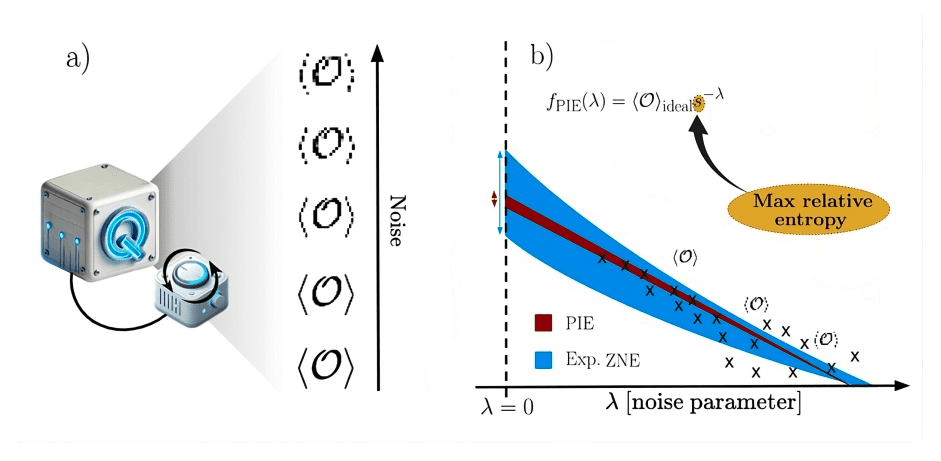
Error mitigation is crucial for noisy quantum machines. Current methods face limitations due to high sampling overhead. EMRE reduces this overhead but introduces bias. The new PIE method enhances EMRE by assigning operational meaning to extrapolation parameters, improving accuracy and robustness. Tested on IBMQ hardware, PIE efficiently simulates 84-qubit dynamics with reduced variance, proving effective for near-term applications. This advancement offers a practical error mitigation strategy for current and early fault-tolerant quantum systems.
Quantum error mitigation (QEM) is crucial for addressing noise challenges in current quantum computing systems, particularly in the NISQ era and beyond. Traditional QEM methods often face limitations due to exponential sampling overhead, hindering their practical application. Researchers have recently developed the Physics-Inspired Extrapolation (PIE) method, which enhances accuracy and robustness within the Error Mitigation by Restricted Evolution (EMRE) framework. Unlike conventional approaches, PIE assigns operational significance to extrapolation parameters, thereby reducing variance and improving results. This work is authored by Pablo Díez-Valle from LG Electronics Toronto AI Lab and other institutions, along with colleagues Gaurav Saxena, Jack S. Baker, Jun-Ho Lee, and Thi Ha Kyaw. Their research demonstrates PIE’s effectiveness through successful implementation on IBMQ hardware, achieving efficient simulations of 84-qubit dynamics. This advancement underscores PIE’s potential as a scalable solution for near-term quantum computing challenges.
Quantum error mitigation addresses noise in quantum computing.
Noise in quantum hardware significantly hinders the development of fault-tolerant quantum computing, confining current processors to the noisy intermediate-scale quantum (NISQ) era. These systems face challenges due to limited qubit numbers and vulnerabilities to decoherence and gate errors, which impede their progression beyond theoretical capabilities. Traditional quantum error correction codes struggle with resource-intensive requirements, making fully error-corrected algorithms impractical for surpassing classical computational limits. This limitation underscores the need for alternative strategies to enhance computational accuracy on existing hardware.
Quantum error mitigation (QEM) is a promising approach that reduces noise effects without requiring complete fault tolerance. QEM employs diverse techniques such as symmetry verification, extrapolation, and machine learning to improve the fidelity of quantum computations, making it particularly relevant in the NISQ era. Despite its promise, most QEM methods face practical limitations due to exponential sampling overhead, which restricts their applicability. This challenge has prompted researchers to seek innovative solutions that balance efficiency with accuracy.
Error Mitigation by Restricted Evolution (EMRE) presents an alternative approach, achieving constant sampling overhead at the expense of a non-zero bias. While this method addresses some limitations, its effectiveness diminishes as circuit size or hardware noise increases, highlighting the need for further advancements.
The Physics-Inspired Extrapolation (PIE) method builds upon EMRE, introducing enhanced accuracy and robustness by assigning operational meaning to extrapolation parameters. This innovation allows PIE to overcome the bias issues inherent in traditional methods, offering a more practical solution. Demonstrated on IBMQ hardware, PIE efficiently simulates 84-qubit dynamics with accurate results and significantly reduced variance. This showcases its potential as a scalable error mitigation strategy for near-term quantum applications. PIE represents a significant advancement in QEM, providing a practical and scalable approach that bridges the gap between theoretical promises and real-world implementations, paving the way for future quantum computing advancements.
PIE estimates error-free quantum results via parameterised extrapolation.
The Physics-Inspired Extrapolation (PIE) method addresses the challenges of traditional quantum error mitigation (QEM) techniques, which often require exponential sampling overhead. By building upon the Error Mitigation by Restricted Evolution (EMRE) framework, PIE aims to reduce this overhead while managing bias more effectively. Unlike conventional zero-noise extrapolation methods, PIE introduces a novel approach by assigning operational meaning to the parameters used in its extrapolation function, thereby enhancing accuracy and robustness.
The method begins by extracting Pauli X, Y, and Z error rates from experimental data. These error rates increase from approximately 0.5% to 1%, indicating significant noise levels. These rates are then used to model noise using Qiskit’s Lindblad dissipators, a standard approach for describing quantum decoherence processes.
A quantum circuit simulating the Ising model with Trotter steps is implemented and tested on IBM’s Heron and Eagle processors under varying noise conditions. This step evaluates how the circuit performs as noise levels change, which is crucial for understanding the method’s practical applicability.
The PIE implementation involves Probabilistic Error Cancellation through multiple circuit passes, amplifying errors to facilitate mitigation. Data collected at different noise levels are fitted using a model, such as linear extrapolation, to estimate error-free results. The provided code example demonstrates creating a noise model with uniform Pauli rates and running simulations to obtain counts, illustrating the practical application of PIE.
Visualisation of magnetisation (Mz) before and after mitigation highlights the method’s effectiveness in improving accuracy. Statistical handling includes calculating standard deviations and weighting data points during fitting, especially when extrapolating from noisy datasets.
PIE’s operational interpretation of extrapolation parameters differentiates it from traditional methods, potentially reducing bias more effectively than EMRE. The method’s ability to simulate 84-qubit dynamics efficiently underscores its scalability, addressing the challenges of large-scale quantum simulations.
PauliTwirl combined with PIE enhances quantum computation accuracy.
The research addresses the critical challenge of quantum error mitigation (QEM) in noisy intermediate-scale quantum (NISQ) and emerging Megaquop-era machines. These systems face limitations due to noise, which affects their performance despite their potential for utility-scale computations. The study introduces a novel approach combining PauliTwirl with Physics-Inspired Extrapolation (PIE), aiming to enhance the accuracy of quantum computations while reducing sampling overhead.
The PauliTwirl technique applies random Pauli gates to average out noise effects, and its effectiveness is demonstrated through experiments on IBM’s Heron processor. The setup involves varying qubit counts (5-10) and circuit depth up to 300, showing scalability and applicability to complex computations. High expectation values (~0.98) indicate successful error mitigation, with fidelity improving as twirling time increases. Error analysis reveals that total Pauli error rates grow with circuit complexity, underscoring the necessity of effective mitigation strategies.
The PIE method, built upon the EMRE framework, assigns operational meaning to extrapolation parameters, achieving enhanced accuracy and robustness compared to traditional zero-noise extrapolation. Experimental validation across different Trotter steps (R=1-9) demonstrates PIE’s efficacy in reducing variance and improving simulation outcomes for larger systems and deeper circuits. This method successfully mitigates errors, particularly when noise significantly impacts fidelity.
The research highlights the effectiveness of combining PauliTwirl with PIE, offering a practical and scalable error mitigation strategy. While acknowledging the computational overhead compared to standard methods, the study provides valuable insights for advancing quantum simulations. The findings underscore the importance of innovative techniques in improving reliability as quantum systems continue to scale, contributing significantly to the field’s progress.
The study demonstrates the effectiveness of PauliTwirl as a quantum error mitigation technique when combined with Physics-Inspired Extrapolation (PIE) on IBM quantum processors. By randomising noise into depolarising channels, PauliTwirl simplifies error correction, enabling PIE to extrapolate accurate results from noisy data. The experiments show consistent improvement in accuracy across varying system sizes and Trotter step counts, with significantly reduced variance compared to raw data. However, the trade-off between bias and circuit size or hardware noise remains a consideration for practical applications.
Future work could explore optimising parameters such as the number of Pauli gates applied to balance error mitigation benefits against increased circuit depth. Additionally, investigating how Trotter steps influence error accumulation and the role of PIE in maintaining accuracy could provide further insights. Extending this approach to other quantum architectures beyond IBM processors may also enhance its applicability for near-term and early fault-tolerant quantum computing.
🗞 Physically motivated extrapolation for quantum error mitigation
🧠 DOI: https://doi.org/10.48550/arXiv.2505.07977




See today’s quantum computing news on Quantum Zeitgeist for the latest breakthroughs in qubits, hardware, algorithms, and industry deals.