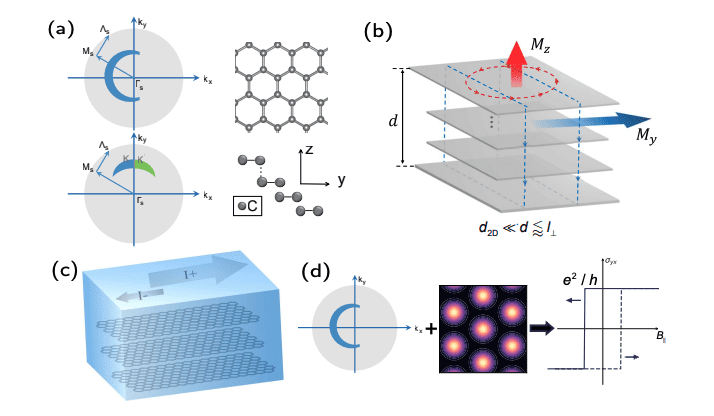
Researchers identified a novel Fermi surface structure, the Fermi lune, in rhombohedral multilayer materials. This crescent-shaped structure breaks time-reversal, mirror, and rotational symmetries due to electron interactions, resulting in giant intrinsic non-reciprocity and transdimensional orbital magnetism. Coupling with a superlattice potential generates a Chern insulator exhibiting quantized anomalous Hall effect controlled by in-plane magnetic fields. This discovery opens avenues for exploring quantum phenomena in symmetry-breaking phases.
The Fermi surface, a cornerstone of condensed matter physics, dictates the electronic properties of materials. In a recent study titled Fermi lune and transdimensional orbital magnetism in rhombohedral multilayer graphene, researchers have uncovered a novel structure within this framework: the Fermi lune. This crescent-shaped contour arises from electron-electron interactions, breaking symmetries and giving rise to unique phenomena such as giant intrinsic non-reciprocity and a new form of magnetism. Furthermore, coupling this structure with a superlattice potential generates a Chern insulator capable of exhibiting quantized anomalous Hall effects under in-plane magnetic fields.
The research was conducted by Min Li from ShanghaiTech University and Liaoning Academy of Materials, along with Jianpeng Liu from the same institutions, leading a collaborative effort involving Qingxin Li from Nanjing University, Xin Lu from ShanghaiTech University, Hua Fan from Southern University of Science and Technology, Kenji Watanabe from the Research Center for Electronics, Takashi Taniguchi, Yue Zhao from Southern University of Science and Technology, and Lei Wang from Nanjing University. Their findings open new avenues for exploring correlated and topological quantum phenomena in symmetry-breaking phases.
Rhombohedral multilayer graphene has rotated layers causing unique electronic properties.
Rhombohedral multilayer graphene (R-MLG) is a unique allotrope of graphene characterised by a stacking configuration where each layer is slightly rotated relative to the one below it. This rotational misalignment disrupts translational symmetry, leading to distinct electronic properties compared to other stacking configurations such as Bernal (AB) stacking. The resulting symmetry-breaking states in R-MLG have garnered significant interest due to their potential for novel electronic and magnetic applications.
The electronic structure of R-MLG is influenced by the interplay between its rhombohedral geometry and electron-electron interactions. Orbital magnetization, a property arising from the motion of electrons around nuclei, is significantly enhanced in R-MLG compared to other graphene allotropes. This enhancement is attributed to the unique electronic states induced by the symmetry-breaking stacking configuration. Theoretical models, including the Hartree-Fock approximation, are employed to account for these interactions and predict the material’s magnetic properties.
Experimental studies of R-MLG have revealed quantum oscillations in transport measurements, providing insights into its electronic structure. These oscillations manifest as periodic changes in electrical resistance under varying magnetic fields or carrier densities, reflecting the topology of the Fermi surface and the effective masses of charge carriers. Such observations are critical for understanding the material’s electronic behaviour and validating theoretical predictions.
The fabrication of R-MLG devices typically involves exfoliating multilayer graphene onto SiO2 substrates, with electrical contacts deposited to enable transport studies. The vertical mean free path is estimated to characterise electron scattering in the multilayer structure. These experimental efforts are complemented by theoretical modelling, which helps explain the observed quantum oscillations and orbital magnetization, paving the way for potential applications in spintronics and magnetic devices.
Quantum oscillation measurements with a continuum model.
The study investigates symmetry-breaking states in 9-layer rhombohedral graphene, leveraging quantum oscillations and transport measurements. The researchers identify distinct Fermi surface topologies, including a nodal-line semimetal state and a partially gapped state with broken rotational symmetry. These observations arise from the interplay of van der Waals interactions, trigonal warping, and electron-electron correlations. A continuum model is developed to describe the electronic structure, incorporating interlayer coupling and trigonal warping effects, while Hartree-Fock calculations demonstrate how electron-electron interactions enhance gap opening.
The methodology combines experimental and theoretical approaches to uncover the symmetry-breaking states. Quantum oscillation measurements are used to extract Fermi surface information, providing direct evidence of the observed topological features. The continuum model predicts the emergence of these states by accounting for interlayer coupling and orbital degeneracy in rhombohedral multilayer graphene. Hartree-Fock calculations further reveal how electron-electron interactions stabilize the partially gapped state with broken rotational symmetry.
The findings highlight the importance of interlayer coupling and trigonal warping in shaping the electronic structure of rhombohedral graphene. The observed symmetry-breaking states are shown to result from a delicate balance between van der Waals interactions, trigonal warping, and electron-electron correlations. This combination of experimental and theoretical techniques provides a comprehensive understanding of the phase diagram of multilayer graphene systems.
The research underscores the potential of rhombohedral graphene as a platform for studying novel quantum states. By combining quantum oscillation measurements with advanced modelling techniques, the study offers insights into the interplay of van der Waals interactions, trigonal warping, and electron-electron correlations in determining the electronic structure. These findings contribute to the broader understanding of symmetry-breaking phenomena in layered materials.
Rhombohedral graphene exhibits orbital magnetization via electron motion.
The study investigates rhombohedral multilayer graphene, where each layer is slightly rotated relative to the one below it, creating a three-dimensional structure. This stacking breaks symmetries present in flat graphene layers, leading to new electronic properties. Transport measurements under magnetic fields reveal quantum oscillations, indicating quantized energy levels influenced by symmetry-breaking states. These findings suggest that rhombohedral graphene exhibits orbital magnetization, arising from the motion of electrons in the crystal lattice rather than their spins.
The research highlights how broken symmetries create complex electron paths, contributing to a net orbital magnetic moment. While similar to other layered materials like transition metal dichalcogenides (TMDCs), rhombohedral graphene’s unique stacking configuration gives rise to distinct electronic behaviours. Theoretical methods, including continuum models and renormalization techniques, are employed to describe the material’s quantum effects and electron-electron interactions.
The robustness of observed quantum oscillations suggests high-quality materials and possibly cryogenic conditions to enhance quantum effects. Although potential applications in spintronics or magnetic storage are not explicitly detailed, controlling orbital magnetization could open new avenues for technological advancements. This discovery contributes significantly to understanding fundamental physics and lays the groundwork for exploring novel electronic phenomena in structured graphene systems.
Symmetry-breaking in graphene enables novel magnetic applications.
The study demonstrates that symmetry-breaking states in rhombohedral multilayer graphene significantly alter its electronic properties, particularly through changes in Fermi surface topology and the emergence of nontrivial Berry curvature. This curvature drives orbital magnetization, a phenomenon arising from geometric phase effects in momentum space. The research identifies external factors such as perpendicular electric fields or strain as effective means to induce these symmetry-breaking states, thereby modifying the material’s electronic structure.
The findings are supported by a continuum model and the Hartree-Fock approximation, which account for electron-electron interactions and their impact on the system’s parameters. Experimentally, orbital magnetization is measurable through magnetic experiments, suggesting potential applications in advanced devices such as sensors or memory technologies that exploit these magnetic properties.
Future work could explore similar effects in other layered materials inspired by insights from multiferroics, potentially leading to new research directions in van der Waals heterostructures. This approach could enable the engineering of novel electronic states, with implications for both fundamental physics and device applications beyond conventional uses of graphene.
🗞 Fermi lune and transdimensional orbital magnetism in rhombohedral multilayer graphene
🧠 DOI: https://doi.org/10.48550/arXiv.2505.05414



See today’s quantum computing news on Quantum Zeitgeist for the latest breakthroughs in qubits, hardware, algorithms, and industry deals.