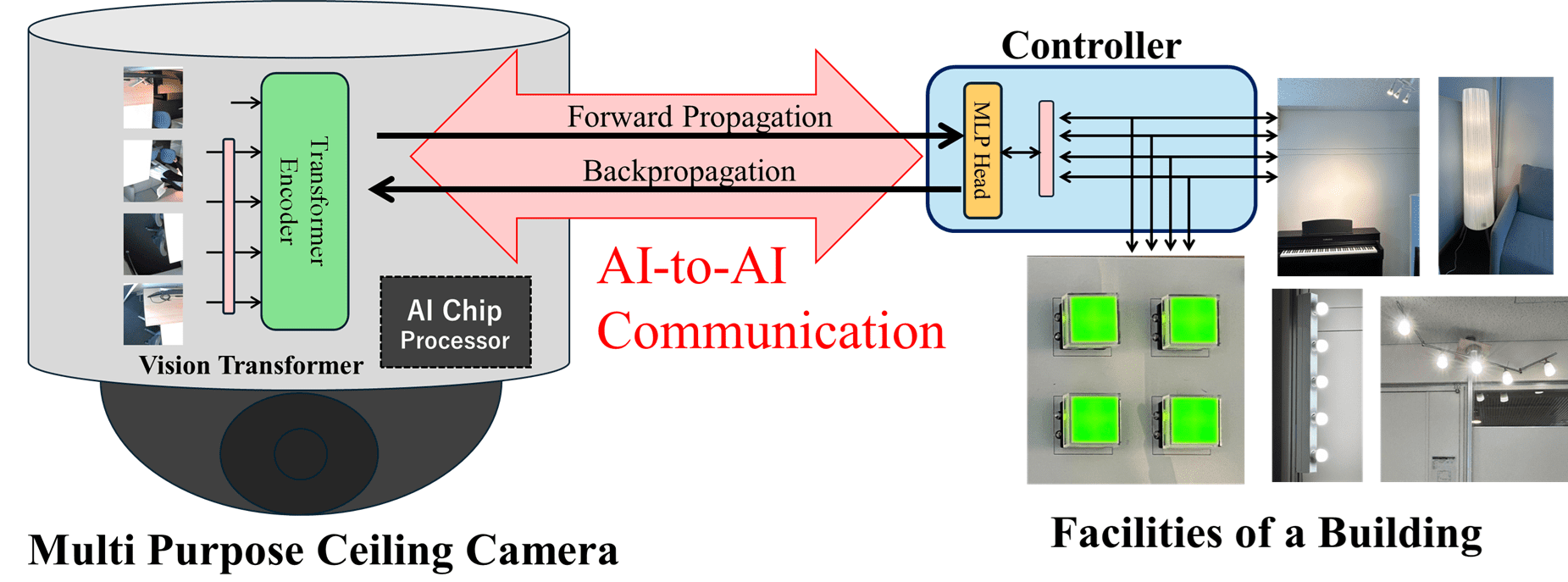
Researchers at the University of Tokyo developed a framework called Distributed Logic-Free Building Automation (D-LFBA) for decentralized AI-based building automation with enhanced privacy. The system allows direct communication between devices like cameras and interfaces, eliminating central servers and reducing data retention risks. Using synchronized timestamps to learn user preferences without programming, D-LFBA offers cross-vendor compatibility and adapts to user habits, as shown in successful trials.
Privacy-Aware Building Automation Framework
The University of Tokyo has developed a Privacy-aware Building Automation Framework aimed at enhancing privacy in building automation systems. This framework, known as Distributed Logic-Free Building Automation (D-LFBA), utilizes split learning to distribute AI tasks across devices, thereby avoiding reliance on central servers. By decentralizing data handling, the system minimizes the risk of data breaches and reduces the need for prolonged data storage.
A key advantage of D-LFBA is its ability to operate without programmed behaviors, allowing it to learn user preferences over time through interactions such as switching lights or moving between rooms. This learning process uses synchronized timestamps to match images with control states, enabling the system to adapt automatically to user habits without explicit programming.
The framework also offers cross-vendor compatibility, meaning it can integrate devices from various manufacturers, enhancing flexibility and reducing dependency on a single supplier. During trials, users were impressed by how well the system adapted to their routines, demonstrating its effectiveness in creating personalized environments.
In summary, D-LFBA represents an innovative approach to privacy-aware building automation through split learning and synchronized timestamps. By decentralizing computation and emphasizing local data processing, the system addresses key challenges in modern building automation while enhancing user privacy.
Device Coordination and Scalability
Implementing such a system presents several considerations, including device coordination and scalability. Ensuring that devices can synchronize effectively without a central authority requires robust communication protocols and error-handling mechanisms. Additionally, the framework must be adaptable to varying network conditions and device capabilities to maintain performance across different deployments.
The system incorporates feedback loops that allow continuous refinement of its operations. By monitoring performance metrics and user interactions, it dynamically adjusts parameters to better meet needs. This capability improves functionality and extends the lifespan of devices by preventing unnecessary wear and tear through optimized usage.
Examples of adaptability include automatically dimming lights in low-traffic areas during off-hours or adjusting heating zones based on real-time occupancy data. These features demonstrate how the framework enhances the practicality of smart environments, making them more responsive and efficient while maintaining user privacy and security.
User Interaction and Adaptive Control
The framework facilitates user interaction through intuitive mechanisms that capture and interpret inputs from various devices. These mechanisms enable users to interact with the system seamlessly, whether adjusting settings manually or allowing the system to learn preferences over time. The design emphasizes ease of use, ensuring that even non-technical users can navigate and customize their smart environment effectively.
Adaptive control is achieved through sophisticated algorithms that analyze usage patterns and adjust system behaviors accordingly. For instance, lighting and temperature settings can be optimized based on occupancy and user habits, enhancing comfort while reducing energy consumption. This adaptability ensures the system remains responsive to dynamic conditions, improving efficiency and user satisfaction without requiring constant manual adjustments.
In summary, the University of Tokyo’s approach to privacy-aware building automation through split learning and synchronized timestamps offers a robust solution for creating secure and efficient smart environments. By decentralizing computation and emphasizing local data processing, the system addresses key challenges in modern building automation while enhancing user privacy.
More information
External Link: Click Here For More
See today’s quantum computing news on Quantum Zeitgeist for the latest breakthroughs in qubits, hardware, algorithms, and industry deals.