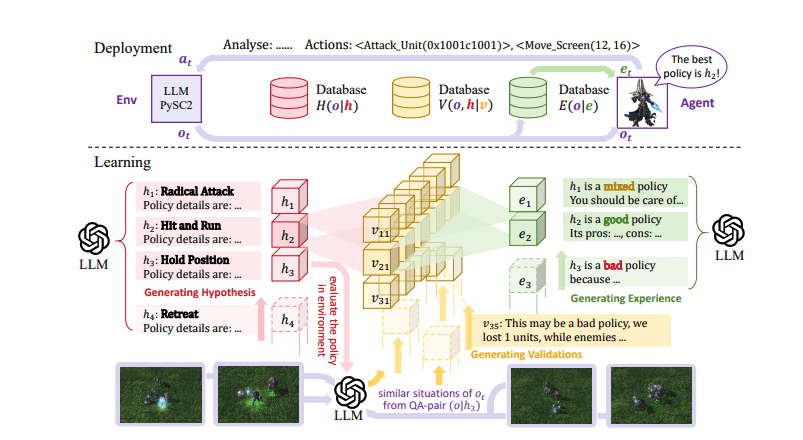
On May 2, 2025, researchers introduced Retrieval Augmented Learning: A Retrial-based Large Language Model Self-Supervised Learning and Autonomous Knowledge Generation, a novel framework addressing data scarcity in large language models (LLMs). The study proposes a reward-free self-supervised learning method, RAL, which enables LLMs to autonomously generate validated knowledge through hypothesis testing. Tested in the complex LLM-PySC2 environment, the approach demonstrated reduced hallucination and improved decision-making at minimal cost, with potential for out-of-distribution tasks and robust performance.
The abstract addresses challenges in LLMs due to limited domain-specific pre-training data and high computational costs for post-training. It introduces Retrial-Augmented Learning (RAL), a reward-free self-supervised framework enabling autonomous knowledge generation without additional training. By integrating Retrieval-Augmented Generation (RAG) as an intermediate data organizer, RAL achieves hypothesis proposal, validation, and knowledge generation. Tested in the LLM-PySC2 environment, experiments show RAL reduces hallucination by leveraging validated knowledge, enhances decision-making performance at low cost, and demonstrates potential for out-of-distribution tasks, robustness, and transferability.
The convergence of artificial intelligence (AI) and gaming has long been a crucible for technological advancement. In recent years, large language models (LLMs), sophisticated AI systems trained on extensive text datasets, have emerged as a disruptive force across industries. Now, researchers are exploring their application in real-time strategy (RTS) games like StarCraft II, where the complexity of decision-making and strategic planning presents a unique challenge for AI systems.
This article delves into how LLMs are being utilised to create more adaptive and efficient game AI, focusing on a novel approach that combines retrieval-augmented generation (RAG) with real-time strategy gaming. The research not only underscores the potential of LLMs in gaming but also highlights their broader implications for AI development and decision-making systems.
The RAG Framework: Enhancing Strategy and Efficiency
At the core of this innovation lies the RAG framework, which integrates pre-existing knowledge into generative models to enhance their performance. In the context of StarCraft II, researchers have developed a system where LLMs access a database of strategies and tactics during gameplay. This approach diverges from traditional AI methods that rely on extensive trial-and-error learning or hardcoded rules.
The RAG framework enables the model to retrieve relevant information from its knowledge base in real-time, allowing it to adapt to dynamic game scenarios with greater efficiency. By leveraging pre-trained models and strategic insights, the AI can make decisions faster and more effectively than conventional reinforcement learning approaches. This reduces the computational resources required for training while maintaining high levels of performance.
Transforming Game Development
The application of LLMs in RTS gaming has profound implications for game development. Traditional AI systems often require significant time and resources to train, limiting their practicality for developers. In contrast, RAG-based systems offer a more streamlined approach, enabling faster iteration cycles and reducing costs.
Moreover, the ability of LLMs to generate creative strategies on-the-fly opens new possibilities for dynamic gameplay. By incorporating human-like decision-making processes, these AI systems can create opponents that are not only challenging but also unpredictable, enhancing player engagement.
The integration of large language models into real-time strategy gaming represents a significant advancement in AI research and application. By combining the power of generative models with strategic knowledge bases, researchers have demonstrated a more efficient and adaptable approach to game AI development. As this technology continues to evolve, it has the potential to transform not only gaming but also other domains where real-time decision-making is critical.
👉 More information
🗞 Retrieval Augmented Learning: A Retrial-based Large Language Model Self-Supervised Learning and Autonomous Knowledge Generation
🧠 DOI: https://doi.org/10.48550/arXiv.2505.01073




See today’s quantum computing news on Quantum Zeitgeist for the latest breakthroughs in qubits, hardware, algorithms, and industry deals.