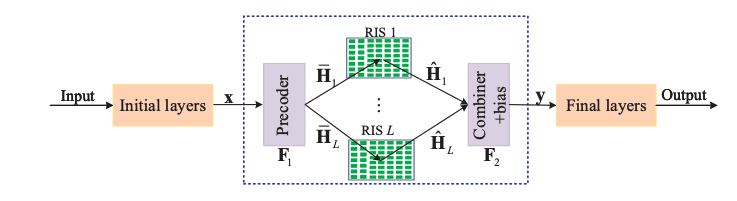
In a study published on May 2, 2025, titled Realizing Fully-Connected Layers Over the Air via Reconfigurable Intelligent Surfaces, researchers Meng Hua, Chenghong Bian, Haotian Wu, and Deniz Gündüz introduced AirFC, a method leveraging reconfigurable intelligent surfaces in MIMO systems to perform neural network computations wirelessly, achieving competitive classification accuracy.
The research introduces AirFC, a novel framework leveraging reconfigurable intelligent surfaces (RIS) and multiple-input multiple-output (MIMO) systems to emulate neural network functionality for over-the-air inference. By manipulating wireless propagation, both RIS and transceivers jointly recreate adjustable weights of digital fully connected layers. An optimization algorithm minimizes imitation error between the effective channel and target FC layer, achieving semi-closed-form solutions. Simulations demonstrate competitive classification accuracy, with multi-RIS configurations significantly outperforming single-RIS setups in line-of-sight-dominated channels.
Wireless communication is undergoing a subtle yet transformative shift, driven by a novel approach to data processing. Researchers have developed a method that leverages intelligent reflecting surfaces (IRS) to perform analog computations directly within wireless networks. This innovation bypasses the traditional reliance on digital signal processing, offering significant improvements in energy efficiency and computational speed. By manipulating radio signals through phase adjustments, these surfaces can execute complex operations such as matrix multiplication and vector addition without converting signals into digital form.
The technology hinges on the collaborative operation of
The technology hinges on the collaborative operation of multiple IRS units, each capable of adjusting its reflection properties based on input data. This approach enables the network to perform linear algebra operations with remarkable efficiency, harnessing the inherent characteristics of radio waves for computation. Initial experiments have demonstrated that this method achieves high accuracy comparable to conventional digital techniques while consuming substantially less energy.
The potential applications of IRS-based analog computing are vast and promising. This technology is particularly well-suited for scenarios requiring real-time processing or operating under strict power constraints, such as in IoT devices. By reducing reliance on energy-intensive digital processing, IRS systems could pave the way for more sustainable and scalable solutions in wireless communication.
One of the most compelling aspects of this innovation is its ability to enhance edge computing capabilities. By performing computations directly within the wireless medium, IRS-based systems can reduce latency and improve data-processing efficiency in IoT networks. This capability opens new possibilities for optimising wireless communication systems and developing greener technologies.
Looking ahead, researchers are exploring how to integrate
Looking ahead, researchers are exploring how to integrate this technology into existing infrastructure. The ability to perform computations directly within the wireless medium represents a significant advancement, offering opportunities that were previously unattainable. As research progresses, the potential for IRS-based analog computing to complement or replace conventional digital processing in various applications becomes increasingly clear.
In conclusion, intelligent reflecting surfaces represent a promising frontier in wireless technology. By enabling efficient analog computations directly within wireless networks, this innovation has the potential to reshape the future of data processing and communication systems. As the technology continues to evolve, it may unlock new possibilities for sustainable and high-performance wireless solutions.
🗞 Realizing Fully-Connected Layers Over the Air via Reconfigurable Intelligent Surfaces
🧠 DOI: https://doi.org/10.48550/arXiv.2505.01170




See today’s quantum computing news on Quantum Zeitgeist for the latest breakthroughs in qubits, hardware, algorithms, and industry deals.