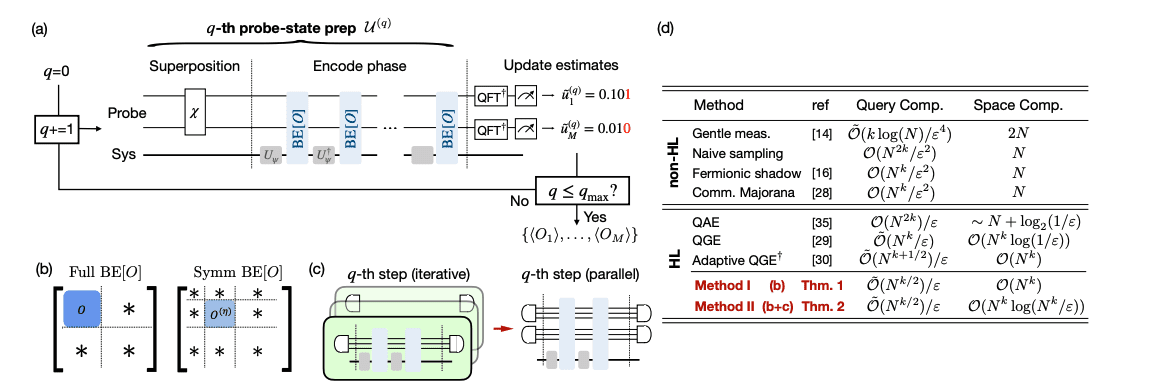
On May 1, 2025, researchers Yuki Koizumi and colleagues published Faster Quantum Algorithm for Multiple Observables Estimation in Fermionic Problems, presenting a method that significantly reduces computational costs by achieving quadratic speedup in estimating collective properties of fermionic systems.
The study introduces a generalized adaptive quantum gradient estimation (QGE) framework for efficiently estimating collective properties of fermionic systems. Two variants are proposed: one exploiting symmetry in target states and another enabling single-shot estimation via parallel schemes. The approach achieves quadratic speedup compared to prior QGE algorithms in fermionic partial tomography tasks. Numerical results demonstrate a 100-fold improvement in query efficiency for nitrogenase FeMo cofactor and a 500-fold improvement for the Fermi-Hubbard model of 100 sites, significantly advancing practical applications in quantum system estimation.
Streamlining Quantum State Reconstruction
Traditionally, reconstructing quantum states required extensive measurements, akin to piecing together a puzzle with an overwhelming number of pieces. Recent innovations have streamlined this process by employing techniques like classical shadows and optimal scheduling. These methods reduce resource demands while maintaining precision, crucial for current quantum devices that operate on a smaller scale. This efficiency not only aids in characterising quantum systems but also accelerates the path towards reliable computations.
Revolutionising Hamiltonian Simulation
At the core of many quantum algorithms lies Hamiltonian simulation, which models complex physical systems beyond classical capabilities. Innovations such as qubitization and singular value transformation have emerged, allowing researchers to amplify specific spectral components. This approach ensures robust simulations across various energy scales, achieving high precision with fewer resources. Applications in quantum chemistry and materials science stand to benefit, offering insights into molecular behaviour that were previously elusive.
Refining Matrix Arithmetic
Matrix operations are fundamental to many quantum algorithms, from solving linear systems to machine learning tasks. Recent advancements have optimised quantum singular value transformation (QSVT), enhancing computational efficiency. These improvements hold promise for industries like finance and drug discovery, where complex computations are paramount. By refining matrix arithmetic, researchers are unlocking new possibilities for practical applications.
A Forward-Looking Conclusion
Collectively, these advancements mark a quiet revolution in quantum computing. Each innovation brings us closer to harnessing the full potential of quantum systems, transforming theoretical possibilities into tangible solutions. As research continues, the focus remains on translating these breakthroughs into real-world impact across diverse fields, heralding a new era of computational capabilities.
👉 More information
🗞 Faster Quantum Algorithm for Multiple Observables Estimation in Fermionic Problems
🧠 DOI: https://doi.org/10.48550/arXiv.2505.00697



See today’s quantum computing news on Quantum Zeitgeist for the latest breakthroughs in qubits, hardware, algorithms, and industry deals.