

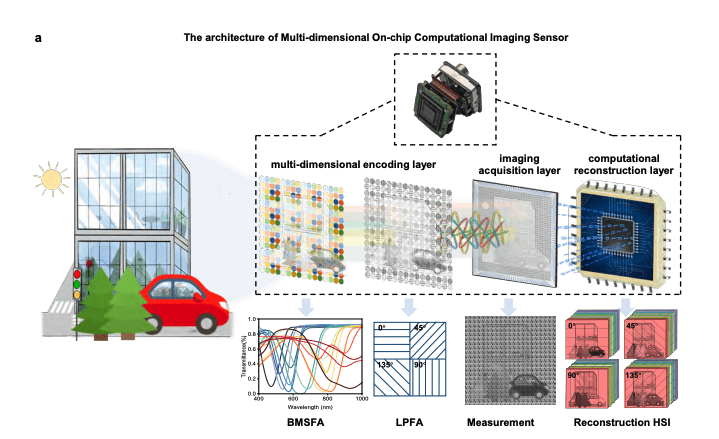
In a significant advancement published on May 1, 2025, researchers led by Liheng Bian introduced an innovative multi-dimensional optical imaging system capable of real-time hyperspectral and polarization sensing.
Researchers developed a multi-dimensional on-chip imaging (MOCI) architecture enabling simultaneous acquisition of hyperspectral and polarization data in a single frame. The system, capable of real-time operation at 74 FPS, features a 2048×2448 pixel sensor with 61 spectral channels across the VIS-NIR range and 4 polarization states. Applications include hyperspectral 3D modeling, normal mapping, height mapping, and glare reduction in complex scenes, demonstrating novel capabilities for multi-dimensional imaging on a chip.
In a world where visual information is paramount, imagine a technology that could revolutionize how we perceive and analyze our surroundings. Enter MOCI (Multimodal Optical Computing Imaging), an innovative imaging system designed to integrate hyperspectral, polarimetric, and 3D sensing into a single platform. This advancement promises to enhance various industries by offering unprecedented insights into visual data.
At its core, MOCI employs advanced optical components such as metasurfaces and liquid crystals to modulate light properties effectively. This allows the system to capture intricate details about polarization, wavelength, and intensity simultaneously. By integrating these modalities, MOCI provides comprehensive data in a single capture, setting a new standard for visual analysis.
The potential of MOCI extends across multiple sectors. In healthcare, it could enable early disease detection by analyzing subtle tissue changes through hyperspectral imaging. Environmental monitoring benefits from its ability to detect pollutants with high precision, aiding in water quality assessments. Additionally, autonomous vehicles can enhance object recognition, improving safety and efficiency on the roads. The technology also offers robust counterfeit detection methods, ensuring authenticity verification.
While MOCI’s potential is vast, integrating multiple sensing modalities presents challenges. The complexity of design requires meticulous engineering to ensure seamless operation. Furthermore, processing the substantial data generated demands significant computational resources. Real-world applications must also consider environmental factors that could affect performance, necessitating robust testing and adaptation strategies.
Research continues to refine MOCI’s capabilities, focusing on improving performance and miniaturization for practical use. Collaborations with industry partners are crucial in translating this technology into real-world solutions. As advancements continue, MOCI has the potential to become a cornerstone of future imaging technologies, driving innovation across various sectors.
MOCI represents a significant leap forward in imaging technology, offering multifaceted capabilities that could reshape industries and daily life. Its development underscores the importance of continuous research and collaboration in pushing technological boundaries, promising exciting possibilities for the future. As we look ahead, MOCI may well redefine how we interact with visual information, opening new avenues for innovation and discovery.
👉 More information
🗞 Multi-dimensional optical imaging on a chip
🧠 DOI: https://doi.org/10.48550/arXiv.2505.00408


