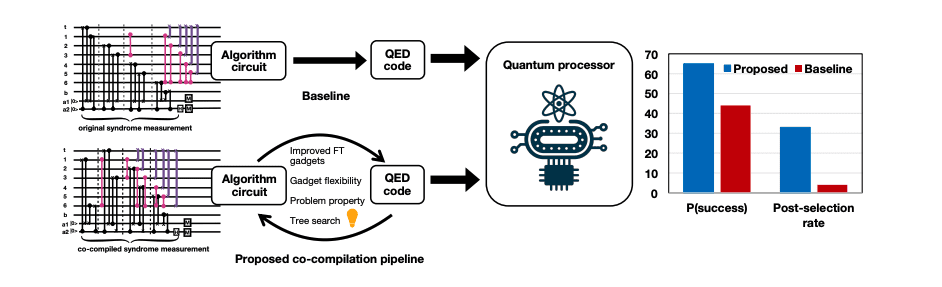
In Iceberg Beyond the Tip, published April 29, 2025, researchers demonstrate how co-optimizing error detection codes with quantum algorithms enhances performance on Quantinuum’s hardware.
The study demonstrates advancements in quantum algorithm performance using error-detecting codes, specifically the Iceberg code tailored for trapped-ion processors. Researchers designed flexible fault-tolerant gadgets and co-optimized them with QAOA circuits using tree search, achieving improved success probabilities and post-selection rates compared to previous demonstrations. The optimized approach utilized fewer physical gates while maintaining better-than-unencoded performance for up to 34 qubits, showcasing practical improvements in quantum algorithm implementation.
Quantum computing has long been anticipated as a transformative technology with the potential to revolutionise industries such as finance, healthcare, and pharmaceuticals. While significant hurdles remain, recent advancements in error mitigation, circuit synthesis, and optimisation are paving the way for more reliable and practical quantum systems. This article explores these developments and their implications for the future of quantum computing.
One of the most critical challenges in quantum computing is the susceptibility of qubits to environmental noise and operational imperfections. These errors can quickly render computations unreliable, particularly with today’s noisy intermediate-scale quantum (NISQ) devices. Researchers at JPMorgan Chase & Co. have made progress in this area by developing methods that mitigate errors without requiring fault-tolerant quantum computers, a technology still years away from maturity.
Their approach combines Bayesian quantum phase estimation with error detection techniques, demonstrating the feasibility of achieving reliable computations on current NISQ devices. This work is particularly significant given the high sensitivity of these systems to environmental interference. By improving error mitigation techniques, researchers are laying the groundwork for more robust and scalable quantum systems.
Enhancing Quantum Circuit Design
Another key area of progress is the synthesis and optimisation of quantum circuits. These circuits form the building blocks of quantum algorithms, and their efficiency directly impacts the performance of quantum systems. A notable advancement in this field is the development of QFAST (Quantum Fast Approximate Synthesis Technique), a method that integrates search and numerical optimisation to synthesise quantum circuits more efficiently.
This approach has shown promise in reducing the complexity of quantum operations, making it easier to implement advanced algorithms on existing hardware. By improving circuit design, researchers are not only enhancing computational efficiency but also addressing one of the most pressing challenges in quantum computing: the need for practical and scalable solutions.
Optimising Circuit Mapping
Efficiently mapping quantum circuits onto physical qubit architectures is another critical challenge. Researchers have developed techniques such as time-optimal qubit mapping, which minimises the overhead associated with routing operations across a quantum processor. This optimisation not only improves computational efficiency but also reduces the likelihood of errors caused by prolonged exposure to noise.
By focusing on circuit mapping and optimisation, researchers are addressing another key barrier to practical quantum computing. These advancements are particularly important as the complexity of quantum systems continues to grow, requiring more sophisticated approaches to ensure reliable and efficient computation.
Conclusion
Recent progress in error mitigation, circuit synthesis, and optimisation is bringing us closer to realising the full potential of quantum computing. While significant challenges remain, these developments demonstrate the ongoing commitment to advancing this transformative technology. As researchers continue to refine their approaches, the future of quantum computing looks increasingly promising.
👉 More information
🗞 Iceberg Beyond the Tip: Co-Compilation of a Quantum Error Detection Code and a Quantum Algorithm
🧠 DOI: https://doi.org/10.48550/arXiv.2504.21172


See today’s quantum computing news on Quantum Zeitgeist for the latest breakthroughs in qubits, hardware, algorithms, and industry deals.