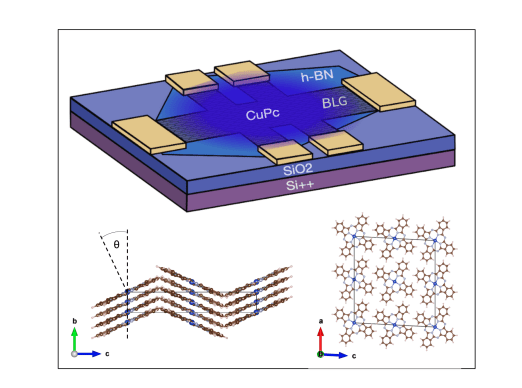
In a recent study published on April 29, 2025, researchers demonstrated that bilayer graphene exhibits suppressed trigonal warping effects when in proximity to a copper phthalocyanine thin film. This finding, detailed in their article titled Modification of the scattering mechanisms in bilayer graphene…, highlights how molecular interactions can influence quantum transport properties in two-dimensional materials, offering insights into potential applications in advanced electronics.
The study investigates quantum coherent effects in bilayer graphene (BLG) using weak localisation measurements in a copper-phthalocyanine / BLG / h-BN heterostructure. Proximity effects with the CuPc layer suppress trigonal warping in BLG, restoring chirality in charge carrier localization properties. A significant charge transfer of 3.6 × 10¹⁰ cm⁻² occurs from BLG to CuPc, with minimal BLG/h-BN mobility degradation. Transmission electron microscopy characterizes the molecular arrangement of CuPc, correlating structural features with electronic transport results.
The Potential of Enhanced Bilayer Graphene
Graphene has long been hailed for its remarkable electronic properties in materials science. A recent study explores how bilayer graphene (BLG), enhanced with copper phthalocyanine (CuPc), could unlock new possibilities in high-performance electronics.
The research reveals significant improvements in BLG’s electronic characteristics when coated with CuPc. Electron density increases by approximately tenfold, while carrier mobility enhances from 250 cm²/Vs to over 400 cm²/Vs. This advancement also extends the mean free path and doubles conductivity. These enhancements are consistent across multiple devices, underscoring their reliability and reproducibility.
The study suggests that CuPc enhances BLG through charge transfer, potentially donating electrons to boost conductivity. BLG’s tunable bandgap under voltage makes it ideal for applications such as transistors, which could benefit from this enhancement. This property positions BLG as a promising candidate for future electronic devices.
While thermal evaporation effectively applies CuPc in laboratory settings, scalability remains a challenge for mass production. Exploring alternative deposition methods could enhance efficiency and cost-effectiveness. Additionally, measurements conducted at 1.5 K highlight the need to evaluate these properties at room temperature for real-world applications.
The long-term stability of CuPc on BLG is crucial for device reliability. Beyond electronics, this modified graphene holds potential in sensors, energy storage, and optoelectronics due to its enhanced conductivity and mobility. These applications could significantly impact various industries, from technology to renewable energy.
The study demonstrates the substantial enhancements CuPc brings to BLG’s electronic properties. However, further research is essential to address practical aspects such as scalability, temperature effects, and stability. As these challenges are met, the potential for BLG in diverse applications continues to grow, promising a new era in materials science and electronics.
👉 More information
🗞 Modification of the scattering mechanisms in bilayer graphene in proximity to a molecular thin film probed in the mesoscopic regime
🧠 DOI: https://doi.org/10.48550/arXiv.2504.20990



See today’s quantum computing news on Quantum Zeitgeist for the latest breakthroughs in qubits, hardware, algorithms, and industry deals.