A research team led by Prof. LI Liang from the Hefei Institutes of Physical Science at the Chinese Academy of Sciences, in collaboration with Prof. ZHAI Tianyou from Huazhong University of Science and Technology, has developed a novel “torsion unipolar barrier heterojunction” device to address challenges in polarization detection. This innovation, detailed in Advanced Materials, utilizes two-dimensional PdSe2 and MoS2 layers for bias-programmable control over carrier transport, enabling real-time measurement of both the angle (AoLP) and degree (DoLP) of linear polarization without external polarizers. The device simplifies on-chip polarization detection while enhancing optical information processing capabilities.
Polarization is a fundamental property of light that enhances imaging capabilities by improving contrast and resolution beyond traditional methods. Alongside intensity, wavelength, and phase, it plays a crucial role in optical imaging and sensing.
Current on-chip polarization devices face significant challenges, often requiring complex four-pixel arrays or external polarizers. These limitations make simultaneous detection of the angle (AoLP) and degree (DoLP) of linear polarization difficult while restricting spectral response.
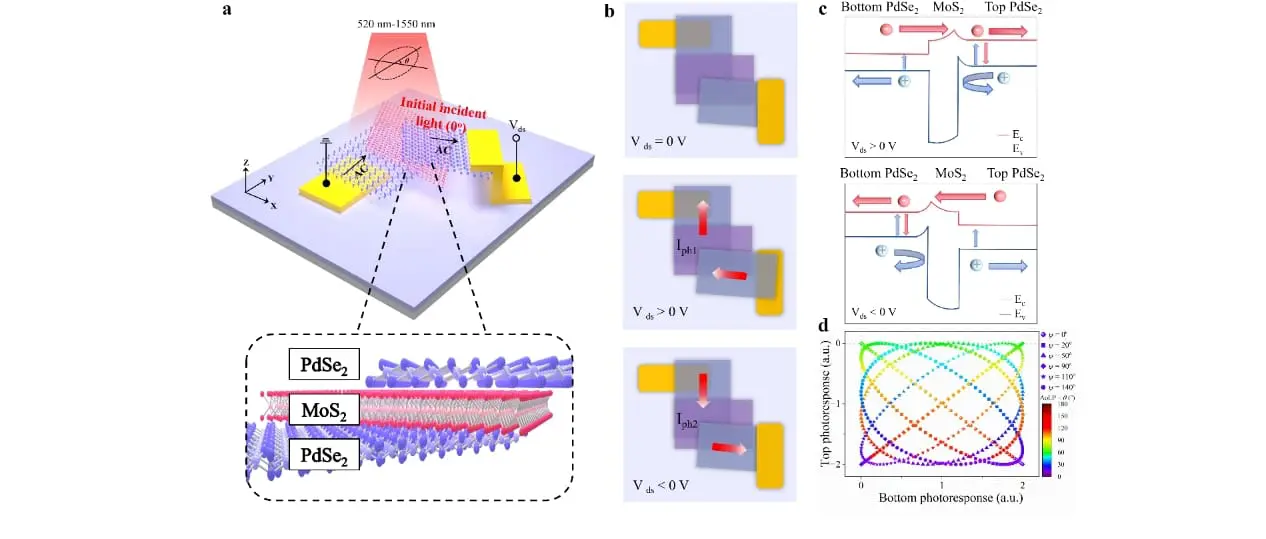
A novel device, the “torsion unipolar barrier heterojunction,” has been developed to address these issues. This innovation utilizes the anisotropic photoelectric properties of two-dimensional PdSe, constructing a dual absorption layer with a MoS barrier in between. This design allows for bias-programmable control over carrier transport paths.
The device offers two key advancements: bipolar photocurrent behavior at zero bias, enabling direct decoding of polarization-encoded signals without auxiliary polarizers, and the ability to simultaneously measure AoLP and DoLP. These features eliminate the need for traditional four-pixel arrays, simplifying device structures while enhancing optical information processing.
This research presents a fresh perspective on next-generation “on-chip polarization detectors,” promising advancements in optical imaging and sensing technologies by overcoming current limitations and paving the way for more efficient and precise applications.
Challenges in Current Polarization Detection Devices
Current on-chip polarization detection devices often rely on complex four-pixel arrays or external polarizers, introducing significant limitations. These systems face challenges in achieving a wide spectral response, particularly in plasmonic and metasurface-based solutions. Additionally, they struggle with the simultaneous detection of both the angle (AoLP) and degree (DoLP) of linear polarization, especially within low-dimensional anisotropic materials.
The difficulty in detecting AoLP and DoLP simultaneously stems from inherent material limitations and design constraints. This challenge is compounded by the limited spectral response of existing devices, which restricts their applicability across various wavelengths. As a result, achieving high-precision polarization detection over a broad spectrum remains a critical hurdle in advancing “on-chip polarization detector” technologies.
These limitations significantly impact the performance and efficiency of current systems, highlighting the need for innovative solutions that can overcome these technical barriers while maintaining or enhancing device functionality.
Advancements in Next-Generation On-Chip Polarization Detectors
The novel “torsion unipolar barrier heterojunction” device represents a significant advancement in on-chip polarization detection. By leveraging the anisotropic photoelectric properties of two-dimensional PdSe, researchers constructed a dual absorption layer with a MoS barrier layer in between. This design allows for fine-tuning of the energy band and bias-programmable control over carrier transport paths, enabling unprecedented performance in polarization sensing.
One of the key innovations of this device is its ability to achieve bipolar photocurrent behavior at zero bias. This feature eliminates the need for auxiliary polarizers, simplifying the detection process while enabling direct decoding of polarization-encoded signals. Additionally, the device can simultaneously measure both the angle (AoLP) and degree (DoLP) of linear polarization in real time.
The development of this device marks a critical step forward in overcoming the challenges associated with high-precision polarization detection across broad wavelengths. By integrating advanced materials and innovative design principles, researchers have created a system that enhances performance while expanding the applicability of on-chip polarization detectors in various fields.
More information
External Link: Click Here For More