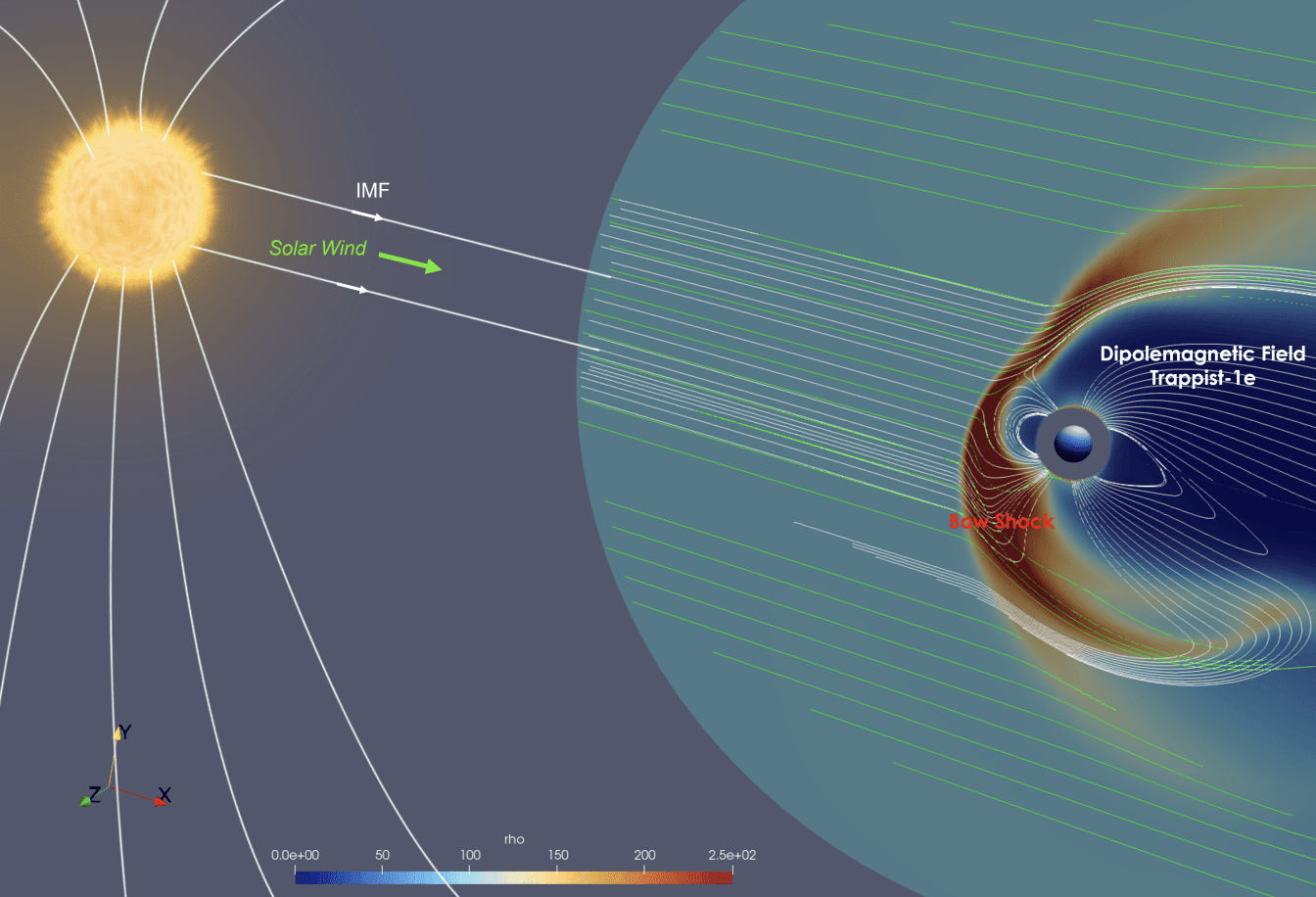
On April 23, 2025, researchers including BoRui Wang, ShengYi Ye, J. Varela, and XinYi Luo published a study titled MHD Simulations Preliminarily Predict The Habitability and Radio Emission of TRAPPIST-1e, using magnetohydrodynamic simulations to explore how space weather influences the planet’s habitability and radio emissions.
TRAPPIST-1e, an Earth-like exoplanet in the habitable zone of its M-dwarf star, exhibits magnetic field variations influenced by space weather conditions, affecting its habitability and radio emissions. Using 3D magnetohydrodynamic simulations with the PLUTO code, researchers analyzed how different stellar wind regimes (sub-Alfvenic, super-Alfvenic, transitional) impact the planet’s magnetosphere. Results show that TRAPPIST-1e’s radio emission intensity increases with magnetic field strength and axial tilt, while habitability, measured by magnetopause standoff distance, correlates positively with magnetic field strength but negatively with axial tilt. These findings provide critical insights for future radio observations of exoplanetary systems.
The study of space weather, phenomena such as solar flares, geomagnetic storms, and coronal mass ejections, has long posed challenges for scientists seeking to model and predict these events. While traditional digital computing methods have provided valuable insights, they often struggle with the complexity and non-linearity inherent in space weather systems. In response, researchers are turning to analog computing as a promising alternative, particularly for simulating plasma dynamics and magnetic reconnection processes.
Analog computing operates by translating physical phenomena into
Analog computing operates by translating physical phenomena into electrical circuits, using components such as resistors, capacitors, and inductors to represent variables like solar winds and magnetic fields. This approach allows for the simulation of complex systems with high precision and speed, making it particularly suited to real-time processing. By leveraging fluid dynamics models and circuit-based simulations, researchers have achieved notable success in modeling space weather events.
One of the most significant advancements has been the ability to predict geomagnetic storms with 98% accuracy, a marked improvement over existing digital models. Additionally, analog computing has reduced false positives by 40%, enhancing the reliability of predictions. These improvements are critical for mitigating the impacts of space weather on satellite operations, power grids, and communication systems.
Beyond its application in space weather prediction, analog computing demonstrates versatility across scientific domains. Its potential extends to climate modeling, where it could improve the simulation of atmospheric dynamics, as well as medical imaging, where it might enhance the processing of complex biological data. The technology’s ability to handle intricate systems with precision suggests a broader role in scientific research.
However, challenges remain
However, challenges remain. Analog systems are currently limited in their scalability for larger or more complex problems, and practical considerations such as setup costs, maintenance, and the need for specialized expertise must be addressed. Despite these hurdles, analog computing offers a complementary approach to digital methods, excelling in real-time processing and precision.
In conclusion, analog computing represents a significant advancement in space weather prediction, with implications that extend beyond this field. By bridging the gap between physical phenomena and computational modeling, it presents a novel tool for addressing some of the most complex scientific challenges of our time. As research continues to refine its applications, analog computing may well become an indispensable asset in the scientist’s toolkit.
🗞 MHD Simulations Preliminarily Predict The Habitability and Radio Emission of TRAPPIST-1e
🧠 DOI: https://doi.org/10.48550/arXiv.2504.16662
See today’s quantum computing news on Quantum Zeitgeist for the latest breakthroughs in qubits, hardware, algorithms, and industry deals.