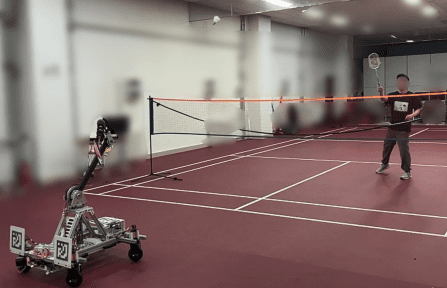
In a study published on April 24, 2025, researchers developed an advanced control system for badminton robots that integrates learning-based manipulation with physics-informed locomotion. The system achieved success rates of 94.5% against serves and 90.7% against human players.
The research introduces HAMLET, a hybrid control system combining model-based methods with imitation (IL) and reinforcement learning (RL) for agile badminton robots. The system uses a physics-informed IL+RL framework, where a model-based strategy guides arm policy training during both phases. A critic model is trained during the IL phase to maintain performance when transitioning to RL. Tested on a self-engineered robot, HAMLET achieved 94.5% success against serves and 90.7% against human players. The approach can be generalized to other agile manipulation tasks like table tennis.
The convergence of artificial intelligence (AI) and robotics has birthed an innovative concept: robotic sports players capable of competing at high levels in games such as table tennis and badminton. Recent advancements, highlighted in academic research, underscore how these machines are increasingly skilled at predicting ball trajectories, adapting to spin, and executing precise maneuvers. This article delves into the science behind these innovations, their implications for sports training, and broader technological potentials.
At the core of these robotic systems lies
At the core of these robotic systems lies a blend of advanced sensors, machine learning algorithms, and precise mechanical control. For instance, researchers at the University of Tokyo developed an automatic badminton-playing robot that employs distance image sensors to track the shuttlecock in real time. By analyzing trajectory and spin, the robot predicts landing points and adjusts racket position accordingly.
Similarly, a team from Tsinghua University introduced Varsm, a versatile autonomous racquet sports machine designed for table tennis and badminton. Varsm uses machine learning to adapt behavior based on specific sport dynamics, utilizing visual tracking systems and predictive modeling to respond effectively to high-speed spins and rapid direction changes.
These robotic players excel in high-speed scenarios. For example, researchers at the Chinese Academy of Sciences developed a table tennis robot capable of returning high-speed spinning balls with remarkable accuracy. By integrating advanced motion planning algorithms with real-time data processing, the robot anticipates ball trajectories and adjusts paddle position within milliseconds.
This precision combines machine learning with traditional robotics engineering. The system observes human players to understand common patterns and strategies, refining gameplay through continuous practice and feedback.
Robotic sports players offer significant benefits for athletic training. Coaches can simulate high-level opponents, providing athletes with challenging and consistent practice environments. For instance, a table tennis robot generates serves with varying spins and speeds, helping improve reaction times and shot accuracy.
Moreover, these systems analyze athlete performance in real
Moreover, these systems analyze athlete performance in real time, offering detailed feedback on technique and strategy. This personalized coaching is difficult to achieve with human trainers alone, making robotic systems valuable tools for sports enthusiasts at all levels.
As AI and robotics advance, the capabilities of these sports players will likely expand. Future iterations could incorporate more sophisticated learning algorithms, enabling adaptation to complex scenarios. Researchers are also exploring integration into interactive gaming environments where humans and robots can compete or collaborate in real time.
Beyond sports, the principles used in developing robotic athletes—real-time decision-making, adaptive control, and human-machine interaction—are applicable to industries like manufacturing, healthcare, and entertainment.
The emergence of robotic sports players represents a fascinating intersection of technology and sport. By enhancing training methods and offering new ways to engage with sports, these innovations promise to transform the future of athletics and beyond.
🗞 Integrating Learning-Based Manipulation and Physics-Based Locomotion for Whole-Body Badminton Robot Control
🧠 DOI: https://doi.org/10.48550/arXiv.2504.17771