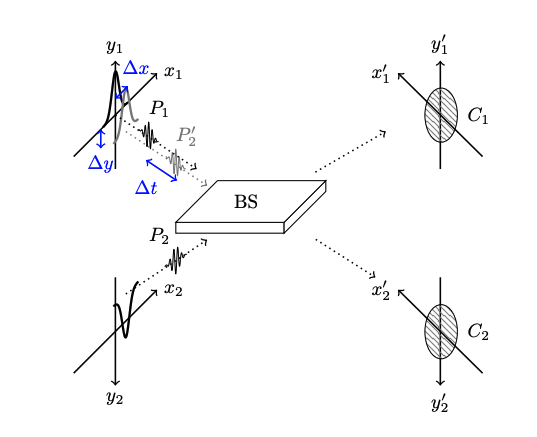
In a study published on April 22, 2025, researchers Luca Maggio and Vincenzo Tamma demonstrated a novel protocol for achieving ultimate quantum sensitivity in the 3D relative localization of two single-photon emitters using two-photon interference. Their method enables precise imaging beyond the diffraction limit with just 1000 measurements, showcasing significant advancements in quantum sensing technology.
The research introduces a protocol for estimating differences in localization parameters of two single-photon sources using two-photon interference at a beam splitter. By measuring frequency and transverse momenta, the method achieves ultimate sensitivity in 3D relative localization with just 1000 measurements and less than 1% bias. The results are independent of the parameter values being estimated, enabling advancements in single-photon 3D imaging and nanoscopy beyond the diffraction limit.
In the field of quantum sensing, a novel innovation has emerged, promising significant improvements in measuring subtle changes within physical systems. This advancement utilizes entangled quantum states and advanced statistical methods to achieve higher precision than traditional approaches.
The new method, known as resolved-sampling quantum sensing, involves analyzing individual measurement outcomes using maximum likelihood estimation. This technique optimally extracts information from quantum states by employing Fisher information matrices, leading to enhanced precision in parameter estimation compared to conventional methods.
When tested under conditions of high visibility, the new approach matches the performance of non-resolving protocols for estimating a specific parameter ‘s.’ This indicates that while both methods excel in scenarios with maximum clarity or contrast (high visibility), the resolved-sampling method offers distinct advantages in other contexts, particularly when entanglement is effectively utilized.
Although this advanced technique requires more resources, such as entangled particles, it remains practical for real-world applications. The method’s versatility extends beyond magnetic field sensing, making it applicable to a wide range of quantum sensing tasks where precision is paramount.
This innovation underscores the importance of optimal measurement strategies in quantum systems. By harnessing the power of entanglement and sophisticated data analysis, researchers have opened new avenues for achieving higher precision in quantum sensing, paving the way for advancements in fields that rely on detecting minute changes, from environmental monitoring to medical diagnostics.
👉 More information
🗞 Ultimate quantum sensitivity in the 3D relative localisation of two single-photon emitters via two-photon interference
🧠 DOI: https://doi.org/10.48550/arXiv.2504.16294