Published on April 21, 2025, The universality of filamentation-caused challenges of ultrafast laser energy deposition in semiconductors by Maxime Chambonneau and colleagues investigates how filamentation universally influences the propagation of ultrashort laser pulses in various semiconductors. Their findings offer key insights into optimizing energy deposition for advanced photonic technologies.
The study investigates ultrashort laser pulse propagation in semiconductors, revealing that filamentation universally governs light behavior across various materials. Key nonlinear parameters differ significantly from standard measurements, and temporal scaling laws for these parameters are identified. The research proposes temporal-spectral shaping to optimize energy deposition, paving the way for ultrafast laser writing to selectively tailor semiconductors internally. This advancement could enable in-chip processing and functionalization, opening new applications in telecommunications, engineering, healthcare, and artificial intelligence.
In the field of quantum sensing and ultrafast optics, researchers have made significant progress by uncovering the intricate dynamics of ultrafast laser interactions with materials such as germanium (Ge) and indium phosphide (InP). These insights are critical for advancing applications that require precise control over light-matter interactions, including precision micromachining and advanced quantum sensors.
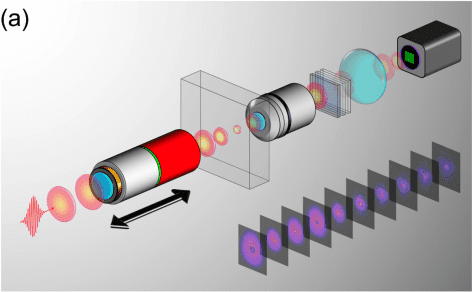
The study utilized a pump-probe technique with a Ti:Sapphire laser system capable of generating pulses ranging from 275 femtoseconds to 10 picoseconds. By adjusting pulse duration and energy levels, researchers examined the influence of these parameters on nonlinear effects within the materials. The focal shift, which measures how light bends due to intense electromagnetic fields, was monitored by observing changes in the probe beam’s intensity.
Key findings revealed that traditional models, which do not account for power losses during laser-material interactions, fail to accurately predict ultrafast laser behavior. By integrating these losses into their theoretical framework, researchers developed a more precise model. This model successfully predicted focal shifts for pulses longer than 3 picoseconds, enabling the determination of effective multi-photon absorption coefficients. However, challenges emerged with shorter pulses: for durations below 900 femtoseconds, the focal shift exhibited erratic behavior, initially decreasing and then increasing with input energy. This unpredictability complicates the extraction of accurate coefficients, suggesting that plasma effects dominate in these conditions.
The implications of this research are significant. For longer pulses, the refined model provides reliable predictions, which is essential for applications requiring precise control over light-matter interactions. However, the unpredictable behavior at shorter durations highlights the need for further investigation into plasma effects and their impact on quantum sensing technologies.
In conclusion, this research enhances our understanding of ultrafast laser interactions with materials, offering a more accurate approach to modeling these phenomena. While challenges remain in predicting behavior at extremely short pulse durations, the insights gained are crucial for advancing applications in quantum sensing and ultrafast optics. As technology continues to evolve, these findings will play a pivotal role in unlocking new possibilities in precision engineering and quantum communication.
👉 More information
🗞 The universality of filamentation-caused challenges of ultrafast laser energy deposition in semiconductors
🧠 DOI: https://doi.org/10.48550/arXiv.2504.14908



See today’s quantum computing news on Quantum Zeitgeist for the latest breakthroughs in qubits, hardware, algorithms, and industry deals.