Published on April 19, 2025, MILUV is a multi-UAV dataset that integrates ultra-wideband (UWB) and vision data to support advanced indoor localization research and applications.
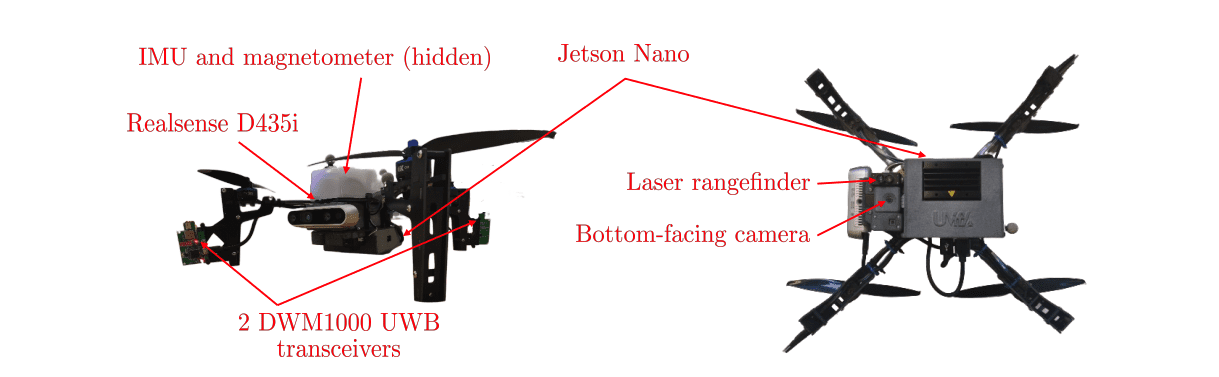
The paper introduces MILUV, a dataset for Multi-UAV Indoor Localization using UWB and Vision measurements. It includes 217 minutes of flight data from 36 experiments with three quadcopters, capturing UWB ranging data, vision data from stereo and monocular cameras, inertial measurements, laser height readings, magnetometer data, and ground-truth poses via motion capture. The dataset features UWB signals from up to 12 transceivers in line-of-sight and non-line-of-sight conditions, with UAVs flying at speeds of up to 4.418 m/s in an indoor environment with visual fiducial markers. MILUV is designed for testing multi-UWB- and vision-based localization algorithms and includes a development kit with benchmarking tools such as visual-inertial odometry, UWB-based localization using an extended Kalman filter, and machine learning approaches for CIR data classification.
In the evolving landscape of robotics, accurate localization—understanding a robot’s position within its environment—is fundamental to effective operation. Traditional methods like GPS often falter indoors or in urban canyons, leaving robots navigating blindly in critical settings such as warehouses, disaster zones, and hospitals. Enter ultra-wideband (UWB) technology: a precise solution transforming how robots navigate complex environments.
At its core, UWB localization employs two-way ranging (TWR), where devices exchange short radio pulses to measure signal travel time, calculating distances with exceptional precision. This method is particularly effective in challenging environments, offering centimeter-level accuracy compared to older technologies like Wi-Fi or Bluetooth.
To enhance reliability, UWB systems often integrate with inertial measurement units (IMUs). This hybrid approach compensates for potential signal losses, ensuring consistent performance even in dynamic settings. The integration of IMUs allows robots to maintain accurate positioning during brief interruptions in UWB signals, crucial for applications requiring uninterrupted operation.
The practical applicability of UWB is validated through datasets like MCD and UTIL. These datasets test UWB’s effectiveness across diverse environments, ensuring its reliability beyond theoretical models. By simulating real-world conditions, these validations demonstrate UWB’s robustness in various settings, from crowded urban spaces to expansive industrial facilities.
Applications Across Industries
UWB technology finds application in numerous sectors:
- Logistics: Enhances warehouse efficiency by enabling precise robot navigation and inventory management.
- Search-and-Rescue: Assists in locating individuals in disaster zones with high accuracy.
- Autonomous Vehicles: Improves vehicle positioning, crucial for safe navigation in urban environments.
- Healthcare: Facilitates accurate tracking of medical equipment and personnel within facilities.
- Smart Cities: Contributes to efficient traffic management and public safety initiatives.
Conclusion
Ultra-Wideband technology addresses the limitations of traditional localization methods, offering precise and reliable solutions across various applications. As robotics continues to integrate into everyday life, UWB stands as a pivotal advancement, enhancing efficiency and safety in numerous sectors. Its potential extends beyond current applications, hinting at future innovations that could further revolutionize the field of robotics.
👉 More information
🗞 MILUV: A Multi-UAV Indoor Localization dataset with UWB and Vision
🧠 DOI: https://doi.org/10.48550/arXiv.2504.14376