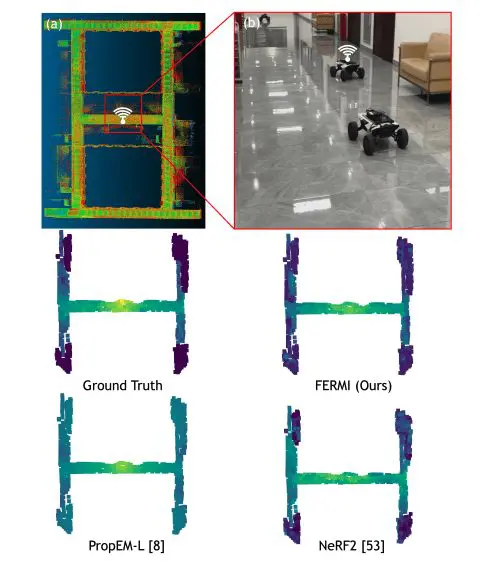
On April 21, 2025, researchers led by Yiming Luo introduced FERMI, an innovative framework combining physics-based modeling with neural networks to enhance radio mapping accuracy and scalability in complex environments.
The study addresses challenges in radio signal prediction for large, obstacle-rich environments by introducing FERMI, a hybrid framework combining physics-based modeling and neural networks. FERMI efficiently learns signal propagation using sparse data and employs autonomous multi-robot teams to optimize data collection, reducing travel costs and improving scalability. Experiments show accurate predictions in complex settings and strong generalization to unseen positions, offering a practical solution for large-scale radio mapping.
In the evolving field of robotics, researchers are increasingly focused on how multiple robots can collaborate effectively to maintain communication networks. This capability is crucial for applications ranging from search and rescue operations to military missions.
One notable approach in this domain is the Relink framework. This method employs real-time line-of-sight deployment, ensuring that robots position themselves optimally to maintain direct communication links, which is essential for their operational effectiveness.
Furthermore, Fast-LIO enhances navigation accuracy using a tightly-coupled iterated Kalman filter. This technique enables robots to estimate their states more precisely in dynamic environments, thereby improving their ability to navigate and communicate effectively.
Additionally, decentralized control systems, as seen in Racer, allow each robot to make independent decisions without relying on a central authority. This approach not only improves efficiency but also enhances robustness against potential failures.
Machine learning techniques are also playing a significant role in this field. For instance, certain methods model cellular network radio propagation, aiding robots in predicting signal behavior and effectively planning communication strategies.
Despite these advancements, challenges remain. Environments with numerous obstacles can disrupt line-of-sight communication, prompting the need for alternative methods or rapid repositioning strategies. Moreover, transitioning from experimental phases to real-world applications is another hurdle, requiring thorough testing and validation.
In conclusion, while multi-robot coordination research presents promising approaches combining machine learning, advanced navigation, and decentralized control, practical implementation faces challenges such as environmental constraints and operational robustness. Addressing these issues could pave the way for more reliable and efficient robotic systems in various real-world scenarios.
👉 More information
🗞 FERMI: Flexible Radio Mapping with a Hybrid Propagation Model and Scalable Autonomous Data Collection
🧠 DOI: https://doi.org/10.48550/arXiv.2504.14862




See today’s quantum computing news on Quantum Zeitgeist for the latest breakthroughs in qubits, hardware, algorithms, and industry deals.