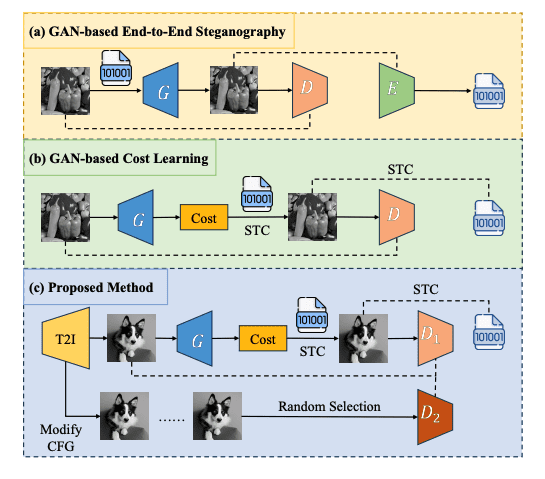
On April 21, 2025, researchers introduced GIFDL, an innovative steganographic technique leveraging generated image fluctuations to enhance security through GAN-based distortion learning, demonstrating a notable improvement in detection accuracy.
The study addresses challenges in steganographic distortion by proposing GIFDL, a method leveraging fluctuations in generated images. By training a GAN to disguise stego images as fluctuation images, GIFDL enhances security compared to existing GAN-based methods. Experimental results show improved resistance to steganalysis, increasing detection error rates by an average of 3.30% across three steganalyzers.
In the digital era, where privacy and security are paramount, steganography has emerged as a critical tool for covert communication. Traditionally, steganography involved hiding messages within other data without arousing suspicion. With the advent of machine learning, particularly generative adversarial networks (GANs), this ancient practice is being redefined, offering new possibilities for secure and undetectable information transfer.
Historically, steganographic methods relied on altering bits in images or audio files to embed messages. However, these techniques were often vulnerable to detection using statistical analysis or machine learning-based detectors. The limitations of traditional methods became evident as the digital landscape evolved, necessitating more sophisticated approaches.
Machine learning has introduced a paradigm shift in steganography through the use of GANs. These models consist of two competing neural networks: one generating images with hidden messages and another attempting to detect them. This adversarial process enhances the robustness of the hiding technique, making it harder for detectors to identify embedded information.
A notable innovation is adaptive cost learning, which adjusts encoding strategies based on the characteristics of the cover image. This method optimizes efficiency and security by tailoring the approach to each specific context, ensuring that hidden messages are less likely to be detected.
To further enhance security, researchers have developed immunoprocessing frameworks designed to make hidden messages resistant to both traditional and machine learning-based detection. These frameworks preprocess data to create a form of digital immunity, ensuring that even advanced detectors struggle to identify embedded information.
Despite these advancements, challenges remain. The development of effective steganographic models requires large datasets like DiffusionDB for training and validation. Additionally, computational resources are significant, highlighting the need for scalable solutions. Ethical considerations also arise, as such techniques could potentially be misused for malicious purposes.
Looking ahead, the integration of machine learning into steganography holds promise for enhancing privacy and security in digital communications. Researchers continue to explore improvements in GAN architectures and detection evasion strategies. The balance between advancing hiding techniques and developing robust detection methods will be crucial as this field evolves.
In conclusion, machine learning is transforming steganography by introducing sophisticated methods that offer enhanced security and efficiency. As technology progresses, the implications for privacy, security, and potential misuse will remain key areas of focus, ensuring that this ancient practice continues to evolve in relevance and importance.
👉 More information
🗞 GIFDL: Generated Image Fluctuation Distortion Learning for Enhancing Steganographic Security
🧠 DOI: https://doi.org/10.48550/arXiv.2504.15139



See today’s quantum computing news on Quantum Zeitgeist for the latest breakthroughs in qubits, hardware, algorithms, and industry deals.