HRL Laboratories and Boeing have achieved a significant milestone by completing the construction and technical validation of a quantum communication subassembly for Boeing’s Q4S satellite mission, marking the first effort to demonstrate four-photon quantum entanglement swapping in space. This advancement is pivotal for establishing secure communications and scalable quantum networks. The subassembly has successfully undergone rigorous testing, showcasing strong signal quality with fidelity between 0.8 and 0.9, and detecting over 2,500 matching photon pairs per second, thereby meeting the project’s requirements for accurate quantum measurements.
HRL Laboratories and Boeing have successfully completed construction and technical validation on a quantum communication subassembly designed for Boeing’s Q4S satellite mission. This milestone marks a significant step toward demonstrating four-photon quantum entanglement swapping in space, a capability crucial for advancing secure communications and distributed quantum networks.
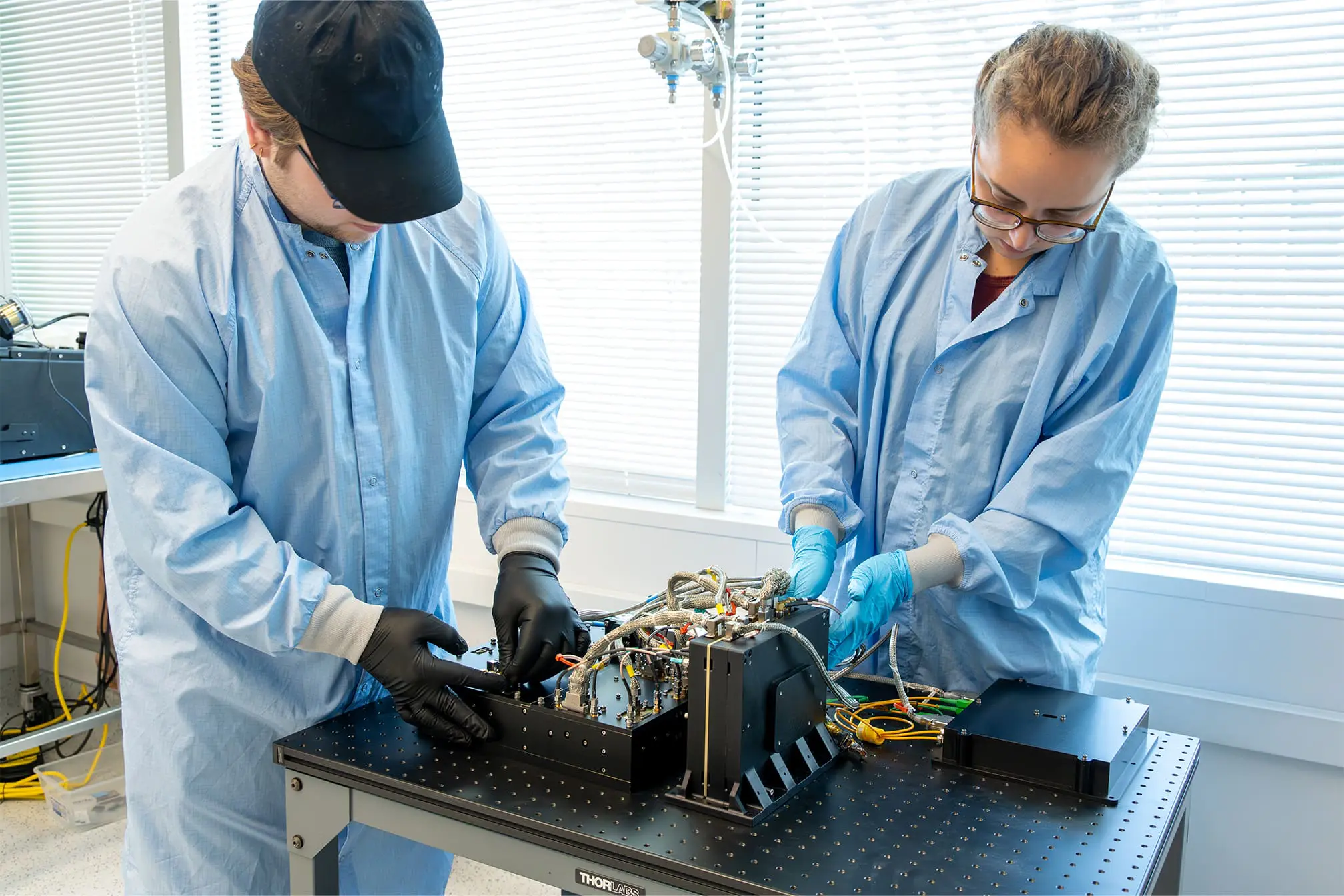
The subassembly integrates an optical board, control electronics, and thermo-mechanical packaging into a compact, 15kg system suitable for space operations. It has undergone rigorous testing, including initial end-to-end software verification, ensuring reliability and performance in orbital conditions. This integrated approach ensures the subassembly is both functional and robust, meeting the stringent requirements of space missions.
Validation tests have confirmed quantum entanglement for each source within the subassembly, a critical step toward achieving entanglement swapping. This process enables previously unconnected nodes to become entangled, paving the way for secure and scalable quantum networks in space. The team demonstrated strong signal quality with fidelity between 0.8 and 0.9, detecting over 2,500 matching photon pairs per second, which satisfies project requirements for accurate quantum measurements.
This achievement underscores the potential of quantum entanglement swapping to revolutionize communication systems, offering enhanced security and connectivity in space-based applications. The successful completion of this subassembly represents a pivotal advancement in quantum technology, setting the stage for future innovations in secure communications and distributed networks.
The quantum communication subassembly developed by HRL Laboratories for Boeing’s Q4S satellite mission has undergone rigorous validation and space qualification testing. These tests are essential to ensure the system can operate reliably in the harsh conditions of space. The subassembly, which integrates an optical board, control electronics, and thermo-mechanical packaging into a compact 15kg unit, was tested in Boeing’s El Segundo Space Simulation Laboratory.
The validation process included measuring key metrics such as photon pair production rates and signal-to-noise ratios to assess the fidelity of quantum states. These measurements are essential for ensuring that entanglement quality meets requirements for secure communication protocols. The ability to maintain high-quality entanglement over long distances is particularly important for space-based applications, where environmental factors can introduce additional challenges.
More information
External Link: Click Here For More