Aline Ramires’ article Symmetry Aspects of Chiral Superconductors, published on April 16, 2025, delves into the symmetry properties underlying chiral superconductivity, which breaks time-reversal symmetry via its two-component order parameter, advancing quantum materials research.
Recent advancements in theory, synthesis, and experimental techniques have identified suitable candidates for chiral superconductivity. Chiral superconductors, as unconventional superconductors, break time-reversal symmetry due to their two-component order parameter with a complex relative phase. This paper explores the symmetry aspects enabling chiral superconductivity, introducing key group theory concepts to classify order parameters and generalise Landau’s phase transition theory in superconductivity contexts.
Superconductivity, a phenomenon where materials conduct electricity without resistance at low temperatures, has long fascinated scientists. While conventional superconductors are explained by BCS theory, which involves electron pairs forming due to lattice vibrations, unconventional superconductors exhibit more complex pairing symmetries. Among these, chiral superconductivity stands out as a unique state where electron pairs possess angular momentum, leading to intriguing properties such as topological states and Majorana fermions.
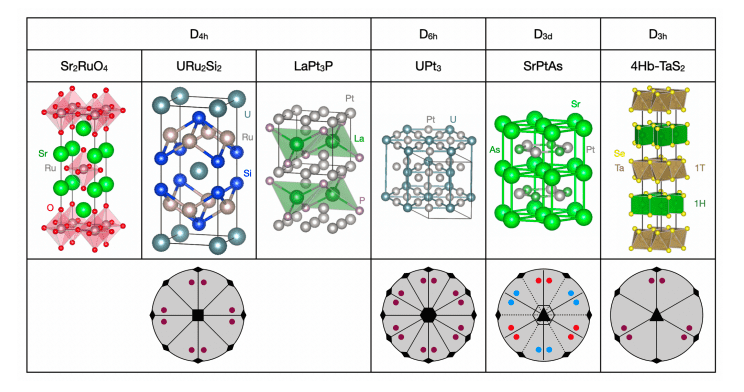
Chiral superconductivity was first proposed in the 1980s but only recently observed experimentally. Materials like Sr2RuO4, a ruthenate, have demonstrated this phenomenon. The chirality of electron pairs introduces a rotational aspect to their spin, which is crucial for forming topological states. These states are characterized by global properties that offer robustness against local disturbances, making them promising for quantum computing applications.
To predict chiral superconductivity in new materials, researchers analyze crystal structures and electronic configurations using group theory and representation theory. This approach helps identify symmetries conducive to chiral pairing. Advanced experimental techniques such as scanning tunneling microscopy (STM) and angle-resolved photoemission spectroscopy (ARPES) are employed to observe these states, providing insights into electron behavior.
The discovery of chiral superconductivity opens avenues for quantum computing, particularly with Majorana fermions, which could enable stable topological qubits. Additionally, the potential for high-temperature superconductors in twisted bilayer graphene suggests practical applications in energy transmission. While challenges remain in translating these findings into real-world devices, ongoing research combines theoretical predictions with experimental observations to unlock the full potential of chiral superconductivity.
In summary, chiral superconductivity represents a significant advancement in quantum materials, offering fundamental insights and technological promise. By understanding how angular momentum influences electron pairing and leveraging this knowledge across various materials, scientists are paving the way for future innovations in physics and technology.
👉 More information
🗞 Symmetry Aspects of Chiral Superconductors
🧠 DOI: https://doi.org/10.48550/arXiv.2504.12414
See today’s quantum computing news on Quantum Zeitgeist for the latest breakthroughs in qubits, hardware, algorithms, and industry deals.