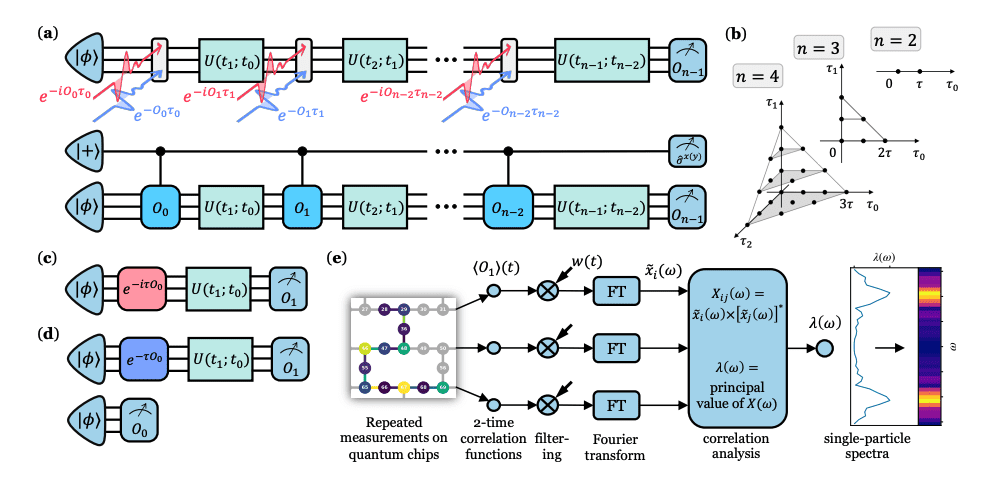
On April 17, 2025, researchers Xiaoyang Wang, Long Xiong, Xiaoxia Cai, and Xiao Yuan published a novel method to compute -time correlation functions without the need for ancilla qubits. Their approach, demonstrated on IBM quantum hardware with up to 12 qubits, relies solely on unitary evolutions of the system under study, significantly reducing hardware requirements and enabling practical measurements even in noisy environments.
The study introduces a method for measuring -time correlation functions without requiring ancilla qubits or control operations, addressing hardware limitations in both digital and analog quantum platforms. The protocol was demonstrated on IBM quantum hardware with up to 12 qubits, successfully measuring fermionic and bosonic spectra of the Su-Schrieffer-Heeger and Schwinger models, as well as out-of-time-order correlators in the transverse-field Ising model. A signal-processing strategy integrated filtering and correlation analysis, enabling accurate results despite hardware noise. This approach advances practical exploration of many-body correlations under realistic quantum computing constraints.
Quantum computing holds significant promise for revolutionizing our ability to solve complex problems in various scientific domains. While the technology is still emerging, recent advancements have brought us closer to practical applications. A study conducted using IBM’s quantum computing platform has demonstrated the capability to simulate intricate quantum systems with notable precision, despite current hardware limitations. This research underscores progress in overcoming technical challenges and highlights the potential for harnessing quantum computers effectively.
The study focused on simulating three distinct quantum models: the Su-Schrieffer-Heeger (SSH) model, the Schwinger model, and the transverse-field Ising model (TIM). Each model represents a different class of quantum system, allowing researchers to test the versatility of their approach. To simulate these systems, the team employed Trotterization, a method that approximates the time evolution of quantum systems using short sequences of quantum gates. This technique is particularly useful for simulating complex energy descriptions of systems, which are challenging to solve classically.
In addition to Trotterization, the researchers utilized randomized compiling and error mitigation techniques to address noise and decoherence in the quantum hardware. These strategies are crucial for enhancing result reliability in current-generation quantum computers, which are sensitive to environmental interference.
The simulations yielded several key findings. For the SSH and Schwinger models, the researchers achieved high-precision measurements of energy spectra, demonstrating the ability to capture essential system features. The TIM model was used to study out-of-time-order correlators (OTOCs), providing insights into quantum chaos and information scrambling in many-body systems.
Despite IBM’s hardware limitations, such as finite qubit coherence times and gate errors, the results showed remarkable agreement with theoretical predictions. This suggests that even imperfect devices can offer valuable insights into complex quantum phenomena.
This research underscores progress in quantum simulation and its potential to address real-world scientific problems. By demonstrating high precision for SSH and Schwinger models and exploring OTOCs with TIM, the study highlights advancements despite hardware constraints. The findings emphasize the importance of continued research in overcoming challenges like qubit coherence and error rates.
The implications of this work extend beyond theoretical contributions, pointing toward potential applications in diverse fields. As quantum computing technology evolves, such studies pave the way for practical implementations that could significantly impact scientific discovery and technological innovation.
👉 More information
🗞 Computing -time correlation functions without ancilla qubits
🧠 DOI: https://doi.org/10.48550/arXiv.2504.12975