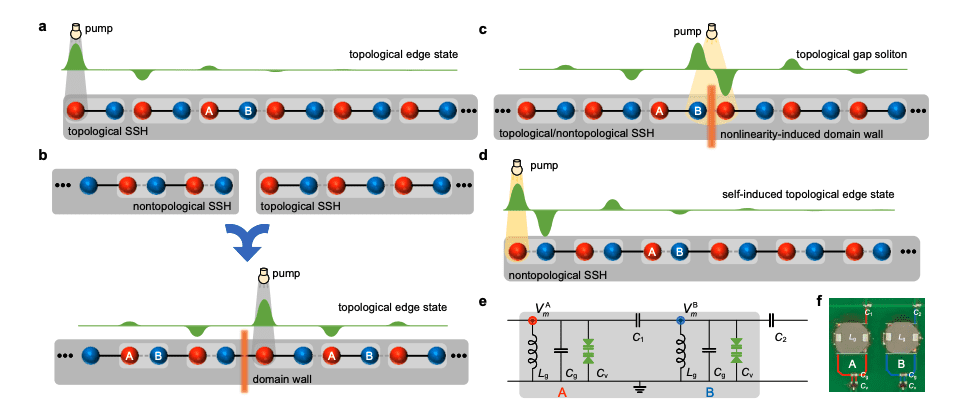
Researchers experimentally realized self-induced topological edge states in a lattice with onsite nonlinearity using electrical circuits. These states exhibit sublattice polarization and phase jumps, with decaying tails approaching zero. A distinctive power threshold for their existence was identified. The findings are applicable to photonic and cold atomic systems, offering new opportunities for exploring correlated topological states of light and matter.
Quantum computing presents a transformative potential for solving complex problems that classical computers find challenging. However, maintaining the integrity of quantum states against environmental disturbances remains a significant hurdle. Topological systems offer a robust solution by protecting quantum information through unique properties known as edge states, which are resilient to defects and disorders.
Recent advancements have integrated nonlinear effects into topological materials, enhancing control over wave propagation. Nonlinear interactions occur when intense stimuli cause materials to behave unpredictably, offering new ways to manipulate light or other waves. By combining these effects with the inherent robustness of topological systems, researchers achieve unprecedented precision in controlling quantum states.
This integration enables precise control over qubits, reduces errors, enhances computational accuracy, supports robust error correction mechanisms, and paves the way for scalable quantum systems. These advancements are crucial for practical real-world applications of quantum computing.
Research highlights include the creation of robust edge states and enhanced harmonic generation in these systems. These findings demonstrate concrete progress in leveraging nonlinear effects within topological materials, offering tangible benefits for quantum computing.
Fusing nonlinear effects with topological systems represents a significant step forward in quantum computing. By enabling precise control over quantum states and enhancing error correction, this research brings us closer to realising practical, large-scale quantum computers. As ongoing studies address remaining challenges, the potential for transformative advancements in various fields continues to grow.
👉 More information
🗞 Self-induced topological edge states in a lattice with onsite nonlinearity
🧠 DOI: https://doi.org/10.48550/arXiv.2504.11964
See today’s quantum computing news on Quantum Zeitgeist for the latest breakthroughs in qubits, hardware, algorithms, and industry deals.