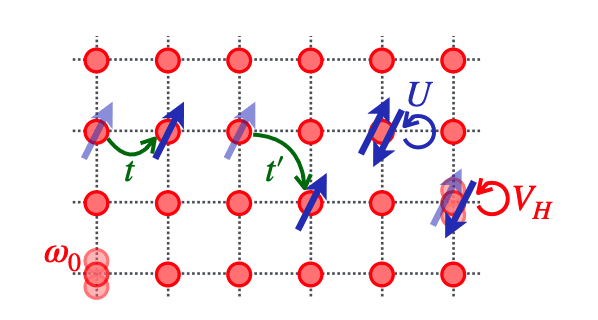
On April 15, 2025, Aiman Al-Eryani, Sabine Andergassen, and Michael M. Scherer published research titled Intertwined fluctuations and isotope effects in the Hubbard-Holstein model on the square lattice from functional renormalization, detailing how electron interactions shape spin, charge, and superconducting properties in quantum materials.
The study investigates electron-electron and electron-phonon interactions in layered quantum materials using the two-dimensional Hubbard-Holstein model. Researchers employed a functional renormalization group approach to analyze magnetic, density, and superconducting fluctuations across parameter spaces of Hubbard repulsion, electron-phonon coupling strength, and phonon frequency. Key findings reveal that self-energy effects enhance superconducting susceptibility at higher phonon frequencies, while at lower frequencies, increasing electron-phonon coupling reduces superconductivity due to density contributions, signaling Migdal-Eliashberg theory breakdown. The work provides systematic diagnostics of intertwined fluctuations and identifies positive and negative isotope effects on physical susceptibilities.
Understanding D-Wave Superconductivity: Insights from Theoretical Research
In recent theoretical research, scientists have deepened our understanding of d-wave superconductivity, a phenomenon observed in unconventional superconductors. This study employs advanced computational methods such as the functional renormalization group (FRG) and dynamical mean-field theory (DMFT), focusing on the Hubbard model—a framework that describes electrons hopping on a lattice with Coulomb repulsion.
The research reveals that d-wave pairing, characterized by its specific angular momentum, is robust against strong electronic correlations. However, it is sensitive to spin-fluctuation dynamics, which can either enhance or suppress superconductivity depending on the material’s conditions. This sensitivity suggests a complex interplay between superconductivity and magnetism, where d-wave pairing can emerge even in the presence of significant antiferromagnetic order.
The study also underscores the role of multiband effects, particularly relevant to high-temperature superconductors like cuprates, which have intricate band structures. Understanding these interactions is crucial for predicting or designing materials with desired superconducting properties.
While this research is primarily theoretical, it provides valuable insights that could guide future experimental work and material design. The findings emphasize the importance of d-wave pairing in unconventional superconductors and its potential implications for quantum technologies, offering a foundation for developing new materials essential for advanced applications such as quantum computing.
In summary, this study enhances our understanding of the conditions fostering d-wave superconductivity, particularly in complex systems with strong correlations and multiband structures. This knowledge is pivotal for advancing material science and technological innovations reliant on superconducting properties.
👉 More information
🗞 Intertwined fluctuations and isotope effects in the Hubbard-Holstein model on the square lattice from functional renormalization
🧠 DOI: https://doi.org/10.48550/arXiv.2504.10863